Pretty simple exercise?

Thread Starter

SpicyShakshuka

Joined Dec 23, 2022
1
I have the following circuit with the question, what is VR2. Now, it appears to me that in this respect the circuit should work just as any simpler voltage divider. However, I am very uncertain if this is correct and would very much appreciate any feedback.
Thanks in advance!
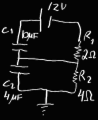
1671780108387.png
(apologies for the lousy sketch, doing it on the way on my Samsung note :oops:)
 
Last edited by a moderator:

DickCappels

Joined Aug 21, 2008
10,661
Once the capacitors charge up there will be zero volts across the resistors because the battery will not be able to provide current through a charged capacitor.
 

WBahn

Joined Mar 31, 2012
32,706
Once the circuit reaches steady state, there will be no current flowing in the capacitors, hence they will look like open circuits. Redraw your circuit with the capacitors removed and then analyze the result.

In addition to figuring out the voltage across R1 and R2, determine what the voltages are across each of the capacitors.
 

RBR1317

Joined Nov 13, 2010
715
The fact that there are no switches in this DC circuit is a clue that the behavior should be evaluated at t=∞, whereas the presence of switch(es) would be a clue that they are to be opened/closed at some specified time (typically t=0). So at t=0 capacitors are treated as a short circuit, while at t=∞ capacitors are treated as an open circuit. For the time between t=0 & t=∞ I believe a circuit like this would be described by a pair of second-order differential equations.
 

WBahn

Joined Mar 31, 2012
32,706
The fact that there are no switches in this DC circuit is a clue that the behavior should be evaluated at t=∞, whereas the presence of switch(es) would be a clue that they are to be opened/closed at some specified time (typically t=0). So at t=0 capacitors are treated as a short circuit, while at t=∞ capacitors are treated as an open circuit. For the time between t=0 & t=∞ I believe a circuit like this would be described by a pair of second-order differential equations.
Whether the capacitors are treated as short circuit at t=0 and what form the equations take depends on where the switch it. If it's in the top perimeter of the circuit, then it's a simple first order diffy-Q and the bottom capacitor never changes. If it's in the bottom perimeter, then the nothing changes at all. If it's in the middle branch, then opening it creates either a single first-order equation while closing it creates two decoupled first order equations, but only one capacitor in one case looks like a short.

The better thing to remember isn't that capacitors look like short circuits at the switch changes, but rather that the voltage across the capacitors is continuous across the switching event. In many, but not all, cases the capacitors initially look like short circuits, but that's only when they had zero voltage across them just prior to the switching event.
 
Top