i am willing to make a muiti-voltage power supply in which i can get an out put of 12v,9v,3v.
but i cannot get the right circuit diagram for it can some one suggest me a good circuit
thx in advance
OR....you could do it the easy way, and steal an old power supply from a computer. I have mine set up for 1.8 volts, 3.3 volts, 5 volts, 7 volts, 8.7 volts, 12 volts, and 24 volts.
OR....you could do it the easy way, and steal an old power supply from a computer. I have mine set up for 1.8 volts, 3.3 volts, 5 volts, 7 volts, 8.7 volts, 12 volts, and 24 volts.
i am willing to make a muiti-voltage power supply in which i can get an out put of 12v,9v,3v.
but i cannot get the right circuit diagram for it can some one suggest me a good circuit
thx in advance
When you say you tried a PC power supply and it didn't start, did you just plug it in or did you short the power on wire to ground? Without that short the supply remains in standby mode.
When you say you tried a PC power supply and it didn't start, did you just plug it in or did you short the power on wire to ground? Without that short the supply remains in standby mode.
My PSU also auto-protects itself if it sees a brief over-current (short) on its outputs. It won't restart until you cycle the power off and back on. It'll just appear dead.
To the OP - power supplies pulled from old used computers are cheaper than free, as you can often be paid to take them (the computers) away. They make excellent workbench power supplies, even if you need to use a LM317 to provide a voltage they don't offer.
When you say you tried a PC power supply and it didn't start, did you just plug it in or did you short the power on wire to ground? Without that short the supply remains in standby mode.
You need to do a couple of things in order to get a computer power supply to work.
First, it needs to be an ATX or ATXplus12 supply. These have a 20-pin (ATX) or 24-pin (ATXplus12) motherboard connector.
You need to use a power resistor or two from the +5v supply to ground; unless there is a couple of amps' load on the 5v supply, it won't regulate properly.
Then there is a green wire which is the enable; you short it to ground to turn the supply on.
Google "ATX Bench Supply" for lots of ideas. I have an old Compaq 250W ATX supply that I converted into a bench supply years ago; I outfitted it with banana jacks/binding posts and it's worked just great.
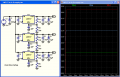
However, if you really want to go the LM317 route, that can be done too. I'll post a schematic in a bit.
i tried it what SgtWookie said me to do but the problem is that when i connect it to the main power and switch it on the fan runs for a second and then runs off it does not start at all what now
i forgot to say that i connected a bulb instead of the power resistor some 6v bulb
What do you mean by "the main power" - I hope you didn't try plugging it in to a wall outlet? As shown, it's to be connected to a 12v DC supply. It needs something like a "wall wart" plug-in supply that has a transformer and rectifier.
... and switch it on the fan runs for a second and then runs off it does not start at all; what now?
Look, this is a low-power supply. Linear regulators dissipate a lot of power as heat. You need a way to get rid of the heat, normally a large heat sink for each regulator.
Note that the tab on the regulator is "live"; it's connected to the OUT pin. If you short it to ground or the input, you're going to have big problems.
You will need 1 IC per voltage level ..... if you want accurate o/p voltages .... otherwise a series zener could be a good bet assuming not much power being drawn by the PSU ....
you can find the circuit(s) in the datasheet of LM317 .... you also have fixed voltage ics like 7809 in your arsenal ....
What do you mean by "the main power" - I hope you didn't try plugging it in to a wall outlet? As shown, it's to be connected to a 12v DC supply. It needs something like a "wall wart" plug-in supply that has a transformer and rectifier.
What voltage and current is the fan rated for?
What voltage and current is the bulb rated for?
Look, this is a low-power supply. Linear regulators dissipate a lot of power as heat. You need a way to get rid of the heat, normally a large heat sink for each regulator.
Note that the tab on the regulator is "live"; it's connected to the OUT pin. If you short it to ground or the input, you're going to have big problems.
Was the supply working when it was removed from a computer?
Did it have a 20-pin or a 24-pin motherboard connector?
Some ATXplus12 supplies might require a load on the +12v supply along with a load on the +5v supply; with no load it may go higher than expected, causing the supply to shut down due to an over-voltage condition.

 Facebook
 Google
 GitHub
 Linkedin