Power supply circuit for UV-C (germicidal) bulb?

Thread Starter

MikeA

Joined Jan 20, 2013
442
I have some UV-C bulbs that I'd like to power in an energy efficient way. The bulbs run on 11V AC, and need to be current limited to 0.27A to run at rated 3W. The trick is the bulbs need a higher voltage for a few seconds to start, around 17V.

I rigged it up with an AC wall wart and a 5W resistor, but that obviously wastes energy as heat. Are there any other not overly complex but more power efficient ways to do this?
 

Jon Chandler

Joined Jun 12, 2008
1,560
You might search Big Clive's channel on YouTube – he's dissected a number of UVC sources and analyzed and explained the power supplies, with schematic diagrams
 

MisterBill2

Joined Jan 23, 2018
27,164
One simple and more efficient scheme would be a transformer with two voltages out, 17volts and 11 volts. The change over could be a snap-action thermal relay that will switch to the lower voltage after it's power is switched off. OR it could be an electronic timer and switch. Adequate quality transformers usually last until long after they become totally obsolete. (Many years)
 

Ian0

Joined Aug 7, 2020
13,097
What sort of lamp produces UV-C from 11V AC?
Obviously not a filament lamp, because it can't get the filament hot enough to emit UV-C
Obviously not an LED because that would run on DC and not require a different voltage to start it.
Obviously not a discharge lamp, because discharge lamps need hundereds of volts to start up.
 

MisterBill2

Joined Jan 23, 2018
27,164
What sort of lamp produces UV-C from 11V AC?
Obviously not a filament lamp, because it can't get the filament hot enough to emit UV-C
Obviously not an LED because that would run on DC and not require a different voltage to start it.
Obviously not a discharge lamp, because discharge lamps need hundereds of volts to start up.
Certainly it can be a filament lamp with only 11 volts on the heater, in a "Mercury Vapor UV Bulb"! LONG ago some clothes dryers, as well as OZONE GENERATORS, used a mercury vapor bulb that was connected with a 25 watt incandescent bulb in series to control the current. At the initial turn on, the current would cause the mercury bulb filament to be quite hot, because it had the higher resistance and therefore took more power. As the mercury liquid evaporated the conductive vapor allowed the current to bypass the filament and that heated the vapor even more. So then the incandescent bulb would drop a greater voltage and it's filament resistance would increase, limiting the current. Quite an excellent and simple-cheap system.
But then came the health and safety issues about the mercury in the bulb being rather toxic, and the hazards of people playing with the broken bulbs. ( I would NEVER eat a broken light bulb!) So now I am not aware of them being available.
BUT THAT is how an 11 volt filament type bulb UV generator system worked in 1958!
 

Thread Starter

MikeA

Joined Jan 20, 2013
442
You might search Big Clive's channel on YouTube – he's dissected a number of UVC sources and analyzed and explained the power supplies, with schematic diagrams
Very eccentric guy. He tore down one lamp that ran off 220v and just had a capacitor to current limit. Not a good design for longevity of the bulb. And he did a teardown of a purpose made "ballast" that converted DC to simulated AC. Those go for >$15 a pop.

Since my UVC bulb is for an aquarium, and the aquarium has a resistive heater to keep the water at about 80F, maybe I can just drop the voltage drop resistor into the water for "100% efficiency".
:cool:
 

Thread Starter

MikeA

Joined Jan 20, 2013
442
The problem with running of 120/220v with a capacitor is large current spikes, but can't the same capacitor method be used with a wall wart AC adapter at say 24v?

Isolated AC going into an aquarium is probably a good idea too.
 

MisterBill2

Joined Jan 23, 2018
27,164
Two big questions: First, what is the exact application???
Second question: Do you already have the UV bulb?? I ask this because UV LEDs are also available.
 

Ian0

Joined Aug 7, 2020
13,097
Certainly it can be a filament lamp with only 11 volts on the heater, in a "Mercury Vapor UV Bulb"! LONG ago some clothes dryers, as well as OZONE GENERATORS, used a mercury vapor bulb that was connected with a 25 watt incandescent bulb in series to control the current. At the initial turn on, the current would cause the mercury bulb filament to be quite hot, because it had the higher resistance and therefore took more power. As the mercury liquid evaporated the conductive vapor allowed the current to bypass the filament and that heated the vapor even more. So then the incandescent bulb would drop a greater voltage and it's filament resistance would increase, limiting the current. Quite an excellent and simple-cheap system.
But then came the health and safety issues about the mercury in the bulb being rather toxic, and the hazards of people playing with the broken bulbs. ( I would NEVER eat a broken light bulb!) So now I am not aware of them being available.
BUT THAT is how an 11 volt filament type bulb UV generator system worked in 1958!
That surprises me. I've only ever seen filament-lamp-ballasted mercury vapour lamps in 230V, and assumed that at least 100V would be required to strike the arc as in every other mercury vapour lamp (i.e. fluorescent tube, metal halide lamp, ). [Edit] or is it more like a thyratron?
Such lamps are woefully inefficient!
 
Last edited:
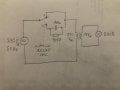
Capacitor in series with primary winding limits the current very effectively (low waist).

So first few second connect the primary directly (position 1) to 17V transformer and then involve the cap to primary path (position 2).

For 3W expect the cap value needed about 47 or 100n. The cap must have 250Vac rating of course.
The higher capacitance the higher current and vice versa.

You can switch between 1 and 2 position manually with switch or automatically with relay + delay circuit (or time relay).

IMG_1870.jpeg

It’s a good manner to place about 4.7Mohm resistor across the cap so it is discharged after power-off.

Note: It’s also possible to connect this cap in series with secondary, composed from two electrolytic ones in series turned against each other (pluses or minuses together) because of AC current.
 
Last edited:

Thread Starter

MikeA

Joined Jan 20, 2013
442
Two big questions: First, what is the exact application???
Second question: Do you already have the UV bulb?? I ask this because UV LEDs are also available.
It's for an aquarium, controlling algae growth, so bulb goes into water.

The LEDs are obscenely expensive for how much UVC energy they put out. Maybe 50mW of actual irradiation while >$35 each. The bulbs I have are less than $1 each and over 1000mW of actual irradiation. So roughly 700 times more bang for buck, if finite life of bulb is ignored.
 

MisterBill2

Joined Jan 23, 2018
27,164
That surprises me. I've only ever seen filament-lamp-ballasted mercury vapour lamps in 230V, and assumed that at least 100V would be required to strike the arc as in every other mercury vapour lamp (i.e. fluorescent tube, metal halide lamp, ). [Edit] or is it more like a thyratron?
Such lamps are woefully inefficient!
Those UV mercury vapor lights did not involve any struck arc at all. The mercury vapor was produced by heat from the filament, and then the vapor conduction was between the broader portions of the conductors leading to the filament. The construction of the bulbs was not the same as normal light bulbs. Remember the "Tungar" rectifiers that were used in battery chargers a LONG TIME AGO?? The TUNGAR bulb had a metal cap on the top, in addition to what I think was a mogul base. The name, TUNGAR, was a combination of Tungsten filament heater and ARGON gas, possibly the first high current rectifier tube, although not the first mercury vapor rectifier.
 
Top