Facebook
 Google
 GitHub
 Linkedin
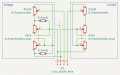
I have an adjustable power supply that I use a lot and the one big complaint I've had with it is that the fine voltage adjustment isn't fine enough. It is really hard to dial in anything less than 30-40mV at a time. So, I took it apart and modified it so it is now about 2x more fine than it used to be (easy to get 10-20mV at a time which is sufficient for my needs). That said, as I was probing the PCB to figure out how things were routed, I put together the below schematic. I am not familiar with how the potentiometers are setup or why they are configured the way they are.
Speaking to just the voltage side of things, can anyone help me understand the purpose of tying the wiper and one of the legs together in a mirrored configuration between the two gangs of the dual-gang pot? I was measuring no meaningful change in resistance between pins 1 and 2 of JP1 regardless of where the two pots were set. Is it that, by tying the wiper and one leg together, the resistance is effectively half of rated and that the two gangs are mirrored so the whole dual-gang pot acts like a 500ohm single-gang pot?
Then there is the question of why the two resistor spots were not populated and what purpose those could have. Before I did the mod, I was initially thinking that they would be used to offer a bypass for when only 1 pot would be used in some other product the company uses the same board in. That was until I realized I could throw some 470ohm resistors in there and effectively halve the series resistance the fine adjustment pot has on the circuit.
Are my thoughts correct? Incorrect? Incomplete?
For those curious, adding in a pair of 470ohm resistors brought the peak resistance on the dual-gang pot down from ~460ohms to ~230ohms and the minimum didn't change from ~2ohms. Overall, I only lost about 60ohms peak from the whole circuit (~1.2%) which is meaningless as the power supply is supposed to cap out at 30 volts yet still goes over 32 volts.
Speaking to just the voltage side of things, can anyone help me understand the purpose of tying the wiper and one of the legs together in a mirrored configuration between the two gangs of the dual-gang pot? I was measuring no meaningful change in resistance between pins 1 and 2 of JP1 regardless of where the two pots were set. Is it that, by tying the wiper and one leg together, the resistance is effectively half of rated and that the two gangs are mirrored so the whole dual-gang pot acts like a 500ohm single-gang pot?
Then there is the question of why the two resistor spots were not populated and what purpose those could have. Before I did the mod, I was initially thinking that they would be used to offer a bypass for when only 1 pot would be used in some other product the company uses the same board in. That was until I realized I could throw some 470ohm resistors in there and effectively halve the series resistance the fine adjustment pot has on the circuit.
Are my thoughts correct? Incorrect? Incomplete?
For those curious, adding in a pair of 470ohm resistors brought the peak resistance on the dual-gang pot down from ~460ohms to ~230ohms and the minimum didn't change from ~2ohms. Overall, I only lost about 60ohms peak from the whole circuit (~1.2%) which is meaningless as the power supply is supposed to cap out at 30 volts yet still goes over 32 volts.