Questionable power supply circuit

Thread Starter

xox

Joined Sep 8, 2017
936
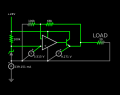
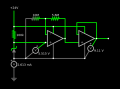
Okay this is probably a really dumb idea. I have several low-voltage projects ranging from about 3V-9V which are all in need of more permanant power sources. I also happen to have numerous old DC power supplies laying around from old laptops, monitors and such with a variety of different ratings, 12V, 14V, 24V, etc. So the idea I had was to put together a little circuit that could be spliced into any one of those cables whatsoever and provide a fixed output voltage. (In the example given I am using 24V to supply ~9V.)
questionable.png

Now I'll bet that using an opamp as a power supply is probably not the brightest idea you've heard of this week. But hear me out! The circuits this will be powering draw less than a couple hundred milliamps (and in fact much less than that on average). I haven't identified the particular opamp to try this out on just yet, but surely there are at least a few that can handle up to 24V and 200mA?

So....

(1) Is this just a terrible idea that should be scrapped altogether? If so then what might be some other options? Otherwise which opamps would be the best to use?
(2) Can I get a lower reference voltage than the ~5.5V that the zener provides?
(3) Is there a better/easier way to get achieve this? I still want to be able to use just about any old cable (interchangeably) in such a way that the same output voltage (+- say 1V) would be maintained?
(4) Could this idea be adapted to much higher voltages/currents?
 
Last edited:

WBahn

Joined Mar 31, 2012
32,703
Okay this is probably a really dumb idea. I have several low-voltage projects ranging from about 3V-9V which are all in need of more permanant power sources. I also happen to have numerous old DC power supplies laying around from old laptops, monitors and such with a variety of different ratings, 12V, 14V, 24V, etc. So the idea I had was to put together a little circuit that could be spliced into any one of those cables whatsoever and provide a fixed output voltage. (In the example given I am using 24V to supply ~9V.)

View attachment 358636

Now I'll bet that using an opamp as a power supply is probably not the brightest idea you've heard of this week. But hear me out! The circuits this will be powering draw less than a couple hundred milliamps (and in fact much less than that on average). I haven't identified the particular opamp to try this out on just yet, but surely there are at least a few that can handle up to 24V and 200mA?

So....

(1) Is this just a terrible idea that should be scrapped altogether? If so then what might be some other options? Otherwise which opamps would be the best to use?
(2) Can I get a lower reference voltage than the ~5.5V that the zener provides?
(3) Is there a better/easier way to get achieve this? I still want to be able to use just about any old cable (interchangeably) in such a way that the same output voltage (+- say 1V) would be maintained?
(4) Could this idea be adapted to much higher voltages/currents?
It should probably be scrapped altogether. If you were only needing a few milliamps or, preferably, less than a milliamp, the basic idea might find some utility. You do need to be careful about using multi-megohm resistors as your input bias currents on some opamps might cause you some problems.

Note that drawing 200 mA from a 24 V supply dissipated ~5 W. The lower your final output voltage, the more of that power must be dissipated in the opamps.

Why not just use something like an LM317? It can take input voltages from 3 V to 40 V and can deliver output currents up to 1500 mA. It would be a linear solution, so you would still be dissipating the same power, but at least you would be doing it with a part that is designed to handle it (with appropriate heat sinking, of course).

Unless you need very low noise, a better solution is probably any of the very inexpensive battery-eliminator modules used in RC cars and airplanes. These are simple DC-DC converters that are very small and easy to use.
 

schmitt trigger

Joined Jul 12, 2010
2,027
Regular opamps, those not costing an arm and a leg and perhaps a kidney too, are limited to the low tens of milliamps.

Tho obtain a couple hundred milliamps, you would require booster transistors. There are plenty of circuits showing how this is done.

To your second question, yes there are voltage references that go down to 1 volt and below.

Having said this, there are better circuit alternatives, as mentioned by other members
 

MrAl

Joined Jun 17, 2014
13,667
Okay this is probably a really dumb idea. I have several low-voltage projects ranging from about 3V-9V which are all in need of more permanant power sources. I also happen to have numerous old DC power supplies laying around from old laptops, monitors and such with a variety of different ratings, 12V, 14V, 24V, etc. So the idea I had was to put together a little circuit that could be spliced into any one of those cables whatsoever and provide a fixed output voltage. (In the example given I am using 24V to supply ~9V.)

View attachment 358636

Now I'll bet that using an opamp as a power supply is probably not the brightest idea you've heard of this week. But hear me out! The circuits this will be powering draw less than a couple hundred milliamps (and in fact much less than that on average). I haven't identified the particular opamp to try this out on just yet, but surely there are at least a few that can handle up to 24V and 200mA?

So....

(1) Is this just a terrible idea that should be scrapped altogether? If so then what might be some other options? Otherwise which opamps would be the best to use?
(2) Can I get a lower reference voltage than the ~5.5V that the zener provides?
(3) Is there a better/easier way to get achieve this? I still want to be able to use just about any old cable (interchangeably) in such a way that the same output voltage (+- say 1V) would be maintained?
(4) Could this idea be adapted to much higher voltages/currents?
Hi,

Nothing is a terrible idea if you have a good use for it and it works the way you want it to work.

The real question is why do you want to use an op amp for a power supply?
You can get op amps that output 1 amp, but why wouldn't you want to use a voltage regulator that can do this?

There are reasons for wanting to use an op amp for a power supply. For example, you want to be able sink current as well as source current. Most voltage regulator made for power supplies assume the circuit will always source current with almost no sinking. That means a lot of regulator chips will not be able to sink current, only source current. In the case of sourcing only it also helps to use a transistor on the output of a regular op amp to increase the power output capabilities.
Another reason is you have a design and a chip with one op amp left over that is not being used. You might be able to use it to create a simple power supply.

So now the question becomes, does your power supply need to sink current as well as source current, or just have to source current?
 

Thread Starter

xox

Joined Sep 8, 2017
936
Nothing is a terrible idea if you have a good use for it and it works the way you want it to work.

The real question is why do you want to use an op amp for a power supply?

You can get op amps that output 1 amp, but why wouldn't you want to use a voltage regulator that can do this?
There were basically two reasons why I wanted to do it that way. First, the cost factor; I would much rather buy a handful of opamps than a dozen individual power supplies. The other thing is that I just liked the idea of putting together a little circuit that could be connected to just about any DC power supply voltage without any further modification. With this particular design (assuming it would have worked) it wouldn't matter if I connected it to a 24V versus a 13.68V supply. Either way it outputs roughly the same voltage. Which is kind of nice feature, if you ask me.

There are reasons for wanting to use an op amp for a power supply. For example, you want to be able sink current as well as source current. Most voltage regulator made for power supplies assume the circuit will always source current with almost no sinking. That means a lot of regulator chips will not be able to sink current, only source current. In the case of sourcing only it also helps to use a transistor on the output of a regular op amp to increase the power output capabilities.

Another reason is you have a design and a chip with one op amp left over that is not being used. You might be able to use it to create a simple power supply.

So now the question becomes, does your power supply need to sink current as well as source current, or just have to source current?
That's an interesting question. I really can't think of a situation where I would need the power supply to sink current! I have seen it happen in oscillatory cicuits and such, but only in the internal aspect of the circuitry. Can you cite a specific example where that sort of thing might arise in "normal" devices interfacing with their power supply?
 

crutschow

Joined Mar 14, 2008
38,316
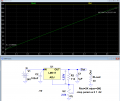
Here's the LTspice sim for an example circuit of the cheap old standby LM317 adjustable voltage regulator (as suggested by WBahn):

It can deliver over an amp (with proper heat-sinking), and adjust from 1.25V to about 2V below the input voltage (green trace).
It has current-limit and over-temperature protection, so is nearly indestructible.

If you don't want the output continually adjustable, you can use one or more (switchable) fixed resistors in place of the pot to give fixed output voltage(s).

1762880675539.png
 

MrAl

Joined Jun 17, 2014
13,667
There were basically two reasons why I wanted to do it that way. First, the cost factor; I would much rather buy a handful of opamps than a dozen individual power supplies. The other thing is that I just liked the idea of putting together a little circuit that could be connected to just about any DC power supply voltage without any further modification. With this particular design (assuming it would have worked) it wouldn't matter if I connected it to a 24V versus a 13.68V supply. Either way it outputs roughly the same voltage. Which is kind of nice feature, if you ask me.


That's an interesting question. I really can't think of a situation where I would need the power supply to sink current! I have seen it happen in oscillatory cicuits and such, but only in the internal aspect of the circuitry. Can you cite a specific example where that sort of thing might arise in "normal" devices interfacing with their power supply?
Hi,

Oh I was not saying to buy a bunch of power supplies, just the voltage regulator chips. They require a minimum number of support components too just like an op amp would.

Sourcing and sinking currents can be required with loads that can store energy unlike just a resistor as load.
For example, a speaker in an audio amplifier needs an amplifier that can sink and source current. A regular power supply voltage regulator does not have that. That's especially true with a capacitive coupling from amplifier output to speaker, the amplifier has to both source and sink current.
Many voltage regulator chips have just one output transistor and that means it can only source current or sink current but not both. You can cheat and use a low value resistor on the output to act as a sink, but that eats up a lot of power; usually too much to be useful unless it is a very low power circuit to begin with.

The most efficient regulator for your application is probably a buck regulator.
 

Thread Starter

xox

Joined Sep 8, 2017
936
Okay, thanks everyone! I think I'll probably go the route suggested by @crutschow.

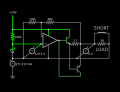
I do however have one more idea to run by you guys. It's just a slight modification to the original circuit that should allow for the load to be driven by a (power) transistor. From what I can tell it would be able to source much higher voltages/amps too, so it might be useful for even more applications.


vr.png


I can get a hold of some TIP3055s for practically nothing, and I do have lots of spare opamps laying around as well. What do you think, does that sound like it might work, or is the LM317 still a better choice?
 

WBahn

Joined Mar 31, 2012
32,703
The LM317 will almost certainly make for a better voltage regulator because, well, it's a voltage regulator. That's what it does. It is designed to operate from a wide range of input voltages while rejecting those variations in the output. It is designed to supply power to things. It is designed to behave well under thermal stress.

Your circuit will have pretty poor power-supply rejection ratio because your zener current is a essentially proportional to the input voltage. While an ideal zener diode would hold it's voltage drop constant regardless of current, zeners in the real world do not -- the more current, the more voltage they drop. Also, their voltage depends on temperature -- though this can be mitigated to a great extent by using a 5.6 V zener because that is where the competing effects cancel out. But another consideration is matching the tempco of the zener to the tempcos of the circuitry it is interacting with. In that case, a zener voltage of about 4.7 V matches the that of a forward-biased silicon p-n junction.

These are all things that the designer of a dedicated voltage regulator has taken into account in the design of their regulator.
 

Thread Starter

xox

Joined Sep 8, 2017
936
The LM317 will almost certainly make for a better voltage regulator because, well, it's a voltage regulator. That's what it does. It is designed to operate from a wide range of input voltages while rejecting those variations in the output. It is designed to supply power to things. It is designed to behave well under thermal stress.

Your circuit will have pretty poor power-supply rejection ratio because your zener current is a essentially proportional to the input voltage. While an ideal zener diode would hold it's voltage drop constant regardless of current, zeners in the real world do not -- the more current, the more voltage they drop. Also, their voltage depends on temperature -- though this can be mitigated to a great extent by using a 5.6 V zener because that is where the competing effects cancel out. But another consideration is matching the tempco of the zener to the tempcos of the circuitry it is interacting with. In that case, a zener voltage of about 4.7 V matches the that of a forward-biased silicon p-n junction.

These are all things that the designer of a dedicated voltage regulator has taken into account in the design of their regulator.
I did consider the zener current fluctuations which is why I went with a 100K resistor. Simulating a range of input voltages the zener current varied by less than 1mA. The output also looks pretty stable. I did not however consider tempco factors so maybe that would affect the stability of the circuit in general. Otherwise I don't know how important power supply rejection issues might be in this case, but one thing to remember is that I would be attaching this to an existing power supply which would likely take all of those matters into acount sufficiently well.

At any rate I do appreciate the advice and, again, I probably will just use the LM317 since that is after all as you say what it is designed to do in the first place.

I am nonetheless curious to see whether or not the second version would even do a halfway decent job of regulating. I just might buy a few TIP3055s anyway just to see what happens. =p
 

crutschow

Joined Mar 14, 2008
38,316
I am nonetheless curious to see whether or not the second version would even do a halfway decent job of regulating.
It should regulate well for changes in the output load, but it has no current limit function, so an output short could zap the 3055.
 

Thread Starter

xox

Joined Sep 8, 2017
936
It should regulate well for changes in the output load, but it has no current limit function, so an output short could zap the 3055.
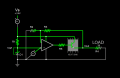
Excellent point! I doubt that would happen in this particular case (AFAICT none of these applications could possibly cause such a condition to arise) but if I did want to provide that sort of protection for the general case, would something like this be sufficient?

current-limited.png

The lead resistor is small enough that it shouldn't interfere much with the operation of the sinking circuit and it seems to do a fair job of keeping the current within a safe range.
 

Thread Starter

xox

Joined Sep 8, 2017
936
You need a series resistor (e.g. 1k) in series with the op amp output to limit its short-circuit current.
Duly noted! Thanks. I was just noticing that in the simulation too. The output impedance of an opamp is after all "theoretically zero".
 
Last edited:

crutschow

Joined Mar 14, 2008
38,316
The output impedance of an opamp is after all "theoretically zero".
A real op amp is, of course, higher than that, but you still don't want to short the output for best reliability.

Note: If you want better Zener stability, use the common programmable TL431 shunt (like a Zener) reference.
It is much more stable with temperature, and for any change in current through it, and has an accurate 2.5V minimum reference voltage.
 

MrAl

Joined Jun 17, 2014
13,667
Okay, thanks everyone! I think I'll probably go the route suggested by @crutschow.

I do however have one more idea to run by you guys. It's just a slight modification to the original circuit that should allow for the load to be driven by a (power) transistor. From what I can tell it would be able to source much higher voltages/amps too, so it might be useful for even more applications.


View attachment 358710


I can get a hold of some TIP3055s for practically nothing, and I do have lots of spare opamps laying around as well. What do you think, does that sound like it might work, or is the LM317 still a better choice?

Hello there,

A zener diode does not provide very good voltage regulation especially not with a 100k series resistor ;)

A better choice is a voltage reference diode shown in the attachment as just D1. It is a TL431 shunt regulator. That configuration can be very stable over temperature if the ambient temperature is relatively constant. More so than a LM317 due to the off-chip voltage reference vs the LM317 on-chip reference which can heat up with increased current.

In this 'new' circuit, R5 limits the current into the base of the transistor but also sets a rough current limit for the entire output. That is due to the limited transistor Beta at higher collector/emitter currents. The output current should only be around ib*Beta, and ib is limited by roughly Vcc/R5.

The D1 minimum current has to be observed also (even if a zener). For the LM431 that is around 1ma. The current through D1 is:
iD1=(Vs-Vref)/R1
and since Vref is fixed at 2.5v, the current is:
iD1=(Vs-2.5)/R1
and since the minimum iD1 is 0.001 amps, that brings us to:
0.001=(Vs-2.5)/R1
and if Vs goes down to 12v, then we have:
0.001=(12-2.5)/R1
or just:
0.001=9.5/R1
and solving for R1:
R1=9.5/0.001
which is 9,5k, so a 10k might work but better a little lower would be better.
If you turn the voltage Vs down more then you need a lower value for R1.

Now the output voltage is due to the op amp gain and the reference voltage. The op amp gain is:
G=1+R3/R2
so the output voltage is:
Vout=Vref*(1+R3/R2)
which is:
Vout=2.5+2.5*R3/R2

The output will not be able to get up to the full Vs source voltage though because of the drop in the transistor CE, and also due to any limits of the output of the op amp. The LM358 op amp may only be able to get up to about Vs-1.5 which means at 24v input the output of the op amp would be about 22 volts, and with the drop in the transistor this can come out to a Vout of maybe 20 to 21v output max.

When you test it, test for max output current as well as the correct voltage output.

Also note the heat sink. With 24v input and 12v output and 200ma, the power in the transistor is 2.4 watts, which may not sound like much, but the power transistor could get very hot with that much power. The metal case type transistor can take more power with no heat sink (maybe 1 or 1.5 watts) but the plastic packages can barely handle 1 watt if that. That means you should use a heat sink.
Unfortunately, the situation gets worse if the output voltage goes lower and the current stays high. With 24v in and 6v out with the same 200ma, the transistor has to dissipate 3.6 watts. The heat sink has to be able to be large enough to handle the expected max transistor power.
 

Attachments

Thread Starter

xox

Joined Sep 8, 2017
936
A zener diode does not provide very good voltage regulation especially not with a 100k series resistor ;)

A better choice is a voltage reference diode shown in the attachment as just D1. It is a TL431 shunt regulator. That configuration can be very stable over temperature if the ambient temperature is relatively constant. More so than a LM317 due to the off-chip voltage reference vs the LM317 on-chip reference which can heat up with increased current.


In this 'new' circuit, R5 limits the current into the base of the transistor but also sets a rough current limit for the entire output. That is due to the limited transistor Beta at higher collector/emitter currents. The output current should only be around ib*Beta, and ib is limited by roughly Vcc/R5.


The D1 minimum current has to be observed also (even if a zener). For the LM431 that is around 1ma. The current through D1 is:

iD1=(Vs-Vref)/R1

and since Vref is fixed at 2.5v, the current is:

iD1=(Vs-2.5)/R1

and since the minimum iD1 is 0.001 amps, that brings us to:

0.001=(Vs-2.5)/R1

and if Vs goes down to 12v, then we have:

0.001=(12-2.5)/R1

or just:

0.001=9.5/R1

and solving for R1:

R1=9.5/0.001

which is 9,5k, so a 10k might work but better a little lower would be better.

If you turn the voltage Vs down more then you need a lower value for R1.


Now the output voltage is due to the op amp gain and the reference voltage. The op amp gain is:

G=1+R3/R2

so the output voltage is:

Vout=Vref*(1+R3/R2)

which is:

Vout=2.5+2.5*R3/R2
Okay so R1 really shouldn't be so high. Also thanks for the diagram. However since this is more of a general solution I would be sure to add some current limiting there as @crutschow pointed out.

The output will not be able to get up to the full Vs source voltage though because of the drop in the transistor CE, and also due to any limits of the output of the op amp. The LM358 op amp may only be able to get up to about Vs-1.5 which means at 24v input the output of the op amp would be about 22 volts, and with the drop in the transistor this can come out to a Vout of maybe 20 to 21v output max.

When you test it, test for max output current as well as the correct voltage output.
I see, the input voltage just has to be moderately higher than the output level. I hadn't really considered the transistor CE. (Another great argument for why I should be using something like LTSpice rather than a more simple simulator like Falstad which tends to offer mostly "ideal" components.)

Also note the heat sink. With 24v input and 12v output and 200ma, the power in the transistor is 2.4 watts, which may not sound like much, but the power transistor could get very hot with that much power. The metal case type transistor can take more power with no heat sink (maybe 1 or 1.5 watts) but the plastic packages can barely handle 1 watt if that. That means you should use a heat sink.

Unfortunately, the situation gets worse if the output voltage goes lower and the current stays high. With 24v in and 6v out with the same 200ma, the transistor has to dissipate 3.6 watts. The heat sink has to be able to be large enough to handle the expected max transistor power.
Good idea. I was planning on mounting these beneath a workbench which doesn't get much airflow. I've got a few heatsinks in box somewhere (if I can find them). Otherwise I'll have to order some.
 

Jon Chandler

Joined Jun 12, 2008
1,560
How about something like this buck/boost module? Supply DC power at a fixed voltageo and you get adjustable voltage output over a wide range, adjustable constant current output, digital display of voltage, current, power and other parameters, a graphic display of voltage and current over time and more.

Screenshot_20251111_204047_AliExpress.jpg

Screenshot_20251111_204110_AliExpress.jpg
 
Top