Possible types of capacitors implied by schematic?

Thread Starter

GregJ7

Joined Jun 7, 2014
42
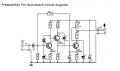
I am building a pre-amplifier for connecting an electric guitar to a sound card mic input from this schematic (I'm hoping my mic input has the required DC bias). I need some guidance to know what types of capacitors to use. I read somewhere that ceramic capacitors are not good for audio circuits, presumably due to some noise generation, and that propylene or polypropylene (?) are good (are these "film?"). Also, on the schematic are three polarized capacitors. Since I have only run into electrolytic polarized capacitors, does the schematic imply those three should be electrolytic? Do non-polarized capacitors on the schematic imply they are not electrolytic? What types of capacitors should I be using for this circuit? Thanks for any help!

If I don't have what I need already, I'd be ordering from Mouser.
Capture1.PNG
 
Last edited by a moderator:

crutschow

Joined Mar 14, 2008
38,526
If the cap is shown as polarized, it's typically electrolytic, but a non-polarized cap would work just fine in its place.

Yes, propylene or polypropylene are "film" type capacitors and are generally better for high-fidelity audio than ceramic caps.
But if it's for a guitar amp where distortion is often added on purpose, then it's highly unlikely the use of ceramic caps will be noticed. :rolleyes:
 

MrChips

Joined Oct 2, 2009
34,826
C1, 1μF - use non-polar poly cap.
C5, C7, 10μF/16V - use aluminum electrolytic polarized cap.
C2, C3, C4 - doesn't really matter, mica is common at those values
C6, 1nF - poly is ok
 

djsfantasi

Joined Apr 11, 2010
9,237
C1, 1μF - use non-polar poly cap.
C5, C7, 10μF/16V - use aluminum electrolytic polarized cap.
C2, C3, C4 - doesn't really matter, mica is common at those values
C5, 1nF - poly is ok
Nice summary! But of the four classifications you propose, why did you select each type?
 

MrChips

Joined Oct 2, 2009
34,826
Nice summary! But of the four classifications you propose, why did you select each type?
Oh my, do I have to?

C1, 1μF - use non-polar poly cap.
C5, C7, 10μF/16V - use aluminum electrolytic polarized cap.
C2, C3, C4 - doesn't really matter, mica is common at those values
C6, 1nF - poly is ok

C1 is directly in the input signal path. Any noise in the capacitor will be amplified all the way through. Electrolytics are notorious for producing microphonics. Also their characteristics will change with bias voltage.

C5, C7 are used for power supply decoupling.

C2, C3, C4 are for frequency compensation and to prevent high frequency oscillation. They provide negative feedback and HF filtering.

C6 seems rather drastic. This will have significant impact on the preamp's frequency response. (Edit: a quick calculation reveals that the HF roll-off is at the high end of the audio range.)
 

dendad

Joined Feb 20, 2016
4,639
I would use Tantalum caps in preference over Aluminum Electrolytics. They have a much longer life in my experience. Like, almost never having to replace one, but have done so with many Electrolytics.
 

Thread Starter

GregJ7

Joined Jun 7, 2014
42
Oh my, do I have to?

C1, 1μF - use non-polar poly cap.
C5, C7, 10μF/16V - use aluminum electrolytic polarized cap.
C2, C3, C4 - doesn't really matter, mica is common at those values
C6, 1nF - poly is ok

C1 is directly in the input signal path. Any noise in the capacitor will be amplified all the way through. Electrolytics are notorious for producing microphonics. Also their characteristics will change with bias voltage.

C5, C7 are used for power supply decoupling.

C2, C3, C4 are for frequency compensation and to prevent high frequency oscillation. They provide negative feedback and HF filtering.

C6 seems rather drastic. This will have significant impact on the preamp's frequency response. (Edit: a quick calculation reveals that the HF roll-off is at the high end of the audio range.)
This is the kind of commentary I've always wished I had whenever I look at a schematic. ☺☺ Oddly (to me), no schematic designer ever does it. Seems like I would learn electronics twice as fast. (I function best starting with a top-down understanding, rather than the more abstract bottom-up.) Even having blocks is currently useless to me.
 

Thread Starter

GregJ7

Joined Jun 7, 2014
42
I would use Tantalum caps in preference over Aluminum Electrolytics. They have a much longer life in my experience. Like, almost never having to replace one, but have done so with many Electrolytics.
Are they as quiet? Functionally, I don't need them at max. quietness, but I am curious.
 

dendad

Joined Feb 20, 2016
4,639
I think Tants are very good caps. As long as you get them the correct way around! If not, the can catch fire, as I have found a couple of times after assembling a stack of boards, and doing the batch with one cap swapped!
They are more stable then elecros, but generally cost a bit more too, and are not available in a large voltage or capacitance.
 

DickCappels

Joined Aug 21, 2008
10,661
For many audio applications ceramic capacitors are just fine. The main issue is distortion and to a minor extent microphonic response. Unless you are making something HIFI ceramic should be fine.
 

Thread Starter

GregJ7

Joined Jun 7, 2014
42
For many audio applications ceramic capacitors are just fine. The main issue is distortion and to a minor extent microphonic response. Unless you are making something HIFI ceramic should be fine.
Thanks for the useful added info. I am trying to learn enough so I won't be intimidated by building something Hi-Fi, because that is one of the few things I want to do. My current enormous limitation is my inability to debug a circuit, although my soldering sure needs a lot of work, too. If I solder on mental cruise control I overheat components.
 

MrChips

Joined Oct 2, 2009
34,826
The major difference between tantalum and aluminum electrolytics is in the ESR. Having low ESR tantalum in switching supplies or HF digital application is important.

Aluminum electrolytics in C5 and C7 in your AF circuit will be ok.

The point about microphonics in capactors is worth some attention. If you have 1mV microphonics in C5 or C7 biased at 1V or 9V, you are not going to hear it.

However 1mV microphonics into C1 is definitely undesirable.
 

Zeeus

Joined Apr 17, 2019
616
Oh my, do I have to?


C2, C3, C4 are for frequency compensation and to prevent high frequency oscillation. They provide negative feedback and HF filtering.

C6 seems rather drastic. This will have significant impact on the preamp's frequency response. (Edit: a quick calculation reveals that the HF roll-off is at the high end of the audio range.)
Please explain more on this..Thanks

Is it the combination of C3 and C2 that provides negative feedback, correct?
If it was only C2, any feedback?

HF filtering?

Hmm, what was that quick calculation? "Quickest"have seen so far (not too far) is Open circuit time constant
Guessing your quick is something else then
 
Last edited:

Zeeus

Joined Apr 17, 2019
616
The major difference between tantalum and aluminum electrolytics is in the ESR. Having low ESR tantalum in switching supplies or HF digital application is important.

Aluminum electrolytics in C5 and C7 in your AF circuit will be ok.

The point about microphonics in capactors is worth some attention. If you have 1mV microphonics in C5 or C7 biased at 1V or 9V, you are not going to hear it.

However 1mV microphonics into C1 is definitely undesirable.
RC filter the 1mV microphone before AC coupling
 

cmartinez

Joined Jan 17, 2007
8,768
I am building a pre-amplifier for connecting an electric guitar to a sound card mic input from this schematic (I'm hoping my mic input has the required DC bias). I need some guidance to know what types of capacitors to use. I read somewhere that ceramic capacitors are not good for audio circuits, presumably due to some noise generation, and that propylene or polypropylene (?) are good (are these "film?"). Also, on the schematic are three polarized capacitors. Since I have only run into electrolytic polarized capacitors, does the schematic imply those three should be electrolytic? Do non-polarized capacitors on the schematic imply they are not electrolytic? What types of capacitors should I be using for this circuit? Thanks for any help!

If I don't have what I need already, I'd be ordering from Mouser.

View attachment 180074
What am I missing here? Why can't I find a power source in the schematic? Is said power being delivered by the mic input that would be connected to K2?
 
Top