I am not that experienced in using LTSpice especially for modelling for Lithium batteries or capacitors to test out a switched capacitor equalising circuits. Please, kindly guide me.
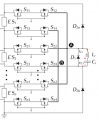
L and C are 2.2uH and 10uF. In place of cells, use a supercapacitors SC1 = 345 F, SC2 = 300 F, and SC3 = 276 F, respectively, and the voltages were initially set to 2.00, 2.30, and 2.50 V.
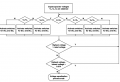
? at #5 "the highest voltage > rated voltage" ← sounds like a fault condition ?
? what would be the peak current load for D₂ʙ? , ?D₂ᴀ ← those things have reverse current and may get faulted to a short . . .
otherwise
your supposedly limitting LC "charge transfer buffer" has a reactance = if the coil is still "busy" ripping the charge from the source it won't transfer it to lower voltage super cap . . . i mean you might want to change the concept
also
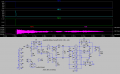
while simulating large caps at LTspice may induce ULF oscillations ← not comfortable to be tracked at transient run cos the transient run is diferential integration
► you can swap the switching mosfets with voltage controlled switches . . . for idealized circuit responce . . .
. . . if the caps had different I&O ports you might try something that allows simultaneous transfer start (← a speculation)
. . . IF the drains of consequential switches (S₁₃ , S₂₁) S-caps are shorted ← induces you have a series stack of S-caps & you CAN NOT have 2 of them connected to your "charge transfer buffer" at the same time window ← and they likely need a signifficant delay in between that
▲ you still may want to rework your concept
also excessive currents (energy) at S-caps induces switching artefacts ~ which even if sucessfully damped would make the simulation a painful waiting
you likely like to reduce your S-caps to milli-F range and perhaps limit the currents . . .
? at #5 "the highest voltage > rated voltage" ← sounds like a fault condition ?
? what would be the peak current load for D₂ʙ? , ?D₂ᴀ ← those things have reverse current and may get faulted to a short . . .
otherwise
your supposedly limitting LC "charge transfer buffer" has a reactance = if the coil is still "busy" ripping the charge from the source it won't transfer it to lower voltage super cap . . . i mean you might want to change the concept
also
while simulating large caps at LTspice may induce ULF oscillations ← not comfortable to be tracked at transient run cos the transient run is diferential integration
► you can swap the switching mosfets with voltage controlled switches . . . for idealized circuit responce . . .
. . . if the caps had different I&O ports you might try something that allows simultaneous transfer start (← a speculation)
. . . IF the drains of consequential switches (S₁₃ , S₂₁) S-caps are shorted ← induces you have a series stack of S-caps & you CAN NOT have 2 of them connected to your "charge transfer buffer" at the same time window ← and they likely need a signifficant delay in between that
▲ you still may want to rework your concept
also excessive currents (energy) at S-caps induces switching artefacts ~ which even if sucessfully damped would make the simulation a painful waiting
you likely like to reduce your S-caps to milli-F range and perhaps limit the currents . . .
L and C are series resonant tank.
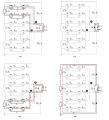
This is the whole idea. One supercapacitor transfer its charge to the tank based on the decision in the flow chart. The charge get transfers to other with low supercapacitor based on the flow chart. Then, the corresponding switches get activated.
It's an active balancer. Basically it transfers energy from the highest voltage source to the lowest. The one I built doesn't have a resonant tank like this though, it's more like a buck converter where one set of switches select/switch the source cell and another set pass through to the destination cell. When the differential reaches a small enough value, system moves on to the next suitable pair.
It's an active balancer. Basically it transfers energy from the highest voltage source to the lowest. The one I built doesn't have a resonant tank like this though, it's more like a buck converter where one set of switches select/switch the source cell and another set pass through to the destination cell. When the differential reaches a small enough value, system moves on to the next suitable pair.
. . . it is that small inductors with fast switching and large electrical capacities
are prone to HF/UHF oscillations
also the spice tends to fail it's energy conservation at fast di/dt dv/dt cases
--means--
your thing is demanding expert level task to cope with . . .

 Facebook
 Google
 GitHub
 Linkedin