Is older manual PCB layout possible with modern software

Thread Starter

oh_uh_okay

Joined Aug 24, 2025
48
Take a look at this PCB from a 1970s era audio amplifier.
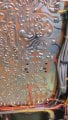
dark-spot-on-pcb-v0-fxv1a6dzl4rf1.jpg

Compared to modern PCBs ... Note the curves and "organic" traces -- among myriad other differences -- that are present in the hand-drawn layout.

Vintage audio and electronics gear have a niche following. Preserving the original aesthetic is important. And that comes down to the inside stuff like metal capacitor cans, etc.
I have not seen anyone attempt to duplicate the original hand-drawn PCB with modern software like Altium .
Is there a "hand-drawn" option or plug-in avail. for modern layout software?
 

Ian0

Joined Aug 7, 2020
13,112
If you were to use Kicad, you could draw filled areas to join all the pads together. Those filled areas can have bezier curve outlines, so, yes, it is possible, but only you can say if it is worth the effort.
 

schmitt trigger

Joined Jul 12, 2010
2,053
It is nostalgic, for sure.
I drew a few myself using Bishop Graphics templates on tracing paper at 2X the size.

Not fun nor easy when a correction was required. Rather, one would use deadbugs like the resistor on the shrink tubing shown in your photo.
 

ronsimpson

Joined Oct 7, 2019
4,660
KiCAD curved traces
Here is a video. He shows several different ways. One way he did not get to work well I did make work. (second method)
Here is one way. See curve traces starting at the left side.
1758836377371.png

I think is method 3:
1758836500388.png
Here is the way he did not like but I made it work. I just can't remember how.
1758836603463.png
 

Thread Starter

oh_uh_okay

Joined Aug 24, 2025
48
Yes, I have noted other KiCad endorsements for such projects.

Since many of these older PCBs were simple (ie. only trace side and component side), and since one can obtain vintage serv. manuals (or even photograph the PCB) ... and then use that image to generate the final PCB .... that might work. But how much work ... at least initially, until one learns some routines and shortcuts?

And I'm not sure how many PCB fab houses (PCB Way, etc) would be able to accept such files?
 

Thread Starter

oh_uh_okay

Joined Aug 24, 2025
48
I think is method 3:
Yes, and the flow of the hand-drawn approach make one wonder if there may not be an EE advantage to " organic" traces over CAD ? That is, sharp CAD corners and angles can add more emission surfaces, and may even add trace length.
 

Ya’akov

Joined Jan 27, 2019
10,226
Welcome to AAC.

The appearance of old boards is an artifact of the layout and production techniques of the time. It certainly had advantages in that environment but these were not based on the physics of the traces.

Modern PCB design routinely deals with frequencies where things like right angles and trace length make a material difference and they are accounted for in highly optimized ways.

Imagining that the old-style trace geometry has some unnoticed advantage feels very much akin to things like $1000.00 oxygen free power cords and Ethernet cables. It is certainly not at the magical thinking level of those things, but it is looking to imbue something that was necessity of the time with magical properties.

Please don't think I am suggesting you are in the hifi crank portion of the population, I am just noting the slippery slope of looking for something that might be there instead of looking for an explanation for some practical, measurable difference. It is the stuff of marketing rather than engineering, and in the "audiophile"* community the two are inextricably linked.

*I put audiophile in scare quotes because the original meaning of the word has long since been swamped by the realities of the self-named group. Something like "arcaniphile", that is a "lover of the arcane" might be more accurate because it is very clear that the love of [accurate reproduction of] sound is not the identifying characteristic any longer.
 

Thread Starter

oh_uh_okay

Joined Aug 24, 2025
48
I'm pretty sure much of the PCB layouts for WW2 radars, Sputnik, and Project Mercury and Gemini were "hand jobs". And Brain Jobs.

Today, Altium. Next year, Grokium.

We're on a roll, folks.
 

panic mode

Joined Oct 10, 2011
4,915
i have not seen software that can do "organic" connections like that. those were done by hand. They may look interesting but one should keep in mind that they were done manually and that means without any DRC. for example there is no check if the traces are wide enough (some spots may be too narrow), there is no check if the clearance between adjacent tracks is meeting minimum design requirements etc.
wider areas around solder pads are helpful on ancient PCBs because adhesive holding copper on board was not very strong, this technique also did not use plated through holes so larger areas improved structural integrity. today one would use copper pours to fill the areas.
There is a reason nobody designs PCBs that way any more (even if cost of labor was not considered). so, for the moment, i cannot think of any advantage of designing boards using that approach:
- slow (manual)
- no design rules check
- no vias (and no multilayers)
- no solder mask,
etc.

modern tools tend to have bunch of options like teardrop pads, rounded tracks etc. i am sure someone could make plugin to make boards look like that.

btw. not sure what went wrong with rounded tracks in #6. anything i tried came out way smoother and without any effort on my side. the conversion is done in a fraction of a second. maybe it is just newer plugin version.
1758892752899.png
1758893130829.png
 
Last edited:
Top