Plug-in balcony solar...

Thread Starter

Externet

Joined Nov 29, 2005
2,682
It wants to be the next trend. What is your opinion ?
Mine derives from 'if the utility allows it, is beneficial for the utility' not for the user, from what I understand.

The system uses solar panels ----> to a DC to 120VAC inverter feeding mains ----> into a dwelling outlet to power loads.

Missing here :

- Supplies power to neighbors too.
- The utility billing the neighbors for energy they use and your balcony generated.
- The utility does not need to invest in more generation equipment nor maintenance.
- Some bad accidents will happen from falling equipment as gravity is always on.
- Do no work while an outage, your 'balconied' system will be off.
- If has batteries, will not store sheet if charged, but did cost your money
- If has batteries, cannot provide power to the dwelling anyway.
 

Jerry-Hat-Trick

Joined Aug 31, 2022
865
I don’t blame you for being skeptical. I do wonder about the payback based on current pricing which is still too high. For safety, it has to see that mains power is actually on, and as with all grid tie inverters it locks itself onto the phase it sees

But for a naughty work around, how about a small battery driven inverter which generates a 50 or 60 Hz mains voltage signal which tricks the solar system into delivering power? Crucial that the mains supply is disconnected, so too dangerous for most people, but suppose you are off grid anyway?
 

nsaspook

Joined Aug 27, 2009
16,539
It wants to be the next trend. What is your opinion ?
Mine derives from 'if the utility allows it, is beneficial for the utility' not for the user, from what I understand.

The system uses solar panels ----> to a DC to 120VAC inverter feeding mains ----> into a dwelling outlet to power loads.

Missing here :

- Supplies power to neighbors too.
- The utility billing the neighbors for energy they use and your balcony generated.
- The utility does not need to invest in more generation equipment nor maintenance.
- Some bad accidents will happen from falling equipment as gravity is always on.
- Do no work while an outage, your 'balconied' system will be off.
- If has batteries, will not store sheet if charged, but did cost your money
- If has batteries, cannot provide power to the dwelling anyway.
Utilities have been fighting it nationwide with IMO mainly bogus fears like you listed above. There is a huge surplus of panels and PV electronics from China. This trend (It's only a new trend in the USA) is IMO driven by that market.

There are worse things to spend your money on, with energy prices increasing, while PV systems are decreasing in price. For me it's been a engineering learning experience hobby building hybrid (on/off grid systems with energy storage) systems so I happy it's going official here like in the EU.
1791229862985.png
1791230319321.png
1791230435648.png
1791230892544.png

https://www.kqed.org/science/200212...olar-opening-the-market-to-the-new-technology

The device is a twist on rooftop solar: smaller, portable, and relatively inexpensive.

Balcony solar kits consist of just a few panels, an inverter that converts solar energy into the kind used in a home, and cables. In places where the technology is popular, like Germany, it can be plugged into a standard wall outlet.
The new law comes as Californians struggle to pay outsized electricity bills, which have risen substantially in recent years. Plug-in devices open the solar market to renters, people with unsuitable roofs, and those without the money to invest in a rooftop system.
 
Last edited:

crutschow

Joined Mar 14, 2008
38,948
It wants to be the next trend. What is your opinion ?
It's an interesting and relatively easy way to add a small amount of solar power to your home.
The caveat is that under rare circumstances, such a plugging two 15A loads into the same circuit along with the solar inverter and, depending on relative location of the sockets in the circuit, the AC circuit breaker might not detect the wire overload, thus giving the potential for an electrical fire.
But since there are few appliances that draw high current continuously besides electrical heaters, I don't think that's something to really worry about.
The utility billing the neighbors for energy they use and your balcony generated.
You utility meter should be configured so outgoing energy is subtracted from your total usage, but don't know if that's standard.
 

Jerry-Hat-Trick

Joined Aug 31, 2022
865
I think the way they work in the UK is that if you are using power the solar power will be used first but if it’s insufficient then the mains supply will make up the difference. But you get no benefit from power you may be feeding back into the mains. In other words, your meter, if it was the old style electromechanical meter, would not turn backwards. It may be different in other countries.
 

crutschow

Joined Mar 14, 2008
38,948
I looked at some of those balcony panels, but the cheapest I found would still have a payback time of 4-5 years at the electricity costs here in Colorado, and that's too long for me, since there's no guarantee they would even last that long.
 

Thread Starter

Externet

Joined Nov 29, 2005
2,682
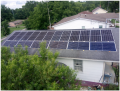
My 7 KW residential grid-tied photovoltaic paid itself in 3.0 years. (No financing, no studies, no experts, no comisions, no transportation, no installation, no wiring)
To this moment I have paid $0.00 monthly electricity for 5+ years. This thread is for asking your opinion. I do not need at all to add any trendy 'balcony' system nor have "mainly bogus fears" I lost track of the local electrical rates as the credit I get is at the same rate my consumption is for the next 20 years when I will be under ground.
I also have 33 - 400W panels =13KW I have no south roof room for, nor balconies. :confused: But not much advantage installing as addition because generating more KWh per year than I consume per year makes no sense.

1791241630393.png
 

WBahn

Joined Mar 31, 2012
33,349
It wants to be the next trend. What is your opinion ?
Mine derives from 'if the utility allows it, is beneficial for the utility' not for the user, from what I understand.

The system uses solar panels ----> to a DC to 120VAC inverter feeding mains ----> into a dwelling outlet to power loads.

Missing here :

- Supplies power to neighbors too.
- The utility billing the neighbors for energy they use and your balcony generated.
- The utility does not need to invest in more generation equipment nor maintenance.
- Some bad accidents will happen from falling equipment as gravity is always on.
- Do no work while an outage, your 'balconied' system will be off.
- If has batteries, will not store sheet if charged, but did cost your money
- If has batteries, cannot provide power to the dwelling anyway.

My 7 KW residential grid-tied photovoltaic paid itself in 3.0 years. (No financing, no studies, no experts, no comisions, no transportation, no installation, no wiring)
To this moment I have paid $0.00 monthly electricity for 5+ years. This thread is for asking your opinion. I do not need at all to add any trendy 'balcony' system nor have "mainly bogus fears" I lost track of the local electrical rates as the credit I get is at the same rate my consumption is for the next 20 years when I will be under ground.
I also have 33 - 400W panels =13KW I have no south roof room for, nor balconies. :confused: But not much advantage installing as addition because generating more KWh per year than I consume per year makes no sense.
View attachment 371985
Many of your objections, such as it supplies power to the neighbors, or the utility billing the neighbors for energy the use and your system generated, or the utility does not need to invest in more generation or maintenance, gravity still applying, or not working while an outage. Those all apply to your rooftop system, as well. Yet you seem to be of the opinion that your rooftop system isn't just beneficial for the utility. Your position appears to be that, since you've concluded that it makes no sense for YOU, that it therefore doesn't make sense, period.

On top of that, some of your points are red herrings. You make it sound like someone with a balcony panel is generating electricity that they are giving to the utility for free and then the utility is selling it to your neighbor. Nothing is further from the truth. Any power that is generated by the user above what they are using at that moment is purchased by the utility. They PAID for it. They then sold it to your neighbor at the SAME RATE that they purchased from you. So the utility made NOTHING off of it. In fact, they are losing money because they are having to cover the lines losses between your and your neighbor.

Beyond that, you are proud of the fact that you haven't paid a dime to the utility in five years. So who is paying for maintaining the grid that services your house and that you need in order for your grid-tied system to work? Your neighbors are subsidizing YOU because their rates are higher because they have to pay your share of those costs.

As with all things, what makes sense for one situation may not make sense for another. That goes for rooftop, it goes for balcony, it goes for grid-tied, it goes for off-grid. What makes sense in one part of the country may not make sense in another part. Regulations vary, insolation varies, rates vary, billing tiers vary, costs vary.

Would you have paid to put all those panels on your roof if you were renting the house? Would you have paid to put up panels on the roof of the building where you owned a condo?
 

MisterBill2

Joined Jan 23, 2018
28,607
I would certainly NOT call the array shown in post #7 a "balcony array" at all. It is far more than that!! The math is fairly straightforward: How many watts (WATT-HOURS) would the balcony array provide, for how many hours each day, versus how much your local utility charges per watt hour.
IFF a solar cell array would charge baatteries to provide power when the local utility was not providing power, that is a different consideration.

BUT if the balcony system must see mains power to deliver any power, that is a "show-stopper flaw" in the product, as I see it.

Any power generation system must be able to serve as a replacement, either temporary or full time. I doubt that the cost of a small system (balcony sized) would provide a payback in a reasonable time for me, and certainly it would not be able to power our heating system
(controls and blower motor) during the winter months, even with a reasonable battery array.
What would be quite educational for many of the folks who follow these threads are some descriptions of solar cell systems that DO provide the only power for some residence. Not a collection of screen-shots .
 
Last edited:

WBahn

Joined Mar 31, 2012
33,349
No one is saying that the system in Post #7 is a balcony system. It's the TS's existing rooftop system. I hardly think the TS would be of the opinion that balcony systems only offer benefits to the utility if they had such a system that paid for itself in just three years and had resulted in them not paying any electrical bill to the utility in five.

Balcony systems are not intended deliver power when there is a power outage. The simple fact that they plug into an existing outlet makes that unacceptable from a safety standpoint. Would you like to be a linesmen working on a down powerline that was being energized to 13 kV or so because someone has a solar system plugged into an outlet? And the same is true with the significant majority of rooftop solar installations.
 
The ONLYreason I would have my own solarcell system of any rating is if it replaced my grid connection entirely.
BUT in my situation that could not happen. Not enough room for an adequate cell array. For those who do have a system that is a substitute, CONGRATULATIONS!!! Energy independence! For me it does not make economic sense, even if I do every bit of the install myself. My problem not your problem.
 
in europe , we have digital electric meteres,
you pay one price for the amount you import, you get about 1/4 of that rate for what you export,
most of europe does not allow plug in batteries .
obviously, its best to use the energy you generate yourself.
but the prices of the plug in panels and inverteres are about twice what they need to be to be cost effective
 

Thread Starter

Externet

Joined Nov 29, 2005
2,682
in europe , we have digital electric meteres,
you pay one price for the amount you import, you get about 1/4 of that rate for what you export,
most of europe does not allow plug in batteries .
obviously, its best to use the energy you generate yourself.
but the prices of the plug in panels and inverteres are about twice what they need to be to be cost effective
It is all about ripoff the user. Am lucky I got 100% of the rate for my generation for the next 20 years. Now they are down to 72%. Yes, consume as much as you can generate.
Plug-in-balconies are another ripoff strategy for the utility and vendors to cash from your generation.
 
Certainly the solar power generating systems I HAVE SEEN have been "rather costly", to put it in polite words.
Considering how reliable and stable my present power utility has been, the price is OK, I guess. At least I can afford all that I use, and I never need to do any repairs or maintenence on it.
 

WBahn

Joined Mar 31, 2012
33,349
It is all about ripoff the user. Am lucky I got 100% of the rate for my generation for the next 20 years. Now they are down to 72%. Yes, consume as much as you can generate.
Plug-in-balconies are another ripoff strategy for the utility and vendors to cash from your generation.
How is the utility cashing in on your generation? If you don't generate, you have to pay them for everything you consume. If you do generate, they don't get that revenue, but they still have to maintain the infrastructure to provide service to you.
 
How is the utility cashing in on your generation? If you don't generate, you have to pay them for everything you consume. If you do generate, they don't get that revenue, but they still have to maintain the infrastructure to provide service to you.
With plug in systems , the excess you don't not use is sent back to the grid , nominally for free.
 

WBahn

Joined Mar 31, 2012
33,349
With plug in systems , the excess you don't not use is sent back to the grid , nominally for free.
Very few plug-in balcony systems produce enough power to reduce your current usage to a negative value, but even if they do, almost all residential meters, even the old electromechanical ones from the middle of last century, measure net real power, so you receive credit for whatever power you send out to the grid at the same rate you pay for power you use, up until you total energy usage for the entire billing cycle is negative, at which point most utilities continue to credit you for the energy you supply, but at the significantly lower rate that they purchase power from wholesale supplies.
 
Very few plug-in balcony systems produce enough power to reduce your current usage to a negative value, but even if they do, almost all residential meters, even the old electromechanical ones from the middle of last century, measure net real power, so you receive credit for whatever power you send out to the grid at the same rate you pay for power you use, up until you total energy usage for the entire billing cycle is negative, at which point most utilities continue to credit you for the energy you supply, but at the significantly lower rate that they purchase power from wholesale supplies.
The old meters are long gone in Europe
Yes they used to rotate backwards if you exported , but even the rotating new ones have a anti reverse action
You need to have one of the modern digital meters in Europe to be paid to export electricity, then you get different rates for import and export.
 
Top