Piezo Transducer Driver Circuit

Thread Starter

h.yakub

Joined Mar 11, 2019
97
Knock is produced by transducer (alone pulse).
Signal after knock, received by transducer,
processed by program (Fast Fourier Transform, FFT).
Hence you can draw conclusion about fluid level.
Yes, I am following the same procedure, the only problem is Knock is produced by the transducer, but signal after knock is no received by the transducer...If I had received the signal after knock, we wouldn't be having this discussion right now..:-D
 

Danko

Joined Nov 22, 2017
2,169
Yes, I am following the same procedure, the only problem is Knock is produced by the transducer, but signal after knock is no received by the transducer...If I had received the signal after knock, we wouldn't be having this discussion right now..:-D
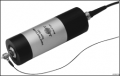
Your setup is good, but you should use low frequency, wideband, non-resonant transducer.
For experiment you can try electrodynamic loudspeaker as transducer:
upload_2019-3-16_2-35-25.png
 

ericgibbs

Joined Jan 29, 2010
21,448
Hi EricGibbs,
Did you find any solution for detecting echo through 1 MHz piezo...?
Hi,
The way I recommended would be to increase the drive to the piezo, either by a tuned step up transformer in the MOSFET driver or increase the drive voltage, which would mean a higher voltage rated MOSFET.
My choice would be a transformer and time swept gain and TXP suppression.

E
 

Thread Starter

h.yakub

Joined Mar 11, 2019
97
Hi,
The way I recommended would be to increase the drive to the piezo, either by a tuned step up transformer in the MOSFET driver or increase the drive voltage, which would mean a higher voltage rated MOSFET.
My choice would be a transformer and time swept gain and TXP suppression.

E
Hi EricGibbs,

Based on your suggestion, I have done some changes in the TX circuit. I am sharing the .asc file, please check and provide your inputs in it.
 

Attachments

ericgibbs

Joined Jan 29, 2010
21,448
hi,
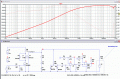
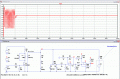
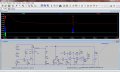
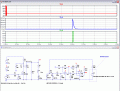
Look at the Transient response and AC Analysis of your circuit.
The power in the PZ is much too low and the resonant frequency is approx 400MHz.
This is due to the incorrect design of the transformer.

Also you have changed the resistance of the piezo from 2R to 25R, this will give you incorrect results in simulation.
E
 

Attachments

Thread Starter

h.yakub

Joined Mar 11, 2019
97
hi,
Look at the Transient response and AC Analysis of your circuit.
The power in the PZ is much too low and the resonant frequency is approx 400MHz.
This is due to the incorrect design of the transformer.

Also you have changed the resistance of the piezo from 2R to 25R, this will give you incorrect results in simulation.
E
Hi,

Can you update the design file and send it to me, accordingly, I guess I am not quite yet familiar with designing transformer ;-)
 

Thread Starter

h.yakub

Joined Mar 11, 2019
97
hi,
You have the supplies +v and v+ , they must be the same.!
Also why have you changed the simulated Echo source.?
E
Yes, Thanks for pointing out the v+ and +v confusion.
I have changed the simulated echo because it is similar to what I am observing through oscilloscope....
 

Thread Starter

h.yakub

Joined Mar 11, 2019
97
hi,
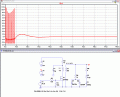
Try this latest version.
Note: on the real version you may have to add some damping on the pz line to 0V, its shown as R11 on this circuit.

E
Hi Eric,
Why don't we use sine wave as simulated echo signal, rather than using a pulse signal, because the nature of the echo that I am seeing is very close to sine wave signal rather than a pulse signal..?
 
Top