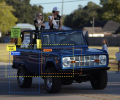
I can't decide if this Bronco looks like a toy or if my picture makes it look like a toy.
If it's the latter, how did I manage to do it? How can I do it again on purpose?
I can't decide if this Bronco looks like a toy or if my picture makes it look like a toy.
If it's the latter, how did I manage to do it? How can I do it again on purpose?
I can't decide if this Bronco looks like a toy or if my picture makes it look like a toy.
If it's the latter, how did I manage to do it? How can I do it again on purpose?
You (accidentally) created a tilt-shift effectbecause of the angle and shallowness of the limited DoF. Tilt refers to altering the focal place of the image by tilting the lens, and shift refers to shifting the lens relative to the focal plane of the sensor (up, down, left, right) which affects the perspective.
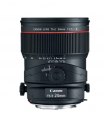
There are lenses specifically designed to produce a controlled version of this. This Canon TS-E 24mm /3.5L II is an excellent example. It's about 1900 bucks.
Another way to achieve this in camera is to use a view camera. The focal place of a view camera can be moved in a method called tilt-swing which is very similar to the tilt-shift lens. The addition of the bellows allows for even more adjustment. View cameras a fantastic pieces of kit, and you can get one used for a decent price, but the lenses will cost you quire a bit, and it's a serious rabbit hoie.
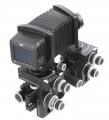
This Sinar Braun M3 is one I have worked with. It's fantastic. View cameras are generally very modular with lens boards that are fitted to the front of the camera and film backs that go on the rear. Of course today there are also digital backs. You can get an idea from the photo just how adjustable the whole thing is.
This sort of camera is very popular among top car photographers since it can be adjust so the focal place is parallel to the side of the car and so the depth of field is "into" the car rather than along it. This allows a front to rear in-focus shot, something a conventional camera can't match.
Of course, there is also digital manipulation that can achieve a limited version of tilt-shift in post processing. It can sometimes be very successful but can also take some skill to adjust so it looks convincing. Search for "tilt shift photography" for a lot of (good and bad) examples!
You (accidentally) created a tilt-shift effectbecause of the angle and shallowness of the limited DoF. Tilt refers to altering the focal place of the image by tilting the lens, and shift refers to shifting the lens relative to the focal plane of the sensor (up, down, left, right) which affects the perspective.
There are lenses specifically designed to produce a controlled version of this. This Canon TS-E 24mm /3.5L II is an excellent example. It's about 1900 bucks.
Another way to achieve this in camera is to use a view camera. The focal place of a view camera can be moved in a method called tilt-swing which is very similar to the tilt-shift lens. The addition of the bellows allows for even more adjustment. View cameras a fantastic pieces of kit, and you can get one used for a decent price, but the lenses will cost you quire a bit, and it's a serious rabbit hoie.
This Sinar Braun M3 is one I have worked with. It's fantastic. View cameras are generally very modular with lens boards that are fitted to the front of the camera and film backs that go on the rear. Of course today there are also digital backs. You can get an idea from the photo just how adjustable the whole thing is.
This sort of camera is very popular among top car photographers since it can be adjust so the focal place is parallel to the side of the car and so the depth of field is "into" the car rather than along it. This allows a front to rear in-focus shot, something a conventional camera can't match.
Of course, there is also digital manipulation that can achieve a limited version of tilt-shift in post processing. It can sometimes be very successful but can also take some skill to adjust so it looks convincing. Search for "tilt shift photography" for a lot of (good and bad) examples!
This is all very interesting and I can hear the rabbit hole calling to me. I don't understand how it could have happened with a regular camera (Canon 5D Mk II) and lens. My wife was using the camera around the same time and complained that the auto focus wasn't working and I found the lens was not fully seated; just turned it until it clicked and then it worked. Maybe that is one she took while the lens was about to fall off.
This is all very interesting and I can hear the rabbit hole calling to me. I don't understand how it could have happened with a regular camera (Canon 5D Mk II) and lens. My wife was using the camera around the same time and complained that the auto focus wasn't working and I found the lens was not fully seated; just turned it until it clicked and then it worked. Maybe that is one she took while the lens was about to fall off.
Here’s my analysis. I think you can attribute it to two things:
1. The wide lens (<50mm) which is not our visual perspective. A 50mm lens on a full frame sensor is about the normal field of view for a human, hence normal lens. This accomplishes enough of a shift that combined with;
2. A chance arrangement of specular reflective surfaces fooling the eye about the about the focal plane of the camera. With the lens wide open creating a narrow DoF, there is a difference between was is actually in focus and what appears to be. DoF is about acceptable sharpness. No matter how wide your aperture there is only one point that is maximally sharp. But we accept a range of sharpness as “in focus” so...
looking at the photo, we can see the in focus area (orange) is the front passenger side of the vehicle, centered around the headlight. But, thanks to the specular reflections of the nicely waxed body panels, an area of the right rear quarter panel appears in focus (blue). The specularity of the wheel, and the lack of detail in the tire due to shadow, add to the impression.
The area above is in the same focal plane, and it’s very clearly not in focus (green). This is just as sharp as body and wheel, but they look sharper. This creates an apparent focal plane (yellow) which, combined with the perspective shift, makes it look like a miniature in the way that tilt-shift photography does.
Picture of a young she llama taken in the vicinity of Susques, located well in the North of Argentina (Jujuy province) quite close to the border with Chile some 3.900 m above sea level. The village is located in way of Route 40, going from the very South to the very North of the country.

 Facebook
 Google
 GitHub
 Linkedin