As a complete novice in this realm, I'm willing to consider your expertise.
What parameters are important to match, under what conditions, and how closely?
And, having put in the effort, what performance improvements will it buy me? Will I notice a difference (I am not an audiophile, and my ears don't hear high Hz anymore)?
Without a full fledged curve tracer, what you could realistically achieve with a static Hfe measurement would be to closely match (or as close as possible) the gains, which would result in the collector currents to be as similar as possible.
Why is this important? For self heating reasons: the transistor drawing the larger current will heat more. With the additional aggravation that the more that a bipolar transistor heats up, the current draw increases. This could lead to, depending on the initial imbalance, to an eventual thermal runaway.
Without a full fledged curve tracer, what you could realistically achieve with a static Hfe measurement would be to closely match (or as close as possible) the gains, which would result in the collector currents to be as similar as possible.
Why is this important? For self heating reasons: the transistor drawing the larger current will heat more. With the additional aggravation that the more that a bipolar transistor heats up, the current draw increases. This could lead to, depending on the initial imbalance, to an eventual thermal runaway.
They won't be matched by either Motorola or Peavey, they will be selected for gain.
A bipolar transistor is a voltage controlled device, so the amount of base current it requires for a certain level of collector current is irrelevant, provided it is not more that the driver stage can supply. I doubt Peavey would reject transistors with too much Hfe.
The relationship between Vbe and Ic is important, but local feedback via the emitter resistor mostly deals with discrepancies in Vbe. So reasonably close Vbe matching will help. Being from the same batch is likely to be good enough - I can't imagine the man-hours Peavey would have to spend grouping output transistors into sets of three. The management would soon be on to the engineers for a design that doesn't need it. However, having all three transistors at the same temperature is important.
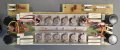
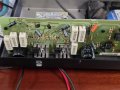
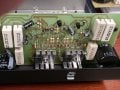
I got the whole thing apart now. Here's a photo of the top side of the board:
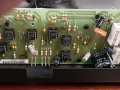
I circled the telepathic thermal link diodes. The bodies of the diodes are installed vertically into the bulk of the heat sink. There is no thermal compound, best I can tell.
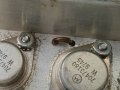
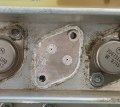
Mica insulators (and insulating shoulder washers inserted from the other side of the heatsink):
I'm going to buy 10 ea. of MJ15024G and MJ15025G from Mouser, about $120 USD with shipping. I'll measure what I can, and choose the best 12 out of 20.
Do I re-use the old mica insulators, or buy new ones? Can I replace them with TO-3 Sil-Pads and eliminate the compound mess? Or, is this a case where it's best to keep it numbers-matching factory original?
The fuses (4) are 314 series. I found exact replacements.
You can re-use them, but there are better alternatives in the form of polymer insulators. They aren’t brittle like the mica ones, and its thermal conductivity is so good that in most applications it can be used without the messy grease.
Grease can be used but the improvement is small.
See attached photo for a sample.
There may be a driver of the same package with different part number.
Make sure all has the same pair numbers
Edit: I guess all are same pairs.
May be the drivers are on the other PCB.
Don't just replace them and power up. Need to check other components and biasing.
Might need to setup a test jig to limit the current for proper testing
I circled the telepathic thermal link diodes. The bodies of the diodes are installed vertically into the bulk of the heat sink. There is no thermal compound, best I can tell.
I'm going to buy 10 ea. of MJ15024G and MJ15025G from Mouser, about $120 USD with shipping. I'll measure what I can, and choose the best 12 out of 20.
Do I re-use the old mica insulators, or buy new ones? Can I replace them with TO-3 Sil-Pads and eliminate the compound mess? Or, is this a case where it's best to keep it numbers-matching factory original?
The fuses (4) are 314 series. I found exact replacements.
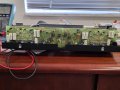
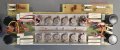
This look like peavey series power amp PCB.. I see these in there music power amps around 2kW ones or so. Same brand.. No wonder they use the same topology. These are very good amps
I edited ( added ) the post after seeing the picture. All power drivers are same pairs.
The power stage comes after voltage amp drivers. ...These also develop faults when the power stage blows, at times
I edited ( added ) the post after seeing the picture. All power drivers are same pairs.
The power stage comes after voltage amp drivers. ...These also develop faults when the power stage blows, at times
Here are my few cents.
I do not replace all power transistors after fixing. I just put one pair and test for issues with a scope or DMM for bias issue after warm up time.
If there is an issue I do not blow the complete stage put just a used pair.
I put a low value resistor in power rail DC path instead of fuses. ( If the fuses are after the rectification. If fuses are in AC path then no use in resistor usage )
This will protect and limit current if issue is there.
No shorts C to E, and good Vbe on all 4. Two thermal switches mounted on the TO-3s read closed. One on opposite side of board mounted to middle of heat sink reads closed.
That's why they didn't save your expensive power transistors.
They have to be rated so that they don't blow on the inrush when the capacitors charge, so they are too large,
They would have done a little better using a lower value of Time-delay fuse, or much better if they were after the capacitors.
The counter-argument is that they wouldn't fail in the event of a rectifier or capacitor short, but almost certainly the transformer primary fuse would.

 Facebook
 Google
 GitHub
 Linkedin