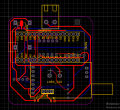
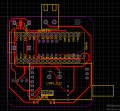
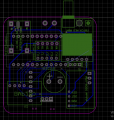
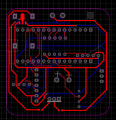
PCB design for rocket

ronsimpson

Joined Oct 7, 2019
4,664
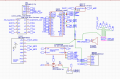
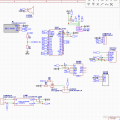
You have a nasty mix of 3.3V and 5V signals. Did you look at each datasheet to see who can work at 5V and who can work at 3.3V? Some parts can live on 3.3V and work with 5V signals. Most parts can live on 5V and work with 3.3V signals.
Example: the BMP280 runs at 5V but talks directly to the Arduino.
I wish there was a way to not use the Level Converter.

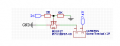
I think the MOSFET circuit needs rethinking. Please tell us what is happening there. I think there are many problems there.
D10 is probably at "tri-state" at power up. It is not good to not know what voltage is on the Gate.
What is "KLBMENS"
What is the "+" and "-" voltage? What is "XL4005" and is Pin-1 and Pin-3 connected together?

Add capacitors at the power supply pins of all parts.

It does not matter but most of us would rename all GNDs to GND. Also, there are many 5V_something that could be 5V.

There are several I2C busses on the board. Is there a reason they are not all connected together as one bus?
On a I2C bus there are normally two pull up resistors.
 

sghioto

Joined Dec 31, 2017
8,634
What is the input voltage on the buck converter?
Is the purpose of the mosfet, to fire an ejection charge? If so the configuration is incorrect?
Is the Nano running on 5 volts?
Has any of this design been tested?
 
Last edited:

Thread Starter

YUCE

Joined Jan 10, 2026
22
Forum Post Draft (English)
Subject: TEKNOFEST Rocketry Project - Flight Computer Design Update & Feedback

Post Content: "Hi everyone, I am a high school student currently designing a flight computer for this year's TEKNOFEST rocketry competition. As I am relatively new to PCB design and electronics, I have been carefully studying data sheets and incorporating feedback from experienced members.

Based on previous suggestions, I have made several critical updates to my design:

  1. Power Stability: I added a 470uF electrolytic capacitor near the LoRa module to handle peak current draws and 100nF ceramic decoupling capacitors to all IC power pins to filter high-frequency noise.
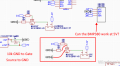
  2. Logic Level Shifting: Since the u-blox NEO-M8 and E22 LoRa modules operate at 3.3V logic, I implemented voltage dividers/logic level shifters between them and the 5V Arduino Nano to prevent overvoltage damage.
  3. MOSFET Configuration: I corrected the IRFU120 MOSFET pinout (Gate-Drain-Source) and added a 10k pull-down resistor to the Gate to prevent accidental triggering during startup.
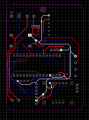
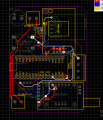
  4. Trace Widths: I increased power trace widths to 0.8mm and the pyro/ignition trace to 2mm to safely handle the high current during recovery deployment.
I would appreciate it if you could review the final state of my design. I have also provided answers to some specific technical questions below."

Technical Q&A (Answers to the Forum Members)
1. What is the input voltage on the buck converter? The input voltage will be supplied by a 2S or 3S LiPo battery (ranging from 7.4V to 12.6V). The XL4005 buck converter steps this down to a stable 5V for the system.

2. Is the purpose of the mosfet to fire an ejection charge? If so, the configuration is incorrect? Yes, the MOSFET is intended for firing the ejection charge. It is configured as a Low-Side Switch. The igniter is connected between the Battery Positive (+) and the MOSFET Drain. The MOSFET Source is connected to the common GND. With the corrected G-D-S pinout and the pull-down resistor, the configuration is now standard for this application.

3. Is the Nano running on 5 volts? Yes, the Arduino Nano is powered by 5V from the regulator. However, as mentioned, logic level conversion is used for the 3.3V peripherals (GPS and LoRa) to ensure hardware compatibility.

4. Has any of this design been tested? The individual modules and the ignition circuit have been verified on a breadboard. The integrated PCB design is currently being finalized for production. Once the PCBs arrive, comprehensive system-wide tests and vacuum chamber altitude tests will be conducted.

Sorry I am not so good at english for that I use some little gemini :)
What is the input voltage on the buck converter?
Is the purpose of the mosfet, to fire an ejection charge? If so the configuration is incorrect?
Is the Nano running on 5 volts?
Has any of this design been tested?
 

Thread Starter

YUCE

Joined Jan 10, 2026
22
You have a nasty mix of 3.3V and 5V signals. Did you look at each datasheet to see who can work at 5V and who can work at 3.3V? Some parts can live on 3.3V and work with 5V signals. Most parts can live on 5V and work with 3.3V signals.
Example: the BMP280 runs at 5V but talks directly to the Arduino.
I wish there was a way to not use the Level Converter.

I think the MOSFET circuit needs rethinking. Please tell us what is happening there. I think there are many problems there.
D10 is probably at "tri-state" at power up. It is not good to not know what voltage is on the Gate.
What is "KLBMENS"
What is the "+" and "-" voltage? What is "XL4005" and is Pin-1 and Pin-3 connected together?

Add capacitors at the power supply pins of all parts.

It does not matter but most of us would rename all GNDs to GND. Also, there are many 5V_something that could be 5V.

There are several I2C busses on the board. Is there a reason they are not all connected together as one bus?
On a I2C bus there are normally two pull up resistors.
 

sghioto

Joined Dec 31, 2017
8,634
4. Has any of this design been tested? The individual modules and the ignition circuit have been verified on a breadboard. The integrated PCB design is currently being finalized for production. Once the PCBs arrive, comprehensive system-wide tests and vacuum chamber altitude tests will be conducted.
Appears the circuit is good to go.
What country are you in?
Post the edited schematic.
 

Thread Starter

YUCE

Joined Jan 10, 2026
22
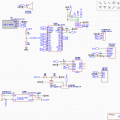
Thank you for your feedback. I have corrected the MOSFET circuit according to the proper configuration. Also, I would like to clarify that I am using the BMP280 (not the BMP380), and the module I am using is compatible with 5V input as it includes an onboard voltage regulator.
 

Attachments

Thread Starter

YUCE

Joined Jan 10, 2026
22
Thank you for your valuable feedback.
BMP280 Power & Logic: I am using a BMP280 module that is fully 5V compatible. It includes an onboard 3.3V voltage regulator and integrated 4.7k ohm pull-up resistors (marked as '472') on the I2C lines (SDA/SCL). This allows it to communicate safely with the Arduino Nano's 5V logic.
 

Irving

Joined Jan 30, 2016
5,070
Thank you for your valuable feedback.
BMP280 Power & Logic: I am using a BMP280 module that is fully 5V compatible. It includes an onboard 3.3V voltage regulator and integrated 4.7k ohm pull-up resistors (marked as '472') on the I2C lines (SDA/SCL). This allows it to communicate safely with the Arduino Nano's 5V logic.
How is this module attached to the PCB? Post a link to it.

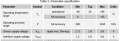
The IRFU120Pbf is a poor choice of MOSFET as it's Vgs is only spec'd at or above 4.5v. It'll probably work but for reliability you really need one spec'd at 2.5v. Don't look at the Vgs(th) parameter, instead look at the Id v Vds curves for each Vgs to see the lowest Vgs the device is spec'd for.

Personally I'd ditch the 5v Nano and go for a 3.3v one and keep to 3.3v throughout.
 

Thread Starter

YUCE

Joined Jan 10, 2026
22
How is this module attached to the PCB? Post a link to it.

The IRFU120Pbf is a poor choice of MOSFET as it's Vgs is only spec'd at or above 4.5v. It'll probably work but for reliability you really need one spec'd at 2.5v. Don't look at the Vgs(th) parameter, instead look at the Id v Vds curves for each Vgs to see the lowest Vgs the device is spec'd for.

Personally I'd ditch the 5v Nano and go for a 3.3v one and keep to 3.3v throughout.
Also, what altitude are you aiming for?
You're right. I've decided to switch to the IRLZ44N. We are aiming for 3500 m. We have L1256 rocket motor
 

Irving

Joined Jan 30, 2016
5,070
You're right. I've decided to switch to the IRLZ44N.
Good choice, but do you really need a big power MOSFET? What does the expected load look like?

Another thought: For your BMP280 to register external air pressure (presumably for altitude measurement), it, and it's PCB, must be open to the atmosphere. At 3500m the air temp is around -7degC, which means there is a high chance of condensation occurring on the PCB. What are your plans to combat that?
 
Top