PCB design for rocket

Thread Starter

YUCE

Joined Jan 10, 2026
22
The ignition sequence is expected to take approximately 300ms to 500ms from the moment the MOSFET is triggered until full parachute deployment. I will program the Arduino to keep the MOSFET gate HIGH for 2 seconds to ensure the e-match bridge wire completely initiates the black powder charge, regardless of minor variations in resistance or battery voltage.
How long does the ignition take, do you have any details?
 

Irving

Joined Jan 30, 2016
5,124
2mm tracks (assuming 1oz board) can handle 7A with some 37degC in temperature rise. with room temperature is 25degC, tracks would reach 62degC. that is blistering hot. better would be 4.5mm. or make sure that ignition tracks are really short and that ignition is only a short pulse.
Ambient will be around -7C at 3500m altitude, so 30C on track for a couple of secs isn't so bad.

Alternatively, if track is on outer layer, just solder some 16awg copper wire over the track to add some meat to it.
 
Last edited:

Irving

Joined Jan 30, 2016
5,124
The ignition sequence is expected to take approximately 300ms to 500ms from the moment the MOSFET is triggered until full parachute deployment. I will program the Arduino to keep the MOSFET gate HIGH for 2 seconds to ensure the e-match bridge wire completely initiates the black powder charge, regardless of minor variations in resistance or battery voltage.
I'd like to see some additional security around the igniter - it would be unfortunate if a glitch set it off prematurely.

Maybe 2 MOSFETs?
 

sghioto

Joined Dec 31, 2017
8,634
I honestly haven't seen a circuit using two triggers to fire a mosfet in these devices.
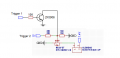
If I were to do this I would have a NPN transistor across the gate fully ON until ejection time.
1768355012322.png
 

Irving

Joined Jan 30, 2016
5,124
Another thought. How wedded to the Nano are you? There's a number of single board MCU out there that are physically much smaller than the Nano. Eg something from the Xiao Seeed stable, various ESP32-C3 boards and so on. Moving to one of those in a 14 or 16 pin wide-body DIP would save a lot of space and you could ditch the level-converter and buck-converter. Use a switch-mode 3-pin regulator direct from 7.4 to 3.3v. You wouldn't need a 6-layer or even a 4-layer probably. If I was doing this I'd probably go with a single chip MCU anyway, maybe one of the ATTiny range, more powerful than a Nano and a single 20pin 0.3" DIP chip instead of a 40pin 0.6" monster. Reliability increases hugely as you remove solder joints...

You don't need USB in flight!
 
Last edited:

Irving

Joined Jan 30, 2016
5,124
I honestly haven't seen a circuit using two triggers to fire a mosfet in these devices.
If I were to do this I would have a NPN transistor across the gate fully ON until ejection time.
View attachment 362021
That works too!

If you look at the trigger circuits in airbag control modules they often have dual control of the trigger, eg a P-ch above and an N-ch below the igniter, or some dual gate enabling arrangement.
 

Thread Starter

YUCE

Joined Jan 10, 2026
22
First of all, thank you again for your suggestions. I don't know much about whether 2 MOSFETs are very effective, but I think 1 MOSFET is enough. I decided to make the PCB board 4 layers; the top and bottom layers are for the signal, and the middle layers are for the firing line. I made both of them flat, and I think this eliminates the heating problem. As for the Nano, since we are a high school group, we don't know much about the others, so Arduino Nano is more suitable for us.
Ambient will be around -7C at 3500m altitude, so 30C on track for a couple of secs isn't so bad.

Alternatively, if track is on outer layer, just solder some 16awg copper wire over the track to add some meat to it.
I'd like to see some additional security around the igniter - it would be unfortunate if a glitch set it off prematurely.

Maybe 2 MOSFETs?
Meaning two in series?
Possibly, or a P-channel in series with the IRLZ44 gate.
I honestly haven't seen a circuit using two triggers to fire a mosfet in these devices.
If I were to do this I would have a NPN transistor across the gate fully ON until ejection time.
View attachment 362021
Another thought. How wedded to the Nano are you? There's a number of single board MCU out there that are physically much smaller than the Nano. Eg something from the Xiao Seeed stable, various ESP32-C3 boards and so on. Moving to one of those in a 14 or 16 pin wide-body DIP would save a lot of space and you could ditch the level-converter and buck-converter. Use a switch-mode 3-pin regulator direct from 7.4 to 3.3v. You wouldn't need a 6-layer or even a 4-layer probably. If I was doing this I'd probably go with a single chip MCU anyway, maybe one of the ATTiny range, more powerful than a Nano and a single 20pin 0.3" DIP chip instead of a 40pin 0.6" monster. Reliability increases hugely as you remove solder joints...

You don't need USB in flight!
That works too!

If you look at the trigger circuits in airbag control modules they often have dual control of the trigger, eg a P-ch above and an N-ch below the igniter, or some dual gate enabling arrangement.
 

sghioto

Joined Dec 31, 2017
8,634
I have one more question: if I were to touch the power and ground terminals together, or if I were to touch them with a metal object, could I cause a short circuit?
If you touch the power and ground together that's a short, of coarse.
Touching the power with a metal object doesn't cause a short unless it contacts another part of the circuit.
Same for the ground terminal.
 

ronsimpson

Joined Oct 7, 2019
4,694
I'd like to see some additional security around the igniter - it would be unfortunate if a glitch set it off prematurely.
I have ESP32 boards designed in China. Three of the pins toggle during bootup. There are relays on those pins. It was a big surprise to see the relays close during boot. I don't remember which pins. Something to check.
 

Irving

Joined Jan 30, 2016
5,124
I have ESP32 boards designed in China. Three of the pins toggle during bootup. There are relays on those pins. It was a big surprise to see the relays close during boot. I don't remember which pins. Something to check.
Exactly my point - in theory every GPIO powers up as an input & tri-state, except there are many instances where that isn't actually what happens in reality.
 

ronsimpson

Joined Oct 7, 2019
4,694
I have connected electricity to chemicals too many times. (read that has you want) I have scars from an engine that did not ignite right. Not a cardboard engine. The engine was in a 50 gallon drum of sand to hold the blast if things went wrong, and it did go wrong. Pieces of the drum ripped up my winter coat and me a little.

I have seen other people get hurt, when they trusted their work, trusted their timer, trusted their logic. When you stand there with chemicals in one hand and a hot wire igniter in the other, think "what is the worst thing that could happen right now."
 
Last edited:

skstrobel

Joined Nov 29, 2023
28
I'm no expert, but why not use the IMU for apogee detection? Surely apogee is when vertical velocity goes negative, isn't it?
IMUs don't provide velocity, just the rate of change in velocity (accelerometer) and rotation (gyro). Once the engine stops providing acceleration, it will start near-zero G "free fall" even while still traveling upward. That being said, if it tips over or tumbles at the apogee, that could be detected by the gyro.
 

skstrobel

Joined Nov 29, 2023
28
At 3500m the air temp is around -7degC, which means there is a high chance of condensation occurring on the PCB. What are your plans to combat that?
Unless I am mistaken, condensation occurs when a cold object enters warm, moist air, such as your glasses when you come inside during the winter. So condensation might happen on the way back down, but I wouldn't expect it to be a concern on the way up.
 
I'm actually kinda curious about the GPS part...apparently it must work, since that other board posted has one on it. I was under the impression that GPS on a model rocket wouldn't work due to the speed and such, because it would allow the creation of a guided missile (once you added fin or other kinds of control surfaces)...was that something that only existed when SA was a thing (actually, "is a thing" - because it still exists I'm pretty sure, and can be turned on/off based on just about any reason or none)?
 

sghioto

Joined Dec 31, 2017
8,634
GPS is allowed and use primarily for location when the rocket is down.
Can't be used for guidance as you stated, as it then becomes a missile.
 

Thread Starter

YUCE

Joined Jan 10, 2026
22
I am 15 years old fr
I'm actually kinda curious about the GPS part...apparently it must work, since that other board posted has one on it. I was under the impression that GPS on a model rocket wouldn't work due to the speed and such, because it would allow the creation of a guided missile (once you added fin or other kinds of control surfaces)...was that something that only existed when SA was a thing (actually, "is a thing" - because it still exists I'm pretty sure, and can be turned on/off based on just about any reason or none)?
 
Top