PCB design for rocket

Irving

Joined Jan 30, 2016
5,123
Apparently so, nothing special about the pcb
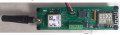
Flight computer from EggTimer Rocketry comes as a DIY assembly as an example.
Maybe, given the timeframe, they just assume it'll be ok. When, back in the 80s, I was designing air-to-ground comms & telemetry systems it was a big issue at altitude, but then mission duration was 10s of hours rather than seconds...

Also wire termination onto the PCB like that wouldn't have passed muster on the vibration table let alone in combat!
 

Irving

Joined Jan 30, 2016
5,123
It's hobby rocketry not military, been working fine for years. :)
Fair point - but when I was involved with a robot wars team (I won't say who to protect the innocent! :D) they said the same thing... till it failed miserably...:rolleyes: - sometimes a little extra effort is worth it...
 

sghioto

Joined Dec 31, 2017
8,634
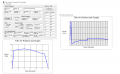
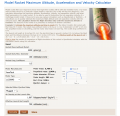
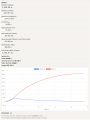
Here's a sample simulation based on motor specs and estimated altitude of 3500m, 11482 ft.
Assuming rocket weight and diameter to meet expected altitude.
Obviously underestimated the time to apogee.
Would like to see the TS simulation on this.
1768325582831.png
 

Irving

Joined Jan 30, 2016
5,123
Ouch - 14G & 26sec

That seems excessive... or a lot of hot glue may be needed :D

Why a launch elevation of 3700ft (1100m) - won't that affect the numbers (air pressure/density, etc)? is the final elevation relative to that or sea level?
 

Thread Starter

YUCE

Joined Jan 10, 2026
22
Thank you all for the incredibly detailed feedback. It’s clear that I need to account for both the electrical and environmental challenges of high-altitude flight. To clarify, this project is for a National Rocketry Competition where our goal is to reach 3,500 meters (11,500 ft) and recover the rocket safely. The judges are aerospace professionals, so reliability is my top priority.

Based on your suggestions, I am implementing the following changes to the PCB and system design:

  1. MOSFET Upgrade: I am switching the IRFU120 to an IRLZ44N (Logic Level MOSFET). This ensures that the gate is fully saturated at the Nano’s 5V output, providing the lowest possible $R_{DS(on)}$ to handle the 5-7A peak current for the ejection charge without overheating.
  2. Moisture & Condensation Protection: At 3,500m and -7°C, condensation is a major risk. I plan to apply a conformal coating (insulating varnish) to the entire PCB. I will be extremely careful to mask the BMP280’s barometer port and the GPS antenna to ensure they function correctly while the rest of the circuitry is sealed from moisture.
  3. Mechanical Integration: All modules (GPS, BMP280, LoRa) will be mounted using female header pins. This allows for easy component replacement during ground testing and provides better mechanical resilience against the vibrations and shocks during the boost phase.
  4. Optimized Trace Widths: To handle the expected currents safely:
    • Ignition Path: I’ve increased these traces to 2.0 mm, capable of handling the 5-7A peak current without significant heating.
    • Power Rails (5V & GND): Main power and ground lines are now 1.0 mm, ensuring stable voltage delivery across the board.
    • Signal Lines: Standard logic traces are kept at 0.25 mm to minimize noise and save space.
    • Sensor Upgrade (BMP390): I have switched from BMP280 to the BMP390. This sensor is specifically designed for high-performance applications like ours. It offers:
      • Higher Precision: Sub-10cm altitude resolution, which is critical for accurate apogee detection.
      • Integrated Filtering: Built-in IIR filters and better noise suppression, allowing for smoother data without taxing the Arduino Nano's CPU.
      • Logic Flexibility: Better handling of logic levels and lower power consumption.
I am now finalizing the updated PCB traces and moving on to the flight software. I’ll keep you updated on the progress. Thanks for helping a student team push this project to professional standards!
 

Thread Starter

YUCE

Joined Jan 10, 2026
22
Can you post a simulation of this proposed flight?
Curious if its close to what I estimated.
I would love to, but the launch hasn't been carried out yet; we're currently in the documentation phase. The launch will only be done once. If it's successful and we reach the desired altitude, we think we can come in first. Then we'll definitely have the launch videos. I will definitely post them here. It will be close to the values you provided, only the burnout time will be 4 seconds. And we hope it will reach an altitude of 3500-3600 meters.
 

Irving

Joined Jan 30, 2016
5,123
You must have done some launch simulations as part of your design? Can you share your rocket parameters, eg all-up mass, diameter, estimated drag coeff. and launch angle?

Higher Precision: Sub-10cm altitude resolution, which is critical for accurate apogee detection.
I'm no expert, but why not use the IMU for apogee detection? Surely apogee is when vertical velocity goes negative, isn't it?
 

Thread Starter

YUCE

Joined Jan 10, 2026
22
Yes, such a simulation has been done, but I'm not in that part of the rocket, so I can't give you the details. I'm in the avionics section of the rocket, and that information will be in the aerodynamics section. If I can get it, I'll share it.
You must have done some launch simulations as part of your design? Can you share your rocket parameters, eg all-up mass, diameter, estimated drag coeff. and launch angle?
We have an IMU sensor and we were undecided about whether to use it or not, but we'll probably use it.
I'm no expert, but why not use the IMU for apogee detection? Surely apogee is when vertical velocity goes negative, isn't it?
 

panic mode

Joined Oct 10, 2011
4,984
  1. Optimized Trace Widths:To handle the expected currents safely:
    • Ignition Path: I’ve increased these traces to 2.0 mm, capable of handling the 5-7A peak current without significant heating
2mm tracks (assuming 1oz board) can handle 7A with some 37degC in temperature rise. with room temperature is 25degC, tracks would reach 62degC. that is blistering hot. better would be 4.5mm. or make sure that ignition tracks are really short and that ignition is only a short pulse.
 

Thread Starter

YUCE

Joined Jan 10, 2026
22
2mm tracks (assuming 1oz board) can handle 7A with some 37degC in temperature rise. with room temperature is 25degC, tracks would reach 62degC. that is blistering hot. better would be 4.5mm. or make sure that ignition tracks are really short and that ignition is only a short pulse.
Since this will be 3.5 kilometers up in the air, it might not be a problem, but just in case, I'm thinking of making the PCB board with 6 layers.
 

sghioto

Joined Dec 31, 2017
8,634
We have an IMU sensor and we were undecided about whether to use it or not, but we'll probably use it.
Do redundancy, use both the baro and orientation sensor to detect apogee, give priority to the BNO055 sensor next the baro sensor and if that fails a backup timer.
 
Last edited:
Top