OP AMP instrumentation amplifier

Thread Starter

Romsha

Joined Nov 29, 2013
17
How does connecting the sources via voltage followers to the input of difference amplifier enhance its performance?

Following is the excerpt from Microelectronic circuits[6th Edition] by Sedra smith:
The low input-resistance problem of the difference amplifier can be solved by using voltage followers to buffer terminals: that is voltage follower is connected between each input terminal and the corresponding input terminal of the difference amplifier.
Please explain it.
Thank you
 

DickCappels

Joined Aug 21, 2008
10,661
The improvement occurs because the input impedance to a voltage follower is ideally infinite, while the input impedance to a simple differential amplifier is not.

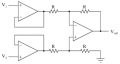
upload_2017-2-1_14-20-2.png
The circuit above shows two voltage followers, each a single opamp, driving the inputs of a differential amplifier, which in the opamp on the right and the four resitors.

The two opamps on the left with the inverting inputs connected to their outputs are voltage followers. They both have high input impedance. Therefore the entire input to the circuit has a high input impedance, both equal and ideally infinate.

The left sides two resistors on the outputs of the voltage followers present input impedance of R ohms in the case of the upper resistor and 2R ohms in the case of the lower resistor. Those are the inputs to the differential amplfier and if driven directly from the (external) source would present unmatched non-infinite impedance to that source. Since this circuit is buffered by the voltage followers, the source does not "see" and is not affected by the input impedances of the differential amplifier. <==That is the improvement you asked about.
 

Thread Starter

Romsha

Joined Nov 29, 2013
17
Thank you i have understood now. The input impedence is tricky.
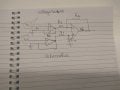
However i have one more question. What if at one input terminal of differential amplifier instead of voltage follower an inverting op amp circuit is connected and the other voltage follower is connected as it is. What would be the input resistance of this configuration?
As far as i know the input resistance of inverting amplifier is R which is connected between inverting terminal of op amp and the source.
Will the input resistance of the entire configuration still be infinite?
 

DickCappels

Joined Aug 21, 2008
10,661
.
(some texdt removed)
What if at one input terminal of differential amplifier instead of voltage follower an inverting op amp circuit is connected and the other voltage follower is connected as it is. What would be the input resistance of this configuration?
As far as i know the input resistance of inverting amplifier is R which is connected between inverting terminal of op amp and the source.
(some text removed)
Your statement that I highlighted in red is the correct answer to your first question.

(some text removed)
Will the input resistance of the entire configuration still be infinite?
(some text removed)
No, the entire input resistance would not be infinite (if I understand what is meant by "entire input resistance") because one of the two inputs would have an input resistance of R.
 

ErnieM

Joined Apr 24, 2011
8,415
If you replace one follower by an inverter you no longer have a differential amplifier.

This way it will amplify the sum of the signals, or whatever gain function is there on the inverter. Post a schematic and I will compute the theoretical gain.
 
Top