Facebook
 Google
 GitHub
 Linkedin
I've got a new circuit idea I'm playing with, but I realized there's a potential problem I hadn't thought about before. In the circuit below, C2 will charge to somewhere around 2.5V and stay in that general range most of the time. When power to the circuit is disconnected, it will continue to hold the input to op amp U2 at that voltage.
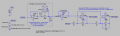
(I apologize for the messiness of the schematic. I was starting to clean it up and annotate it when I realized I might have a problem with it. It's a work in progress.)
I know there are abs max input limits, and they're referenced to the supply voltage. When the supply voltage drops, is it critical to bleed that cap immediately? Do I need a diode to the supply voltage maybe? Do op amps usually have input protection diodes like GPIO pins often do? If so, can they handle discharging a 10uF tantalum cap?
It seems like filters in the midst op amp circuits are pretty common, so I assume issues like this are a possibility pretty regularly, but I don't remember seeing protection diodes sprinkled liberally through every op amp circuit I look at. Am I just being paranoid, or is this a real issue that I need to address?
For anyone who's interested, the circuit above is a new idea for a silly one-off project where I'm amplifying the output of a Hall Effect sensor to try to read very, very small magnetic fields with it. It was inspired by this thread:
https://forum.allaboutcircuits.com/threads/hall-effect-sensor-circuit-recommendations.143813/
I realized pretty quickly that I could manually trim my reference for the null point and get very good results in an given moment, but that sensor null point drift made my readings useless in a fairly short order. So, the idea in this circuit is to use a few op amp stages and a very slow RC filter to get a long term average (10 second time constant as drawn, will probably increase to 47 second) of the idle sensor null value and the amplify the difference between that and the current value.
Obviously I could get better low Gauss measurements with a dedicated digital magnetometer IC, but I just thought it would be a fun exercise in analog design to see how far I could push the limits with a simple analog sensor.
(I apologize for the messiness of the schematic. I was starting to clean it up and annotate it when I realized I might have a problem with it. It's a work in progress.)
I know there are abs max input limits, and they're referenced to the supply voltage. When the supply voltage drops, is it critical to bleed that cap immediately? Do I need a diode to the supply voltage maybe? Do op amps usually have input protection diodes like GPIO pins often do? If so, can they handle discharging a 10uF tantalum cap?
It seems like filters in the midst op amp circuits are pretty common, so I assume issues like this are a possibility pretty regularly, but I don't remember seeing protection diodes sprinkled liberally through every op amp circuit I look at. Am I just being paranoid, or is this a real issue that I need to address?
For anyone who's interested, the circuit above is a new idea for a silly one-off project where I'm amplifying the output of a Hall Effect sensor to try to read very, very small magnetic fields with it. It was inspired by this thread:
https://forum.allaboutcircuits.com/threads/hall-effect-sensor-circuit-recommendations.143813/
I realized pretty quickly that I could manually trim my reference for the null point and get very good results in an given moment, but that sensor null point drift made my readings useless in a fairly short order. So, the idea in this circuit is to use a few op amp stages and a very slow RC filter to get a long term average (10 second time constant as drawn, will probably increase to 47 second) of the idle sensor null value and the amplify the difference between that and the current value.
Obviously I could get better low Gauss measurements with a dedicated digital magnetometer IC, but I just thought it would be a fun exercise in analog design to see how far I could push the limits with a simple analog sensor.