You have to ask?nightlight? or what?
So your wanting to learn about SCRs? or make an LED circuit? Perhaps you need to clarify your request. Because right now it feels shifting sand.Have successfully converted xmas accessories like a tree top angel from old incandescent bulbs to leds using discrete components by doing some math but am not seeing a clear way to modify these simple one scr ldr night light circuits simply because the led bulbs are an unknown ... does anyone have a simple solution to reusing these devices with led bulbs? Or know how to model these 7W Led bulbs to do calculations
I suspect at least part of the problem is triggering the SCR With a tiny teeny weeny little current. I won't reinvent the wheel, have a look around for dimmers etc and you should see circuits that use a smallish cap to dump a proper trigger current into the gate when a sidac (diode with useful breakdown characteristics) fires. Your 3M6 will probably not allow enough current to reliably trigger the SCR but the 3M6 value is not out of the ballpark either. Hence the usual tack of using a sidac and cap.Thank-you for all the replies ... retired life seems to be busier than normal ... thought I had flagged this thread for email notification but haven't received any email notifications which is why I haven't returned to the site until now.
Wasn't looking to start a row ... reading between the lines, the feedback suggests that my original wording was too vague ... so let me try this again ... hopefully those of you that have nothing to offer can just remain silent
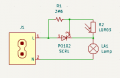
These are stock C7 7W night light (for incandescent bulbs) devices that plug in to 120VAC NA outlets ... they have a po102 SCR with the gate controlled by a 3M6 and LDR (voltage divider) ... this circuit is designed for incandescent bulbs because they provide a short to N when the SCR is off ... LED C7's don't look like a short ... during the day, C7 LED bulbs visibly flicker at 60 Hz and at night they are on full brightness ... so still kind of work but would like the bulbs to turn off during the day
View attachment 340731
I am not a fan of e-waste ... there is plenty of space within these housings so just reached out to see if someone can shed light on a way to incorporate a better off scenario for the LED C7 bulbs using a simple LDR circuit ... I have a plethera of parts and 40+ years of electronic design experience ... C7 Led bulbs are meant to be used in 120VAC sockets so in order to start a design for them one has to understand their on and off characteristics. Which was what I was kind of asking for ... specifically if anyone had knowledge regarding these new Led Bulbs they would be willing to share.
Thanks again
And to avoid jittering on the threshold, a little hysteresis.... maybe not just one transistor. And what would you do to get the gate current high enough to trigger the SCR? A 3M6 resistor simply will not allow enough current to trigger the SCR reliably.OK, after a nights rest I can see that a single transistor gain stage could easily provide a much larger signal change, which will allow a more solid "turn off" resistance for the SCR gate circuit. So just a single stage of amplification, not even needing to be linear, but with a DC gain of at least ten, or better, will allow much more solid switching. The larger voltage change for the actual resistance change of the LDR is what is required. But then the various resting voltages will need to be adjusted, probably.
Given the circuit impedance, where will all this current come from? And what will determine the point where the SCR is triggered? (Assume a very slowly changing light level on the LDR.)That single stage of amplification, with a gain of between 40 X and 50X will certainly allow solid triggering of the SCR. At least that is the plan.
No I do not. This is why triac dimmers use diacs.About the “snap action”: Don’t you think the SCR has enough “snap” by itself?
The fact of "an amplifier" rather implies that a power supply portion of the circuit will also be added. In this case, a diode, a resistor or two, and a capacitor. At least I had thought that would be understood. It seems that I should have provided a much more detailed description of the whole addition.Given the circuit impedance, where will all this current come from? And what will determine the point where the SCR is triggered? (Assume a very slowly changing light level on the LDR.)
Just saying to stick a transistor in there ignores the details of exactly how that should be done and so loses any value as a post. Having said that, I may have incorrectly assumed that the light level on the LDR is a slowly changing thing. It may not be.
In any event, an electronic switch should pretty much always have some hysteresis to give the switch a 'snap' action.
I think the OP and others would benefit from your sharing the details.The fact of "an amplifier" rather implies that a power supply portion of the circuit will also be added. In this case, a diode, a resistor or two, and a capacitor. At least I had thought that would be understood. It seems that I should have provided a much more detailed description of the whole addition.
If you have a look at some data sheets and application circuits you might get some clues about what is inside those lamps. In my experience from pulling a few lamps apart (engineers,we can't help ourselves.We have to know what makes things tickThx ... there is plenty of room to add caps a bridge and or replace the scr with a triac and diac ... however still think knowing the C7 Led on/off characteristics, or better yet, having a schematic of one of these bulbs would help with this project ... pulled out all my C7 devices and C7 Led Bulbs and have one combination that works properly (like the original incandescent bulbs) so as soon as I have a moment I will investigate what the difference is between the new bulbs I just purchased ... will update this thread with my findings
| Thread starter | Similar threads | Forum | Replies | Date |
|---|---|---|---|---|
|
|
LED Night-Light Circuit | General Electronics Chat | 25 | |
| H | Keep the solar light on over night | General Electronics Chat | 11 | |
|
|
Simple night light circuit operation questions | General Electronics Chat | 5 | |
|
|
Night Light | General Electronics Chat | 28 | |
|
|
DLD, day night light sensor switch, help. | Analog & Mixed-Signal Design | 10 |