Facebook
 Google
 GitHub
 Linkedin

Traveling, stayed in a large international chain motel. The bathroom had a nightlight with a CdS (cadmium sulfide) light sensor, so of course I opened it up. First thing to notice - no high-voltage components. None. Zero. Big fat film capacitor as a voltage dropper? Nope. Hmmm . . .
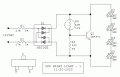
The light comes from four white LEDs in series, and they act as a shunt regulator for the control circuit. When the ambient light is low, R4 is almost an open circuit, Q1 is turned off by R3, and the LED string limits the max voltage to around 14 V (assuming 3.5 Vf per LED). When the ambient is high, R4 turns on Q1, which shunts current away from the LEDs to turn them off.
Not the most efficient circuit, but the actual part for Q1 is an S8050 that is rated for only 25 V Vce. AND while there are pc traces and holes for thru-hole parts, R1 and R2 are SMT 0805.
Fun fact: There are zero markings of any kind anywhere on the enclosure. Manufacturer, Voltage rating, UL, part number, inside, outside - nothing.
R4:
7.5 K - normal room light
2.5 K - workbench light
150 K - dark room
ak
The light comes from four white LEDs in series, and they act as a shunt regulator for the control circuit. When the ambient light is low, R4 is almost an open circuit, Q1 is turned off by R3, and the LED string limits the max voltage to around 14 V (assuming 3.5 Vf per LED). When the ambient is high, R4 turns on Q1, which shunts current away from the LEDs to turn them off.
Not the most efficient circuit, but the actual part for Q1 is an S8050 that is rated for only 25 V Vce. AND while there are pc traces and holes for thru-hole parts, R1 and R2 are SMT 0805.
Fun fact: There are zero markings of any kind anywhere on the enclosure. Manufacturer, Voltage rating, UL, part number, inside, outside - nothing.
R4:
7.5 K - normal room light
2.5 K - workbench light
150 K - dark room
ak