LED Night-Light Circuit

MisterBill2

Joined Jan 23, 2018
27,522
The funny night lights were the ones that used a small neon bulb with a series resistor. I think that they were rated at 1/25 watt. This was in the early 1950's period. By the 1970's some of them would not start glowing in the dark after a power loss. BUT shining a flashlight on them would start the glow again.
The physics explaining this was that the additional energy imparted by the added light allowed the neon gas to breakdown and start conduction by ionizing.
 

ronsimpson

Joined Oct 7, 2019
4,693
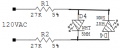
Many years ago, I had the task of making a light to go into a switch or a power outlet. They wanted the least parts. This is what I did. I don't remember the resistor values. At one point I had a three-legged LED but the price was wrong.
1767030670112.png
 

Jon Chandler

Joined Jun 12, 2008
1,596
Given that the main purpose of switching a night light OFF is to avoid wasting power, the circuit in post #1 achieves exactly the opposite.
I know that many people here are adverse to watching videos or clicking links....

In the video I posted, Clive analyzes nearly this exact circuit and has looked at many other night lught circuits as well.

I dare say he is an expert in LED night light circuits. When comparing this circuit to others that shut off the LEDs properly, he's found those circuits require many more components (with increased odds of failure), and that that circuitry actually draws even more power in standby than doing it as shown here.
 

schmitt trigger

Joined Jul 12, 2010
2,089
The funny night lights were the ones that used a small neon bulb with a series resistor. I think that they were rated at 1/25 watt. This was in the early 1950's period. By the 1970's some of them would not start glowing in the dark after a power loss. BUT shining a flashlight on them would start the glow again.
The physics explaining this was that the additional energy imparted by the added light allowed the neon gas to breakdown and start conduction by ionizing.
NE2-type are the cheapest, and therefore the most ubiquitous neon lamps.
There are, or were, some hi-rel neon lamps in which a minute amount of radon (a radioactive gas) had been mixed with the neaon in order to provide an ionizing "kick" to allow them to keep starting reliably for a long time.
 

Jon Chandler

Joined Jun 12, 2008
1,596
On a friend's charter fishing boat years ago, he had a depth finder with a rotating neon bulb that flashed as it pointed at the indicated depth. It stopped working one night in the dark. He turned on the lights in the wheelhouse to see what was wrong. The neon bulb started flashing. Turned on the lights....and no flashing.

That's when I learned about the increase in voltage required as the bulbs aged.
 
Top