The number of “LED Groups” is the best way. Either obtain the current requirement of one group from the specs. Or measure the current drawn by the entire roll and divide by 100 (number of three LED groups assuming 3 per group in a 300 LED roll). Or cut off one three LED group and measure the current drawn.
The total current required is the number of groups times the current needed per group.
I did this exercise when creating a large four digit seven segment display. Each segment was nine LEDs or three groups. For a total of 28 segments… displaying four 8s was the maximum current drawn for the display.
Manufacturers of commodity items may not be the best source of technical information. That’s why I and some others said you need to measure the actual current draw.
maybe
For example, their document shows how to use serial connectors to make a longer strip. It doesn’t say that you need a more powerful power supply. If one 300 LED strip requires 2A, then two connected serially requires 4A. But they don’t say that.
These strips connect groups of three LEDs and a resistor in series, in multiples of groups in parallel. Rough estimates say that 100 groups (of 3 LEDs) draw 2A. Then, each group draws 20mA. If you need close to 1foot, and each group is approximately 3”, that’s four groups in 1’ for a current draw of 80mA
One foot of the strip will only draw as much current as it needs off the 2A supply. It does not mean that it will draw the full 2A. The 2A rating of the supply is to tell you what it is capable of supplying.
We're back to this again. One set of LED's consists of three LED's and one current limiting resistor. MY set (or segments) are approximately 3 7/8 inches long. If we assume 4 inches, then there are three segments per foot. In my examples I've brought you to the understanding that each of YOUR segments are probably around 25mA each. Though they may look like they're in series, review the illustration in post #40. It shows three segments of three LED's each. Follow the top wire, the 12V+ wire and you see that it goes continuously the entire length. Whether one foot or 16 feet - that 12V+ goes the entire length. Then there's also the negative wire at the bottom. It, too, runs the entire length. Therefore if you look carefully you will see that each segment connects to the 12V+ and the Negative lines. Thus, as many segments as I choose, they're all in parallel to all other segments. Let me draw it for you in a different way. Perhaps you're getting confused seeing LED's in what looks like a straight line.
OK, each group of three requires 25mA. In my illustration I have seven sets of them. Though I didn't draw them in a straight line, this is how they are wired. The wires go around each set and provide 12V for each set. So seven sets at 25mA = 175mA of current. If this doesn't clear it up for you then I'm at a loss; and either you are just not getting it - OR you fully understand it and are just having fun with us. In either case I can offer no more useful information.
No, that is not correct. As several of us have tried to explain, the entire strip is a series/parallel circuit. Typically, the LEDs are wired in series in groups of three, plus a resistor. Then, these groups are all wired in parallel.
It is a series+parallel circuit on the strip of LEDs. Each inch contains 3LEDs and 1 resistor in series. Each inch takes about 30mA (or 0.030 Amps). All of those 1" segments are in parallel with each other.
just add up the inches, multiply by 0.030 to get the amps. Multiply those amps by 12VDC to get the watts.
Some LED,strips are marked in 25mm instead of 1inch segments but who cares.
now, most importantly, start wiring things up and stop asking questions - it's time to learn by experimenting a little.
Don't know why I'm back, but I am. But only for this one post:
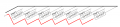
This illustration shows how there are three LED's in series with one resistor forming a group. There are three groups of LED's. There is a cut line where you can cut the string of LED's. No, you can't just cut it in one foot increments unless that's where the cut lines fall.
Here is that illustration:
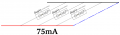
Notice at 12 volts with LED's who's Vf is 3Vf (each rectangle with three LED's inside) with a 120Ω resistor with a calculated total current at 25mA. Yes, I said twenty-five milliamps. There are three groups in parallel. 3 x 25mA = 75mA per set. One set consists of three groups. One group consists of three LED's and a resistor.
In this illustration you can see how the amperage adds up.
Here are four sets. Count them. 75mA each set. There are four sets. 4 x 75mA = 300mA (or 0.3A). Whatever the length you have or want - you MUST cut them at the Cut Line. Otherwise you'll have an incomplete set and it won't work right. However many sets you have, multiply them by 75mA and you'll know exactly how much current the string of LED's you desire will draw.
Just to be clear, if an approximately 1 foot length has four sets then your string will be drawing 300mA. Give or take a few milliamps due to the exact specific Vf of your LED's. But it should be pretty close to accurate. And by "pretty close" I mean within a few tens of milliamps.
So you understand; a power supply that is capable of delivering as much as 10 amps is just the max capacity. If you're drawing only 300mA then the 10 amp supply will have no problem. However, your string WILL NOT BE DRAWING ALL 10 AMPS.
If you still have questions - I beg of you - don't post them here. If you haven't gotten it by now then it's dubious whether you will ever get it.

 Facebook
 Google
 GitHub
 Linkedin