Understanding Contactor (Big relay) Coil Measures 12MΩ ohms, but works when 24V is applied.

Thread Starter

Qmavam

Joined Nov 6, 2016
25
I have a Schneider Electric LC1D115 3 ph 440 115 amp contactor. After reading the inrush current is 15amps, and thinking that is odd for a coil,
I measured the coil resistance, it is infinite (open-12MΩ). Then testing it with a 3.5Amp 24VDC supply it had a slight noise like it was trying to pull in.
We got a bigger supply, 10amp, and it pulled in hard.
I was expecting a coil, but with this info, I have to think there is an electronic circuit that maybe bumps up the voltage and current to the coil,
to make it close fast and hard and then backs off for the 0.170ma holding current. It also my force a fast open of the contacts during opening.
This would imply storage and capacitors, thus the high inrush current.
If you have more info about what is going on with the contactor activation I'd appreciate your feedback, I'm kinda guessing at this but want to understand.
Mikek
 

Thread Starter

Qmavam

Joined Nov 6, 2016
25
My pdf reader is not working but I have the Datasheet printed out at work. The contactor is labeled DC and I find DC in the data sheet.
Here is another number from the contactor, it might provide more info. LA9 D 115 603/604.
 

ericgibbs

Joined Jan 29, 2010
21,626
hi Q,
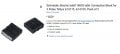
That LA9 D 115 603/604 code is a Connector Block???

Can you post a photo of the Contactor and Block? showing the label

E
EG 2258.jpg
 

Reloadron

Joined Jan 15, 2015
7,977
My read:

The coil resistance of a Schneider Electric TeSys D / TeSys Deca LC1D115 contactor depends on the specific control voltage (\(U_{c}\)) rating of the coil at 20 °C (±10%):
  • 110 V AC (50/60 Hz) [LX1D8F7]: ~4,377 Ω
    • 220 V AC (50 Hz) [LX1D8M5]: ~104.77 Ω
They do make a DC coil version which I believe is 24 VDC.

After reading the inrush current is 15amps, and thinking that is odd for a coil,
I measured the coil resistance, it is infinite (open-12MΩ).
I can't see that being correct? You even mentioned trying a few power supplies to energize it and needed higher current?

Ron
 

MisterBill2

Joined Jan 23, 2018
28,508
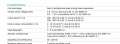
Certainly the data sheet does not mention if the device is "solid state" or not. Nor does it say anything except that the control circuit is 220 VAC, 50/60 Hz. Given that specification I would not expect it to operate on 24 volts DC or AC.,and the TS has not mentioned what the specified coil voltage is. Coil voltage and required operating currents, both holding and pull-in, matter a great deal.
The data sheet "coil specs" do not make much sense either. DC coil operation is not mentioned in those spec sheets.
Clearly this is not the type of contactor/motorstarter that I am familiar with.
My experience with other brands of motor starters is that the coil must have the correct voltage and current supplied for achieving the specified operation.
 

MisterBill2

Joined Jan 23, 2018
28,508
Based on the coil information provided, it is certainly not "just a solenoid coil" to operate this contactor. The specifcations we see verify my opinion. And the details will remain a top secret for quite a few years. And repair parts will never be available except from the OEM.
 

Ian0

Joined Aug 7, 2020
13,310
They often have coils with two windings. A high-current low resistance to pull it in, which then operates a microswitch to switch a higher resistance winding in series.
(But that doesn't explain why it measures open-circuit)
 

Ian0

Joined Aug 7, 2020
13,310
This happened to me once when hooking up a new machine that had 24vdc solenoid valves.
On opening up, a bridge rectifier was on each input guaranteeing operation and polarity on AC or DC.
Fooled me for just the same reason a couple of weeks ago. Chint 200A mains contactor with a 230V AC Coil is actually a DC contactor with a rectifier (and the dual coil and microswitch arrangement).
 

schmitt trigger

Joined Jul 12, 2010
2,276
I have operated AC only relays on DC at a much lower voltage lever. Probably not advised.
Indeed! These coils rely in the coil's complex impedance, not only the DC resistance, to limit the operating current.
And let's not forget that once the relay closes, the magnetic path also decreases, increasing the reactance. An even lower current level ensues.
 

MaxHeadRoom

Joined Jul 18, 2013
30,876
yes the AC version has the edge at switch-on due to the high inrush current, but the DC have it when closed due to constant voltage with no transition through zero!
 
Top