Odd Question for an Odd Problem: Making an Old Scoreboard into a Clock

MrChips

Joined Oct 2, 2009
34,870
Now, you can eliminate a lot of diodes by going with discrete logic ICs.

For example, P10 is always ON except when "1" is OFF.
Hence this can be reduced to "1" -> NOT GATE -> P10.

Here is another example, P1 is always ON except for "1" and "2".
In other words, if "1" OR "2" are active, you want P1 to be off.

"1" --)
2-INPUT NOR GATE }O---> P1
"2" --}


Do the same for P4 and P13.
 

Jon Chandler

Joined Jun 12, 2008
1,609
I'm really sorry, but I have to say I don't think you're going to be able to carry this off on your own. All the "little details" needed to make this work get brushed aside.

Let's start with a simple example: How much current will the digit bulbs (whether incandescent or LED) draw? You potentially need to power 186 bulbs at a time. Without knowing the current, you can't determine the power supply requirements. This doesn't even consider lighting the period, bonus and home/visitor lights. Are 6 volt LEDs the right answer? Maybe, maybe not. If the same bulbs are available in 6 and 12 volt versions, the power supply would have to supply half the current at 12 volts than at 6.

To make "plug-in" boards to control the lights, you need to know the connections and what you'll be switching.

Once all the hardware issues are figured out, several circuit boards will need to be designed. This requires precise measurements of connections to be made, and ensuring the boards will fit.

After that, there's software to write; software that will be hard to test and troubleshoot by long distance.


scoreboard unknowns.jpg
 

Thread Starter

r8f1k

Joined Oct 1, 2023
164
Now, you can eliminate a lot of diodes by going with discrete logic ICs.

I think I understand, let me make a few circuits and see what I can make with a pile of 1n4001 and a 4017.

For example, P10 is always ON except when "1" is OFF.
Hence this can be reduced to "1" -> NOT GATE -> P10.

Here is another example, P1 is always ON except for "1" and "2".
In other words, if "1" OR "2" are active, you want P1 to be off.

"1" --)
2-INPUT NOR GATE }O---> P1
"2" --}


Do the same for P4 and P13.
 

Thread Starter

r8f1k

Joined Oct 1, 2023
164
I'm really sorry, but I have to say I don't think you're going to be able to carry this off on your own. All the "little details" needed to make this work get brushed aside.

Nothing to apologize for. You are 100% correct. I know I am out of my depth, that's why I posted on the forums. As far as electronics go, I am interested in it, but my experience is being a glorified parts changer. I can't design or engineer anything. I am appreciative of any help I can get. With all the information that came through, it has been hard to sift through what is what. I also don't know enough to decide on the fly. I know you are/were frustrated with my lack of timely answers, but I only have so much bandwidth. I am willing to work and I'm willing to try things I don't know. I honestly never thought anyone would even respond to a new forum member.

Let's start with a simple example: How much current will the digit bulbs (whether incandescent or LED) draw?
You potentially need to power 186 bulbs at a time. Without knowing the current, you can't determine the power supply requirements. This doesn't even consider lighting the period, bonus and home/visitor lights. Are 6 volt LEDs the right answer? Maybe, maybe not. If the same bulbs are available in 6 and 12 volt versions, the power supply would have to supply half the current at 12 volts than at 6.

So one 6.3V red LED running on 6.3VAC draws 15.40mA
Making a number "1" with 7 bulbs on 6.3VAC draws 14.88mA


To make "plug-in" boards to control the lights, you need to know the connections and what you'll be switching.

Once all the hardware issues are figured out, several circuit boards will need to be designed. This requires precise measurements of connections to be made, and ensuring the boards will fit.

I agree. I like the idea of mounting the driver board right to a row of header pins. The only issue I see is the irregular pattern on the existing light matrix. All the wires can be desoldered no problem, a row of header pins installed, but depending on the size of the driver boards, it might put too much stress on the lamp boards. Since there are already wires soldered to the lamp board, a female Molex connector could be pinned on those wires and then connect to male header pins on a new driver. There is lots of room inside of the scoreboard itself, especially with the old relays and steppers removed.

After that, there's software to write; software that will be hard to test and troubleshoot by long distance.

I agree, but I will try my best. I don't give up easy.

To answer your lettered list of unknowns:


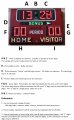
A - The first digit has only one of 7 bulbs, one full board of 28 bulbs @ 35 bulbs total
B - Colon, only painted on the front, no bulbs.
C - Two full boards of 28 bulbs each @ 56 bulbs total
D - The bulbs were 4 @ 10 watts with E26 bases @ 110V, switching source is the Jones plug that connects to the missing controller.
E - Period bulbs are 4 @ 7.5 watts with E26 bases @ 110V, switching source is a rotary electromechanical switch.
F - G - Two single row boards of 7 bulbs, two full boards of 28 bulbs each @ 70 bulbs total. The two single rows only share a common wire with the adjacent boards, the power wire goes back into the Jones plug heading to the stepper switch.

H - I - Home and Visitor bulbs are 8 bulbs in total as follows from left to right: 1st 10w, 2nd 10w, 3rd 40w, 4th 25w, 5th 10w, 6th 10w, 7th 10w, 8th NO BULB. It seems that they were all MEANT to be 10 watts. I have emailed Fair-Play for a service manual if possible or an owners manual.


View attachment 305078
 

Jon Chandler

Joined Jun 12, 2008
1,609
1. I believe the board pins are one 0.2" spacing in the groups of pins, and multiples of 0.1" between the groups. If that is a true fact, just snip off the pcb side of the pins where there is no hole.

2. The driver boards will be reasonably small and light weight. Suspending the driver boards from the digit boards should pose no problems is there is sufficient depth for them. If the boards need extra support, install 3mm spacers in the board mounting holes and tack them to the digit board with a hot glue gun.

3. The digit bulbs are easiest to control using a regulated DC Supply (I swear I've said that more than once). To determine the power supply requirements, you must KNOW the voltage and current requirements of the bulbs. This is critical, and as I said in the last post, a bulb operating at 12 volts will draw less current than one operating at 6 volts for the same light output.

4. Switching the 120VAC lamps will require different switching mechanisms and safety precautions.

5. Four of the digits will display the time. For the other digits, you've said you want month and day, and if you follow MrChip's and MrBill's recommendations, you're stuck with take. Maybe you decide you want to display temperature, both in the barn and outside? Not a complicated change with a microcontroller solution. Maybe you want to alternate between temperature and month/day? Not a problem.

6. Concerning time and month/day: a clock chip will keep track of it for the next 75 years, except for correcting for daylight savings time. By the way, a clock chip continues to run during a power failure, so the clock will display the correct time when power is restored.

If the barn has WiFi, you could even use NTP (Nwtwork Time Protocol) so the clock will always be correct if there's a network connection.


Try to have the big-picture view when thinking about the best way to implement the scoreboard. Yep, you have to think about all the details up front but the results will be worth it.
 

MisterBill2

Joined Jan 23, 2018
27,652
OK, the physical implementation can consist of as simple as two pieces of the "proto" board material that has copper strips on one side. One side has the ten input lines, the other piece of material has 16 of the strips running at right angles to the numbers strip, Then the diodes are installed between rows and columns.
The number of diodes is why I had suggested PROMs as an alternative option. Certainly this is tedious but not hard to do.
 

Thread Starter

r8f1k

Joined Oct 1, 2023
164
1. I believe the board pins are one 0.2" spacing in the groups of pins, and multiples of 0.1" between the groups. If that is a true fact, just snip off the pcb side of the pins where there is no hole.

2. The driver boards will be reasonably small and light weight. Suspending the driver boards from the digit boards should pose no problems is there is sufficient depth for them. If the boards need extra support, install 3mm spacers in the board mounting holes and tack them to the digit board with a hot glue gun.

As a note, the PCB boards on the back of the digits are NOT very thick. They are not fiberglass/resin boards that are rigid. They are acetate sheets and are quite flexible.

There is plenty of depth. Between 4.5" to 4.75" depending on where there is internal reinforcement for the back panel of the scoreboard. I would assume that is plenty to mount boards.


3. The digit bulbs are easiest to control using a regulated DC Supply (I swear I've said that more than once). To determine the power supply requirements, you must KNOW the voltage and current requirements of the bulbs. This is critical, and as I said in the last post, a bulb operating at 12 volts will draw less current than one operating at 6 volts for the same light output.

You have mentioned the DC power supply more than once. Given that 12v bulbs will offer a lower current draw, I will look for suppliers of 12v LED bulbs of the same base. Below is a common set up for standup arcade games when 30-45 year old power supplies move on to the next world. Perhaps that is an option for what I currently have. My transformer puts out just over 11V which could be used for lights, then a switching power supply like shown or an ATX like you have recommended.


1697460784606.png


4. Switching the 120VAC lamps will require different switching mechanisms and safety precautions.

Yes they will. What is more concerning is that the company uses the frame of the scoreboard for the neutral leg. I would want to remedy that and use only the body of the scoreboard for ground. A separate line neutral would not be hard to add.

5. Four of the digits will display the time. For the other digits, you've said you want month and day, and if you follow MrChip's and MrBill's recommendations, you're stuck with take. Maybe you decide you want to display temperature, both in the barn and outside? Not a complicated change with a microcontroller solution. Maybe you want to alternate between temperature and month/day? Not a problem.

Alternating between date and temp is quite clever........Adds another interesting layer. Also, the score sections have room for 3 digits capably of displaying 100-199. I'm game for that.

6. Concerning time and month/day: a clock chip will keep track of it for the next 75 years, except for correcting for daylight savings time. By the way, a clock chip continues to run during a power failure, so the clock will display the correct time when power is restored.

Power failure has been a concern of mine. We installed the new vault at our farm in 2017 for three phase service, its all buried, but we do get interruptions, once or twice a year.

If the barn has WiFi, you could even use NTP (Nwtwork Time Protocol) so the clock will always be correct if there's a network connection.

We literally just had a friend pull a road bore conduit from the communications box across the street from our farm on Friday. Internet should be set up by next month, but not written in stone.

Try to have the big-picture view when thinking about the best way to implement the scoreboard. Yep, you have to think about all the details up front but the results will be worth it.

You will get no argument from me. Planning is a complicated process for any one thing to be successful. When I started my orchard in 2016, it took 4 months just to plot out where the trees will be planted, where the irrigation will be routed, power for automating the irrigation, turn radiuses for equipment to navigate the tree rows, future growth and additions, orientation of the rows in relation to the seasonal shift of the sun and prevailing winds, wind breaks and integrated pest management. Without that time spent, it would be a mess.

Tell me what else I should do or questions that need answering.
 

Thread Starter

r8f1k

Joined Oct 1, 2023
164
OK, the physical implementation can consist of as simple as two pieces of the "proto" board material that has copper strips on one side. One side has the ten input lines, the other piece of material has 16 of the strips running at right angles to the numbers strip, Then the diodes are installed between rows and columns.
The number of diodes is why I had suggested PROMs as an alternative option. Certainly this is tedious but not hard to do.
I am going to play with this tonight. More rain is slated for our area and I will experiment to get a better understanding of the light matrix and how it orients on the display. Thank you!
 

Thread Starter

r8f1k

Joined Oct 1, 2023
164
I like the idea, but my unit is way to complete to go the string light route. If it were missing a bunch of parts and I were throw some parts at it, I would. I would like to keep the flexibility of being able to change the bulbs over time rather than having to worry if one goes out in the string, replacing large sections of LEDs.
 

Thread Starter

r8f1k

Joined Oct 1, 2023
164
1. I believe the board pins are one 0.2" spacing in the groups of pins, and multiples of 0.1" between the groups. If that is a true fact, just snip off the pcb side of the pins where there is no hole.

2. The driver boards will be reasonably small and light weight. Suspending the driver boards from the digit boards should pose no problems is there is sufficient depth for them. If the boards need extra support, install 3mm spacers in the board mounting holes and tack them to the digit board with a hot glue gun.

3. The digit bulbs are easiest to control using a regulated DC Supply (I swear I've said that more than once). To determine the power supply requirements, you must KNOW the voltage and current requirements of the bulbs. This is critical, and as I said in the last post, a bulb operating at 12 volts will draw less current than one operating at 6 volts for the same light output.

4. Switching the 120VAC lamps will require different switching mechanisms and safety precautions.

5. Four of the digits will display the time. For the other digits, you've said you want month and day, and if you follow MrChip's and MrBill's recommendations, you're stuck with take. Maybe you decide you want to display temperature, both in the barn and outside? Not a complicated change with a microcontroller solution. Maybe you want to alternate between temperature and month/day? Not a problem.

6. Concerning time and month/day: a clock chip will keep track of it for the next 75 years, except for correcting for daylight savings time. By the way, a clock chip continues to run during a power failure, so the clock will display the correct time when power is restored.

If the barn has WiFi, you could even use NTP (Nwtwork Time Protocol) so the clock will always be correct if there's a network connection.


Try to have the big-picture view when thinking about the best way to implement the scoreboard. Yep, you have to think about all the details up front but the results will be worth it.
These might be an option:
https://cointaker.com/products/161-button-12v?scrlybrkr
 

BobTPH

Joined Jun 5, 2013
11,555
I am agreeing with @Sensacell.

The entire project can be done with 1 string of addressable LEDs, 25 per digit 8 digits, so 200 pixels in all. The are then all controlled by a single output pin from a microcontroller. I have a lot of experience with these LED strings and I am totally sold on them. If you wanted, you could even change the colors! The update would take about 8 msec so no problem there.

This would replace every chip, diode and MOSFET in other proposed solutions, leaving you with 1 microcontroller as the only electronic device. Nothing could possibly be simpler.

I have never seen one of these pixels fail once a project was done, and the wired ones he linked to would be easy to replace - just snip and solder 4 wires. I have 2248 of them in one installation (on strips, not wired).
 

MrChips

Joined Oct 2, 2009
34,870
Presumably, you need high current drivers to power the lamps or LEDs.
If you use digital logic ICs, PROMs or MCU, the current drivers have to go on the P1-P16 side of the circuit.
 

Jon Chandler

Joined Jun 12, 2008
1,609
These might be an option:
Yes, those look to be ideal. The single LED element, blasting out the top, is exactly what you need in the scoreboard.

The current draw of 0.05 amps is a huge reduction from what the bulbs draw. 184 bulbs × 0.05 amps = 9.2 amps at 12 volts. This is reasonable current draw.

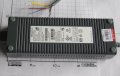
If you can find an Xbox 360 power supply at a thrift store, this beast of a power supply provides 12 – 16 amps @ 12 volts depending on the exact model and an amp at 5 volts, which is plenty to power a microcontroller solution.

I hope you can find those bulbs at a more reasonable price! Just keep an eye on the current drain.

brick (1).jpg
 

Jon Chandler

Joined Jun 12, 2008
1,609
If you're concerned about the digit boards carrying the weight of the driver boards, sure they can be connected by wires. I have a visceral dislike of assembling cables, so I do everything possible to avoid it. Still might be easiest/most reliable to install header pins on the digit boards and use pre-built ribbon cables to connect to the driver boards.
 

BobTPH

Joined Jun 5, 2013
11,555
I like the idea, but my unit is way to complete to go the string light route. If it were missing a bunch of parts and I were throw some parts at it, I would. I would like to keep the flexibility of being able to change the bulbs over time rather than having to worry if one goes out in the string, replacing large sections of LEDs.
I thought it was determined that you were going to LEDs, and entirely new electronics.

The other solutions will have dozens of chips and multiple circuit boards.

@Sensacell’s suggestion will require 184 of the addressable LEDs, 1 microcontroller, (could be as small as 8-pins), a crystal and few of capacitors, and a few buttons for setting the clock, all on one tiny PCB.

The only caveat is whether they are bright enough.

Other than that, it looks like a no-brainer to me. Your board could be a standard Arduino, nothing else would be required. If you want to build the minimum, you can’t do better than that.
 

Thread Starter

r8f1k

Joined Oct 1, 2023
164
If you're concerned about the digit boards carrying the weight of the driver boards, sure they can be connected by wires. I have a visceral dislike of assembling cables, so I do everything possible to avoid it. Still might be easiest/most reliable to install header pins on the digit boards and use pre-built ribbon cables to connect to the driver boards.
That might be the way to go
 

Thread Starter

r8f1k

Joined Oct 1, 2023
164
Yes, those look to be ideal. The single LED element, blasting out the top, is exactly what you need in the scoreboard.

The current draw of 0.05 amps is a huge reduction from what the bulbs draw. 184 bulbs × 0.05 amps = 9.2 amps at 12 volts. This is reasonable current draw.

If you can find an Xbox 360 power supply at a thrift store, this beast of a power supply provides 12 – 16 amps @ 12 volts depending on the exact model and an amp at 5 volts, which is plenty to power a microcontroller solution.

I hope you can find those bulbs at a more reasonable price! Just keep an eye on the current drain.

View attachment 305105
I’m going to look for that exact power supply and I think I found the bulbs in 12v at a reasonable price. Waiting to see if the current draw is able to be specified by the seller.
 

Jon Chandler

Joined Jun 12, 2008
1,609
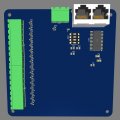
Since the bulbs may be nailed down and a realistic power supply has been identified, I can start nailing down the digit driver boards. A picture of a rough layout is shown below.

> One of these boards per digit.
> Removable terminal blocks for connections to the wires from the digit boards.
> RJ45 cables daisy-chain the control signal from microcontroller to the digit boards. These cables must be kept as short as possible.
> The board shown is 100mm x 100mm, but can be reduced in size.
> Dip switches set the address of each driver board. A maximum of 8 are allowed.
> An additional mosfet is included to control the two "ones" digits from the microcontroller.

Ten of these boards can be assembled by JLCPCB for $50 or less (<$5 per board).

The MCP23017 port expander is a widely used component, with drivers for Arduino very available. Each group of bulbs on the digit board is controlled by one bit in the MCP23017 control register. Any combination of groups may be illuminated by a single command.

Doesn't look so complex compared to a massive diode matrix per digit, or a bunch of logic "simplifying" the diode matrix, does it? Neither MrBill nor MrChips has explained anything beyond controlling the digits - I'm looking forward to hearing how simple that's going to be.

SCOREBOARD PCB 3D.jpg
 

AnalogKid

Joined Aug 1, 2013
12,158
Looks good to me. Do these just plug into the plastic carriers that now hold the old bulbs?

Also - in the original scoreboard the bulbs were static. There was no multiplexing; when a bulb was on, it was on continuously (as opposed to being pulsed). Is multiplexing acceptable for the rebuild? If so, it opens up a different logical approach to the decoding problem.

ak
 
Last edited:
Top