NPN biasing state in linear regulator

Thread Starter

yef smith

Joined Aug 2, 2020
1,459
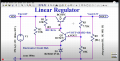
Hello,There is this youtube video of a regulator I saw .
According to the manual the Key in this regulator is the VCE of the BC547C increasing and decreasing according to the current at the base.
What do you think should be the steps to design of the NPN BJT steps?
Thanks.
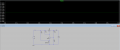
LTspice file is attached.
1742650177153.png
1742650940327.png
 

Attachments

crutschow

Joined Mar 14, 2008
38,512
According to the manual the Key in this regulator is the VCE of the BC547C increasing and decreasing according to the current at the base.
The Vce voltage simply equals the input voltage minus the output voltage. It's not a "key", and the base current is that taken by the transistor based upon its Beta and the output current.
The base current is something you provide, not control.
What do you think should be the steps to design of the NPN BJT steps?
That makes little sense.
What are "BJT steps"?

You keep asking about using BJT's but you seem to have little intuitive understanding about them.
Suggest you read another tutorial and try to understand that.
The transistor equations will make sense once you understand how a BJT works.
 

Thread Starter

yef smith

Joined Aug 2, 2020
1,459
Hello,I need to deside regarding where should I bring the BJT?
In the following regulator where should the NPN operate?
Thanks.

1742674331005.png
 

Papabravo

Joined Feb 24, 2006
22,082
A device that is being controlled in a "linear" fashion would not work very well in cutoff or saturation. I think that leaves only one remaining choice for the region of operation. Can you tell me which region you think is most likely being used for such a "LINEAR" regulator?

I'm also confused because your circuit and the circuit from the you-tube video are not remotely related to each other. If you think they are related, I need a detailed explanation of why you think so.
 
Last edited:

crutschow

Joined Mar 14, 2008
38,512
In the following regulator where should the NPN operate?
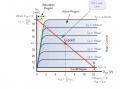
There are three regions of operation, one is fully-on in saturation, one is fully-off in cutoff, and one is conduction under base control in the active region.
Three guesses as to which would be appropriate for a linear regulator.

And that DC load line is for a fixed value collector load resistor, which that regulator circuit does not have.
Q1 is being used in an emitter-follower configuration.

Edit: Due to the negative feedback from the output, the transistor will operate in the active region based upon the input voltage, the output voltage and the output current.
You can look at the graph to determine where it will operate, but that's not arbitrarily determined.
 
Last edited:

tonyStewart

Joined May 8, 2012
237
The curve tracer waveforms do not apply to this design, since there is no emitter R to regulate current from the base voltage. There is an exponential control of base voltage on the collector current. The Q point is determined by the Vz emitter Zener current and voltage and the base Vb controlled by the Vth Thevenin (&Rth) divider resistance.

As long as the Rth resistance of the feedback resistor divider is low enough to regulate the collector current, the hFE is irrelevant as well as the base current.

It is imperative that you understand that transistors are exponential Vbe-controlled collector current devices.

When you add sufficient Re they can become transformed from voltage to become Norton equivalent current controlled devices. But that does not apply here. Relative to Rbe, base-emitter resistance, and that of Rz of the Zener is also low resistance, it does not linearize base current with base voltage.


As you duplicated this question on the EDAforum site, I already indicated the following;

The process to choose 12V requires knowing;

1. Zener is 6.2V @ 5mA test current, so using less reduces voltage slightly. (knee resistance ... R*Iz wiil shrink if Iz is much less than 5mA. Examine the base current of Q1 to prove that assumption with no load.
2. Q2 collector current depends on Vbe (quick guess if Ic= 1mA, Vbe = 600 mV)
3. Vbe depends on Thevenin voltage Vth from R divider from 12V and Vz on emitter.
4. The R values minimize current may be computed several ways such as derating hFE min by 50% for cold temperatures for a stable result.
 
Last edited:

Ian0

Joined Aug 7, 2020
13,132
This isn't a precision circuit.
Assume that the zener voltage IS 6.2V (which it won't be because the current through it is not the rated current)
Assume that the Vbe is 0.6V, although it varies with (Ic/Hfe)
Assume that no extra voltage is dropped across R3 due to the base current.
Then the output voltage will be somewhere near (Vz+Vbe)*(1+R3/R4), certainly not close enough to warrant E96 series resistors.
If you want something more accurate, buy a voltage regulator.
 

WBahn

Joined Mar 31, 2012
32,849
Hello,There is this youtube video of a regulator I saw .
According to the manual the Key in this regulator is the VCE of the BC547C increasing and decreasing according to the current at the base.
What do you think should be the steps to design of the NPN BJT steps?
Thanks.
LTspice file is attached.

View attachment 345156
View attachment 345157
There are several layers at which you can approach choosing component values, but first you need to decide what you need your voltage regulator to do and how well you need it to do it. Until you establish that, you don't know whether this circuit topology is adequate, woefully insufficient, or complete and total overkill.

So far, all we know is that you want the output to be 12 V. Well, that's a start, but it's a pretty poor one. It's one thing to want it to be able to output 12 V while delivering 100 mA and quite another to want it to be able to deliver 12 V while delivering 100 A. So before you can really even start a meaningful design, you at least have to decide what the maximum load current you want the regulator to be able to supply. The only thing we have to go on is that the simulation schematic in the video does runs with the load resistor varying between 1 kΩ and 10 kΩ. That implies a maximum current of just 12 mA. With no indication of how tight the output voltage tolerance needs to be, there's a lot of reason to believe that this circuit might be major overkill.

The fact that the circuit is using a BZX84C series Zener diode implies that the output voltage tolerance is pretty loose, since that series has about a ±5% tolerance on the Zener voltage at 5 mA at room temperature. So if you really want the regulator's output to be tighter than something approach ±1 V, you need to be looking more closely.

But let's set that aside and just look at the roughest pass through the circuit. We aren't going to be concerned with tolerances or temperature coefficients. We are primarily interested in getting a feel for the gross considerations needed to put the design in the ballpark.

You want as much as 12 mA of load current. That means that Q1 needs to be able to deliver that, plus the current to the feedback network for Q2. We should be able to make the feedback network small in comparison, so if we design the regulator to be able to deliver 20 mA, we should have sufficient margin. To deliver 20 mA, Q1 needs some base current. But how much? For that, we look at the BC547C datasheet. Note that this is an obsolete transistor, but we'll go with it. We see that, at 20 mA collector current, this transistor has a typical base current of 50 µA (a beta of 400). Reading between the lines a bit, we can estimate that the minimum beta at this current is somewhere around 300, so assuming that we can count on the beta being at least 100 should give us quite a bit of room. That means that we need 200 µA of base current. This current is supplied via R1. To size that, we need to know what the minimum input voltage is. The simulation implies that the input voltage range of interest is from 15 V to 30 V, so let's go with that. At 15 V, R1 will have about 2.4 V across it. To deliver 200 µA, it can't be any larger than 12 kΩ. We got this number while being very conservative, so we could probably just use it and be fine, but to be on the safe side, let's pick 10 kΩ. Now, the circuit uses 22 kΩ, or about twice this value. That's probably because they were a bit less conservative that I was and assumed a minimum beta of 200, which would have put the maximum R1 at 24 kΩ, But let's stick with mine and use 10 kΩ for R1, at least for now.

At the other end of the input voltage range, R1 will have 17.4 V across it, so there will be 1.74 mA flowing through it. The role of Q2 is to adjust the base current of Q1 to just the right value by diverting the excess current from R1 away from Q1. At low output currents and with a Q1 beta that's at the high end of it's tolerance range, that means that we might need to divert virtually everything away, so we want to have the ability to divert not only the 1.74 mA, but enough more so that we have plenty of margin. Going with 5 mA is probably sufficient, but 10 mA makes me more comfortable (I like an order of magnitude margin when I can get it, so I might even go for 20 mA, but since our output current tops out at that, it seems a bit excessive). Plus, even 10 mA is twice what the current is that the Zener diode is characterized at. So this would be a reasonable motivation to go back and make a less conservative assumption about that minimum beta for Q1. By the same token, being able to shunt 10 mA doesn't mean that we expect it ever to do so -- we don't expect it to ever shunt even 2 mA. So we don't have any deal breakers yet.

To be able to shunt 10 mA, Q2 needs a base current (assuming that same minimum beta of 100) of 100 µA. This means that we want the current in the feedback network to be at least around 1 mA, which in turn means that we want the sum of R3 and R4 to be no more than about 12 kΩ. The circuit in the simulation uses about 18 kΩ, which again reflects slightly less conservative assumptions. If we used a beta of 200, for instance, our max R1 current could have been about 750 µA, and we could have settled for being able to shunt at least twice this, or 1.5 mA, which would have then put the max Q2 base current at about 7.5 µA, meaning an R3,R4 current of 15 µA, making the max value for the sum of these two resistors 800 kΩ. So you can see that we actually have a broad range of potential component values to work with -- which one's are "best" depends on all of those other unstated requirements for the regulator, such as power dissipation, efficiency, input voltage rejection, etc. So let's stick with 12 kΩ.

As for what to make R3 and R4, that is just a simple voltage divider problem where the input is 12 V and the output is the Zener voltage plus the Vbe of Q2, which, from the data sheet, we can reasonably take to be about 650 mV (using either 0.6 V or 0.7 V would be quite reasonable).

About the only thing left is R2. It's purpose is to ensure that the Zener diode has sufficient bias current to keep it near its Zener output. We can see from the datasheet that we should have at least about 1 mA flowing through it, so at Vin = 15 V, R2 will have about 8.8 V across it, making it's maximum value about 8.8 kΩ, so we might choose 8.2 kΩ or perhaps 7.5 kΩ. This is pretty close to the sim's 10 kΩ value and represents a willingness to push the Zener current a bit lower, perhaps in recognition that there will always be some current coming out of Q2, as well. At the other end of the input voltage range, R2 will have 23.8 V across it, so our 8.2 kΩ resistor would have just shy of 3 mA. But at high input voltages, we are also shunting a lot of current away from Q1, perhaps as much as another 2 mA. So that puts us right at the 5 mA that the Zener is characterized at. We could probably drop R2 to 4.7 kΩ so as to operate the Zener more closely to its preferred 5 mA operating point.

To go any further than this, you need to start with what the circuit needs to achieve as far as performance and then start looking at how that performance is determined and adjust component values accordingly. But you have to keep in mind that nearly everything in engineering is a compromise. Getting better performance against one metric generally means accepting worse performance against others. The basic circuit topology limits your maneuvering room, so it is always possible that you can't achieve all of your performance requirements using this topology.
 

crutschow

Joined Mar 14, 2008
38,512
For a more accurate and stable output, you can replace D1, Q2, and R2 with the TL431 programmable voltage reference.
The regulated output voltage will then be when the TL431 Ref input voltage from R3 and R4 is 2.5V.
 

AnalogKid

Joined Aug 1, 2013
12,135
I'm also confused because your circuit and the circuit from the you-tube video are not remotely related to each other.
Really? Unless the images in post #1 have been updated and I'm not seeing what you saw, it looks to me like the video screen capture and the LTS schematic are identical.

This is a classic low-cost, medium performance regulator. I first saw this in a Vital audio/video routing switcher in the early 70's.The performance was not exactly terrible, but the signal electronics were so finicky that we had to make a drop-in replacement board using an LM309.

ak
 

Papabravo

Joined Feb 24, 2006
22,082
Really? Unless the images in post #1 have been updated and I'm not seeing what you saw, it looks to me like the video screen capture and the LTS schematic are identical.

This is a classic low-cost, medium performance regulator. I first saw this in a Vital audio/video routing switcher in the early 70's.The performance was not exactly terrible, but the signal electronics were so finicky that we had to make a drop-in replacement board using an LM309.

ak
I may have posted a response to another thread in this one. Let me see if I can find the thread I was looking for. The schematic I was looking for looked like a misconnected differential stage followed by what might have been either an emitter follower or a common emitter stage.
 

WBahn

Joined Mar 31, 2012
32,849
Really? Unless the images in post #1 have been updated and I'm not seeing what you saw, it looks to me like the video screen capture and the LTS schematic are identical.
I thought the same thing, but when I looked at the .asc file that was attached, it was for a different circuit (that was the topic of a different thread). I think the TS simply attached the wrong file.
 
Top