New to wiring LEDS - what am I doing wrong?

Ya’akov

Joined Jan 27, 2019
10,259
OK, well you do have a small problem right off the bat. That battery holder has two 1.5V cells in series. In series, voltages add which means it wants to supply 3V to the 1.5V lights.

If you tested it on something else and found it working, I can only surmise what the problem might be. I am going to make a guess that the very high gauge (thin) wires are presenting enough resistance that when the potentially very large load (it the 100mA@1.5V in the specs is to be believed) is causing so much of a voltage drop the the battery just can't provide enough current.

The very short version of that is, the battery isn't appropriate because of the wires on the case. (If I am right). I will take a quick look for a readily available plug-in solution for you. There won't be anything more dangerous about it, it would still only provide the correct voltage and current. The high voltage all stays at the other end.
 

AlbertHall

Joined Jun 4, 2014
12,635
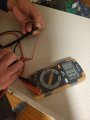
Do you have a voltmeter or multimeter?
If so measure the voltage between the wires from the battery pack with nothing else connected, and then the voltage at the same place but with the lights connected as well as the meter.
 

Thread Starter

debb1985

Joined Feb 16, 2022
19
Do you have a voltmeter or multimeter?
If so measure the voltage between the wires from the battery pack with nothing else connected, and then the voltage at the same place but with the lights connected as well as the meter.
I can have my husband try this after work.
 

Ya’akov

Joined Jan 27, 2019
10,259
So, here's my quandary. If the specifications the manufacturer provides are correct, at 1.5V those lights draw 100mA. Since they are in parallel, the currents add, if there are 100, then it is 100mA times 100 or 10A!

Trust me, that's a lot. But if the light level the AA battery produced is good enough for you, then we can use less since the AA battery can only supply about 2A peak.

While this is much better, a 2A supply is still pretty large. The correct solution to this would be to put some of the lamps in series strings, then put those strings in parallel, then use a higher voltage. But that's fairly complex.

I can tell you "just want it to work" at this point. So, I will the cheapest option ≥2A 1.5V supply—which has a good chance of working but there is no guarantee. There is no danger if it fails, but it might just not work. If that's something you want, I will look into it.
 

Ya’akov

Joined Jan 27, 2019
10,259
I can have my husband try this after work.
I wrongly assumed you'd not have access to a meter. But if you can measure the resistance across the soldered bulbs, from one lead to the other, that would be very helpful as a first approximation of the current requirements.
 

Thread Starter

debb1985

Joined Feb 16, 2022
19
I wrongly assumed you'd not have access to a meter. But if you can measure the resistance across the soldered bulbs, from one lead to the other, that would be very helpful as a first approximation of the current requirements.
Yes my husband has one so I will have him check tonight. I really appreciate everyone trying to help.
 

Ya’akov

Joined Jan 27, 2019
10,259
I do have an idea. It will be a lot easier to find a 3V supply than a 1.5v supply. So, if you cut your lamps halfway along the solder joint, then connect the resultant two sets of lamps in a series, the proper supply voltage will be 3V.

The only complication is you can't just guess at the middle, it has to be as close to exactly half the lamps as you can get, and it has to be still each one connected on each side. I would probably not cut but instead melt the counted halfway point with the soldering iron, then reconnect any wires that come loose.
 

AlbertHall

Joined Jun 4, 2014
12,635
I wrongly assumed you'd not have access to a meter. But if you can measure the resistance across the soldered bulbs, from one lead to the other, that would be very helpful as a first approximation of the current requirements.
The expected resistance would be 1.5 / 0.1 / 100 = 0.15Ω and it will probably be lower than that as the filaments would be cold. There aren't many meters that could read that low with any hope of accuracy.
 

Ya’akov

Joined Jan 27, 2019
10,259
The expected resistance would be 1.5 / 0.1 / 100 = 0.15Ω and it will probably be lower than that as the filaments would be cold. There aren't many meters that could read that low with any hope of accuracy.
Yes, I wanted to confirm it reads as basically a dead short.
 

Tonyr1084

Joined Sep 24, 2015
9,744
The first impression I got when I saw the battery holder is that it's one of those holders that holds four batteries. Can you confirm the number of batteries? Whether there are two batteries or four? Also, it would be a good idea to do the same test you tried the first time - before you connected the battery holder. If they no longer work then you may have over-voltage'd them.

Those are in fact NOT LED lamps. If they were they might have had current limiting resistors, one for each LED.
 

Ya’akov

Joined Jan 27, 2019
10,259
The first impression I got when I saw the battery holder is that it's one of those holders that holds four batteries. Can you confirm the number of batteries? Whether there are two batteries or four? Also, it would be a good idea to do the same test you tried the first time - before you connected the battery holder. If they no longer work then you may have over-voltage'd them.

Those are in fact NOT LED lamps. If they were they might have had current limiting resistors, one for each LED.
Hey, @Tonyr1084, see #15
That's post-not-working-with-battery-holder.
 

Thread Starter

debb1985

Joined Feb 16, 2022
19
I do have an idea. It will be a lot easier to find a 3V supply than a 1.5v supply. So, if you cut your lamps halfway along the solder joint, then connect the resultant two sets of lamps in a series, the proper supply voltage will be 3V.

The only complication is you can't just guess at the middle, it has to be as close to exactly half the lamps as you can get, and it has to be still each one connected on each side. I would probably not cut but instead melt the counted halfway point with the soldering iron, then reconnect any wires that come loose.
I can definitely do this. I did a decent job of keeping then next to each other and if I have re-solder some not a problem. Are you saying to try this with the current battery pack or something else you may recommend?
 

Tonyr1084

Joined Sep 24, 2015
9,744
Hey, @Tonyr1084, see #15
That's post-not-working-with-battery-holder.
Am I wrong? Aren't the lamps working with just one AA battery pressed up against the soldered wires? If the battery holder is just a 2 AA holder, could that burn out all the lamps? At that much current I doubt two batteries would burn out all those lamps. And if any burned out they would one by one go out. But if the battery holder is in fact a 4 AA holder then that could be a definite problem.

Just one other comment on the battery holder: It looked to me like there may be a shoulder on the positive end. If the positive nib of the AA isn't reaching inside that pocket all the way it might not be making contact. That could be the whole problem right there. Clearer pictures would be useful. Also knowing whether we're talking about a 2 AA holder or a 4 AA holder. Confirmation removes doubt.
 

Ya’akov

Joined Jan 27, 2019
10,259
Am I wrong? Aren't the lamps working with just one AA battery pressed up against the soldered wires? If the battery holder is just a 2 AA holder, could that burn out all the lamps? At that much current I doubt two batteries would burn out all those lamps. And if any burned out they would one by one go out. But if the battery holder is in fact a 4 AA holder then that could be a definite problem.

Just one other comment on the battery holder: It looked to me like there may be a shoulder on the positive end. If the positive nib of the AA isn't reaching inside that pocket all the way it might not be making contact. That could be the whole problem right there. Clearer pictures would be useful. Also knowing whether we're talking about a 2 AA holder or a 4 AA holder. Confirmation removes doubt.
You are not wrong about that, no. But that photo is from after the attempts to use the battery holder so the lamps are still working.

Unfortunately, the TS reported in a later post that she tested the battery holder with a string of LED fairy lights and it worked, so there is power coming out of it.

I am currently entertaining the idea that the high cause leads on the battery case are limiting the current enough that the ~2A that battery can output is just not enough to reach a voltage that lights the filaments.

The manufacturer claims those lamps draw 100mA @ 1.5V and she's got 100 of them.
 

Boggart

Joined Jan 31, 2022
82
As suspected, it is a 2 x AA holder with low current slide switch, so yes, it outputs 3 volts with no load. As Yaakov says, the thin wires have too much resistance for the bulb load, but also as I stated much earlier, the tiny slide switch is nowhere near suitable for that much current.

At the risk of repeating myself, the OP is going about this the wrong way, 1.5V bulbs were the wrong choice to start with, but if they want to stick with them then I would suggest connecting them in series/parallel strings to get the current down and let you use a higher voltage, as suggested by others. Trying to supply 1.5V at several amps is not a task for someone who doesn't know the difference between an incandescent lamp and an LED (not trying to be mean, it's just a fact that the OP seems to have no knowledge of components or electrical circuits and requirements and so setting up a system that even a knowledgeable DIYer probably wouldn't do anyway is asking too much.)

Maybe a 4 x AA batt holder, to give a decent amount of energy capacity so the batts don't flatten too rapidly, and connect 5 bulbs in series so each bulb gets 1.2V or so. With these little 1.5V bulbs, 1.2V should be enough to light them adequately, and it will also drop the current requirement. This would mean 20 paralleled strings of 5 bulbs in each series string, and even at a full 100mA per bulb that would be 2A total, but with the lower voltage, I reckon it will be around 1A because there will be considerable voltage drop from the batteries as well, so each bulb will probably only see 1V or so.

Really, you would be best off taking a few of these bulbs and try a few different configurations and different battery holders with different output voltages and see what gives you the best result. Just remember that you want as many bulbs in series as possible, and each bulb must see no more than 1.5V. Also, as you load up the batts with more strings of bulbs, the battery voltage will drop somewhat.

Personally, if I were doing it, I would ditch the incandescents and use a bunch of 3mm or smaller warm white LEDs. Each LED needs around 3V but you can drop the current down to 2mA per LED and you would still be fine. Then, put 3 in each series string with a 1k5 (1500 ohm) resistor and run the whole thing from a 12V plugpack or small 12V battery and you're done. This would give a total of 33 strings (you would have one spare LED needing a separate 4500 ohm resistor if you really needed all 100 LEDs) and a total current of around 70mA.

To understand how series/parallel circuits relate to voltage and current, you can look at the Education/Textbook/Vol. I - Direct Current (DC) menu on this site and scroll down to Series and Parallel Circuits. Everything you need to know is in there.
 

ThePanMan

Joined Mar 13, 2020
933
You are not wrong about that, no. But that photo is from after the attempts to use the battery holder so the lamps are still working.
My husband had me solder them together in parallel and when I test them on a battery they light up. I bought a battery holder with switch that I was then going to solder to my lights. I did this and it does not work.
I have to agree with @Tonyr1084. I got the impression too, that the lights were soldered together and tested. THEN the holder with the switch was added, and that's when it didn't work.
 

Ya’akov

Joined Jan 27, 2019
10,259
I have to agree with @Tonyr1084. I got the impression too, that the lights were soldered together and tested. THEN the holder with the switch was added, and that's when it didn't work.
Except that I asked about the original test and that's when she provided the new photo. I don't think she had any photos of the working lights before trying the battery because there was no reason for it.
 
Top