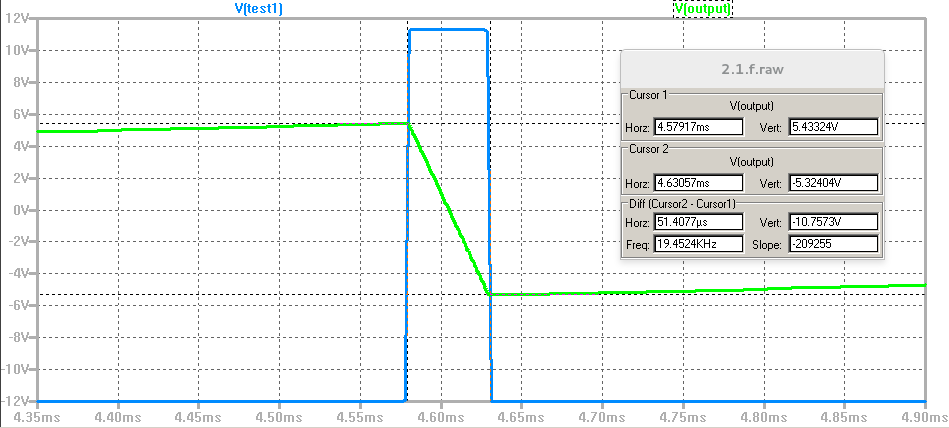
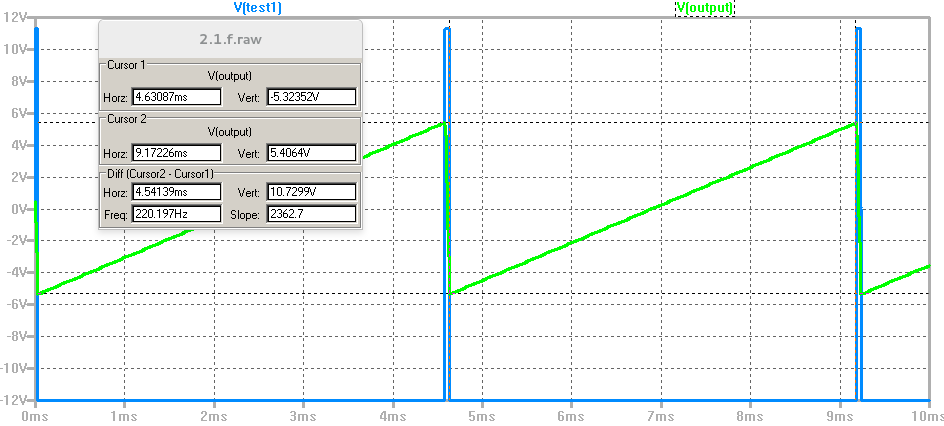
The theoretical if we assume that our components are ideal we can find negative slope time as you did or this way:
Vthp - Vthn = 10.9091V, the capacitor current I = (12V - 0.7V)/R3 = 51.3636mA and this current is constant during whole " negative slope" and the time is C = Q/V = (I*t)/V----> t = C*V/I
T = 220nF*(10.9091V/51.3636mA) = 46.7257μs
The simulation result will very because in simulation op amp and the diode are not ideal.
ok, thanks for the help. I'm going to use my way because I already have the formulas in Word Equation editor. At the end of the problem I'll explain that the simulation OpAmps are no ideal, therefore there is slight differences in the results!
The theoretical if we assume that our components are ideal we can find negative slope time as you did or this way:
Vthp - Vthn = 10.9091V, the capacitor current I = (12V - 0.7V)/R3 = 51.3636mA and this current is constant during whole " negative slope" and the time is C = Q/V = (I*t)/V----> t = C*V/I
T = 220nF*(10.9091V/51.3636mA) = 46.7257μs
The simulation result will very because in simulation op amp and the diode are not ideal.
Is it possible to test the triangle wave generator (Blocks 1&2) on the breadboard? I'm trying to test it but instead of R3 = 22kΩ and C = 220n, I have R3 = 10kΩ and C = 100n but I can't get any triangular wave!
I'm using the sloppy UA741 (x2) and a film capacitor of 100n... Could it have anything to do with that option in LTSpice to skip the initial Operationg point solution calculation?
Is it possible to test the triangle wave generator (Blocks 1&2) on the breadboard? I'm trying to test it but instead of R3 = 22kΩ and C = 220n, I have R3 = 10kΩ and C = 100n but I can't get any triangular wave!
I'm using the sloppy UA741 (x2) and a film capacitor of 100n... Could it have anything to do with that option in LTSpice to skip the initial Operationg point solution calculation?
I'm using a single power supply but it has an external circuit that can convert the power supply voltage into +12V, -12V, +3.4V, +5V and GND. It was a friend of mine that borrowed it to me. So, after all, I'm using a split (symmetrical) power supply of +12V and -12V.
I have it already built on the breadboard! But the scope is only showing +10V at the output of OpAmp 1 (AO1) and -10V at the output of the 2nd OpAmp (AO2).
You or your friend must made some error when assembling the circuit.
I also quickly build this circuit with LM358 and R3 =10kΩ and C1 = 220nF; R1 = 10kΩ ; R2= 22kΩ power from split supply +/-12V
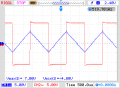
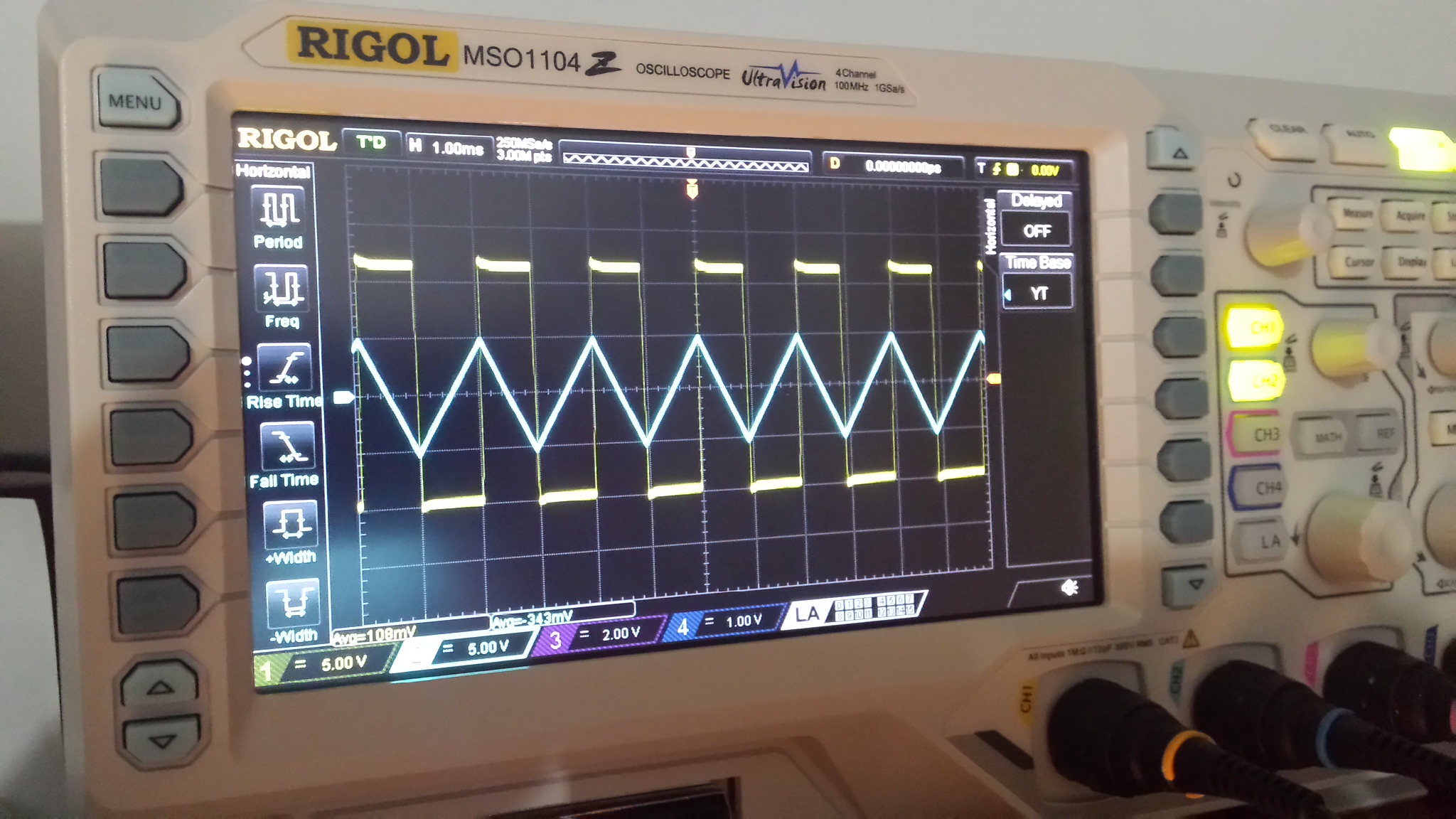
And circuit works as a treat. Take a look at scope shot
You or your friend must made some error when assembling the circuit.
I also quickly build this circuit with LM358 and R3 =10kΩ and C1 = 220nF; R1 = 10kΩ ; R2= 22kΩ power from split supply +/-12V
And circuit works as a treat. Take a look at scope shot View attachment 95141
Ok, but the converter circuit is just fine! It was from some old power supply I guess he had! The rail voltages are just fine.out of the circuit! I have used them on other experiments and they were nice!
Can you show your circuit? I'm only talking about Blocks 1 & 2. Not the whole circuit with three OpAmps...
Is that IC only 1 LM358 or are those IC's that has 2 or 4 OpAmps inside? I'm using 2 UA741. But I think I'm going to tear this down again and build the 2 blocks separately and test each one!
I think the integrator is also working fine but I can't get the triangular wave out of AO2...
I checked both OpAmp supply voltages and they are fine! I used a potentiometer to vary the input voltage both for the Schmitt Trigger and for the Integrator at both worked fine but when I put both together, I just get 11.6V at AO1 output and -10V at the AO2 output! 2 flat lines!
The 2 blue wires are the +12V. The grey/green wires on the bottom side of the picture are the -12V.
Then I have 10kΩ+10k+2.2kΩ = 22kΩ from the +in to the AO1 output. Then a 10kΩ from the +in to one end of the cap. Then I have another 10kΩ from the AO1 output to the AO2 +input! I guess it's all!
The first op amp on the left is Ao1 ?
Form what I see the 10k resistor is wrongly connected and this green wire go to 100nF cap ? Why ?
I do not see any connection between 100nF cap and AO2 -input.

 Facebook
 Google
 GitHub
 Linkedin