Never had/played with a 'variable frequency drive' VFD... How does it work ?

meth

Joined May 21, 2016
304
The input to what can be anything ? What controller ? Potentiometer? Really ? Digital signals ? What are those ? Where/how does networking play any role here ?
If we are talking about the external input, how the user (or the PLC) is controlling the VFD, you would have to choose a specific VFD model so we can talk about it, because there are all combinations possible. You can load stored settings using Digital I/O, or you can send various numeric values and triggers using PROFINET, you can use RS232 or RS485 to change parameters and so on..

If we are talking what is going on inside the VFD from electronic aspect, which values from the output (current, frequency..) are evaluated and controlled to maintain the desired speed, that is completely different subject.
 

panic mode

Joined Oct 10, 2011
4,995
fieldbus is a way to go specially when there is several VFDs and quite often, single control panel can be packed with dozens of VFDs. sometimes VFDs are integrated into motor itself. analog speed control using potentiometer is usually found in places with individual VFD. digital signals are bread and butter of automation world. by far the most common are 24VDC I/Os. AC types (mains voltage) I/Os used to be popular where higher loads or longer wire lengths are involved but with fieldbuses those are nearly extinct nowadays. fieldbus (networking) allows control of many drives distributed over large floor areas such as assembly lines, automated warehouses, etc. any time there is a motor, there is a good chance it is controlled by VFD. often very small areas will have bunch of conveyor sections that are each driven by a separate VFD so that products can be routed/diverted smoothly. and that is just one "intersection". typical plant will have many, often controlled from central controller.

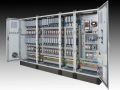
example control panel, note that three wings on the left are packed with drives. purple cable that jumps from one drive to the other is a fieldbus (network) cable. controller is PLC in the right wing.
regardless if drives are grouped in one cabinet or distributed, fieldbus reduces wiring and cuts the cost. here bus (in this particular example ProfiBus) is using 2 wire and shield, no I/O cards in the PLC rack.
one could of course use discrete I/Os to control start/stop/direction/speed/fault present/fault reset etc. but that would add some 10 wires to each drive. with 40 drives that would be 400 wires (get wire, measure to length, cut it, strip the ends, crimp ferules, print and apply wire labels, connect both ends). this is SERIOUSLY labour intensive. not to mention needed space in the PLC rack for I/O modules, cost of I./O modules, troubleshooting and fixing any mistakes during commissioning/startup, then any future downtime when swapping failed drive etc.

and all of this is replaced by a single 2-wire cable.

1773152670956.png
 
Last edited:

MrAl

Joined Jun 17, 2014
13,707
A modern air-conditioner will have a VFD to drive its compressor. The AC input will be rectified (and probably boosted by a power-factor controller) to give a DC voltage (usually about 400V) to run the VFD.
The right battery voltage connected to the right part of the circuit would mean neither VFD nor inverter would be required.
The PFC is simply a boost converter, so in theory would work with a DC input.
However, there may be other parts of the circuit that do run off AC (smaller fan, perhaps, condensate pumps etc.)
Hi,

You mean modify the modern air conditioner?

"The PFC is simply a boost converter"
What DC input you think would be required?
 

Ian0

Joined Aug 7, 2020
13,132
Hi,

You mean modify the modern air conditioner?

"The PFC is simply a boost converter"
What DC input you think would be required?
Hi,

You mean modify the modern air conditioner?

"The PFC is simply a boost converter"
What DC input you think would be required?
Just because I know of aircons that are done this way, it doesn't mean that they all are. You'd have to look inside and see how it works.
A universal PFC front-end will generate the bus voltage from anything between 90V AC and 253V AC, so it should be quite happy at 120V DC.
 

MrAl

Joined Jun 17, 2014
13,707
Just because I know of aircons that are done this way, it doesn't mean that they all are. You'd have to look inside and see how it works.
A universal PFC front-end will generate the bus voltage from anything between 90V AC and 253V AC, so it should be quite happy at 120V DC.
Hi,

Oh I did not mean to imply that they were all like that. Just wondering what your thoughts were on modifying one that we knew about already.

A good question might be how do we ensure we get a modern AC unit and not the old style. I see the old style still being sold too at 5000 BTU.
 

Ian0

Joined Aug 7, 2020
13,132
Hi,

Oh I did not mean to imply that they were all like that. Just wondering what your thoughts were on modifying one that we knew about already.

A good question might be how do we ensure we get a modern AC unit and not the old style. I see the old style still being sold too at 5000 BTU.
They are usually referred to as being "inverter driven". But that might be the terminology they use to sell it to the British! Marketing-speak might not translate! The European Energy Using Products directive might mean that they all have to be inverter driven for efficiency.
 

Mussawar

Joined Oct 17, 2011
158
Hi.
What is the input ? What is the circuitry inside ? Does it rectify the AC mains and then creates another mains outputting a different frequency AC mains ?

If rectifies the inputted voltage first; could it be modified to accept DC as input and create AC at a certain frequency output ? Sort of selectable/variable frequency inverter ? Do they exist single phase output ?
Yes. Most VFDs accept external DC input at their DC Bus terminals. Some provide input selection method in the parameters (Mitsubishi etc.) and some simply start working if you provide required DC at bus terminals. Mostly Chines models are a bit simple and free for input supply method.
VFDs come both for single phase and three phase output.
International models always come with select-able input supply frequency (i-e 50Hz or 60Hz) from within software through a specific parameter.
 

MrAl

Joined Jun 17, 2014
13,707
They are usually referred to as being "inverter driven". But that might be the terminology they use to sell it to the British! Marketing-speak might not translate! The European Energy Using Products directive might mean that they all have to be inverter driven for efficiency.
Hi,

I actually had a modern 6000BTU unit not that long ago and when I bought it I had no idea it had that advanced technology.
It resulted in a reduced current surge when it first turned on, and it did not "try" to turn on after just turning off. WIth the old type, if you turned them off and then back on, they would draw a large current and just hum quietly, but the compressor would not be able to start up I think because there was still pressure in there and the motor can't start having to work against that pressure. I think it was the inline surge suppressor that prevented a really really huge current like 100 amps, it was more like 15 amps with the limiting. With the new unit, it simply waited for a set time like 3 minutes before it would try to start up the compressor again. The surge would be mild and very short, and it started and ran fairly quiet too. It also had a remote control which does come on a lot of the modern ones now.
 

MaxHeadRoom

Joined Jul 18, 2013
30,665
Yes. Most VFDs accept external DC input at their DC Bus terminals. Some provide input selection method in the parameters (Mitsubishi etc.) and some simply start working if you provide required DC at bus terminals. Mostly Chines models are a bit simple and free for input supply method.
VFDs come both for single phase and three phase output.
International models always come with select-able input supply frequency (i-e 50Hz or 60Hz) from within software through a specific parameter.
Very few use a single phase motor version due to the problems listed above (#6).
 

Mussawar

Joined Oct 17, 2011
158
Very few use a single phase motor version due to the problems listed above (#6).
Yes VFDs are mostly designed for three phase but have seen single phase capacitor motors working very well with 3ph output. Might not be 100% perfect but somehow acceptable. Especially Chines versions are a lot more flexible. Western models are more sophisticated but with higher performance and safety.
 
Top