Why are decoupling caps never aluminum polymer or tantalum polymer?

Thread Starter

ballsystemlord

Joined Nov 19, 2018
253
Hello,
In every schematic from a datasheet I've ever read, they always either explicitly say that the decoupling caps are ceramic, or they show them as being non-polar thus leading one to guess either film or ceramic caps are required (film have very high ESR in my experience, so they may not work). C0G/NP0 is impressive over frequency and temperature, but I'm still confused.

Why are decoupling caps never aluminum polymer or tantalum polymer?

Thanks
 

MisterBill2

Joined Jan 23, 2018
27,336
Decoupling capacitors are mostly ceramic or paper because it is the least critical portion of a circuit, and ceramic capacitors cost less and seldom fail short circuited. In addition, they are often physically smaller, making them fit where other types will not fit. Those are the primary reasons.
 

nsaspook

Joined Aug 27, 2009
16,274
Because the world is not circuit theory perfect and engineers design in an imperfect world of actual components that only deliver the specific need properties in slices of the vast range of electrical properties.
 

Thread Starter

ballsystemlord

Joined Nov 19, 2018
253
Decoupling capacitors are mostly ceramic or paper because it is the least critical portion of a circuit, and ceramic capacitors cost less and seldom fail short circuited. In addition, they are often physically smaller, making them fit where other types will not fit. Those are the primary reasons.
So then in theory other types could be used, but it's easier for the EEs to just recommend what's most likely to work?
 

nsaspook

Joined Aug 27, 2009
16,274
So then in theory other types could be used, but it's easier for the EEs to just recommend what's most likely to work?
Risk aversion is a good thing if you know something works and there is no science based reason to change.. Easier now likely means it was much harder at least once before.

Wisdom is not making the same mistake, more than, twice. ;)

There are times at RF where a silver mica is most likely to work: https://en.wikipedia.org/wiki/Silver_mica_capacitor
Mica has been used as a capacitor dielectric since the mid-19th century. William Dubilier invented a small mica capacitor in 1909 which was used in decoupling applications.[1] They were put into large scale commercial production to meet military requirements in World War I. Mica is less prone to crack under mechanical shock than glass, a useful property for equipment subject to shellfire. Like glass, mica has a substantially higher permittivity than paper so capacitors can be made smaller.[2] In 1920 Dubilier developed a capacitor consisting of a flaked sheet of mica coated on both sides with silver. He formed the Dubilier Condenser Company to manufacture them. Ceramic capacitors were also used in the 1920s due to a shortage of mica, but by the 1950s silver mica had become the capacitor of choice for small-value RF applications.[1] This remained the case until the latter part of the 20th century when advances in ceramic capacitors led to the replacement of mica with ceramic in most applications.[3]
https://www.cde.com/resources/catalogs/MC.pdf
https://www.mouser.com/c/passive-components/capacitors/mica-capacitors/?termination style=SMD/SMT
 
Last edited:

MisterBill2

Joined Jan 23, 2018
27,336
Aside from avoiding any risk, which would include excessive cost, ceramic capacitors ARE physically more durable, which is a definite advantage in the assembly process.
 

Thread Starter

ballsystemlord

Joined Nov 19, 2018
253
Aside from avoiding any risk, which would include excessive cost, ceramic capacitors ARE physically more durable, which is a definite advantage in the assembly process.
I thought they were no more durable than any other type given that they can be all too easily broken by board flexing during assembly.
Thinking more about it, why do we care about durability? Like, who takes capacitors and hits them with a hammer or something after manufacturing?
 

Thread Starter

ballsystemlord

Joined Nov 19, 2018
253
@nsaspook I watched the videos. They really didn't talk about why ceramic caps so much as the general properties of capacitors (most notably ceramic ones), and their necessity, or lack thereof, in a circuit.
 

MrChips

Joined Oct 2, 2009
34,703
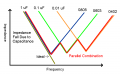
The key consideration for choosing a decoupling capacitor is its ESR and high frequency response.
This frequency response graph of capacitors in parallel graphically shows that capacitors behave differently at higher frequencies.

1738513270102.png
 

crutschow

Joined Mar 14, 2008
38,420
@nsaspook I watched the videos. They really didn't talk about why ceramic caps so much as the general properties of capacitors (most notably ceramic ones), and their necessity, or lack thereof, in a circuit.
Ceramic caps generally have a lower ESR and self-inductance to provide better high frequency decoupling than electrolytic types.

Decoupling capacitors are needed near IC power pins to provide a local low-impedance supply voltage at that point, to minimize circuit oscillations or malfunction from changes in the power voltage due to the transient current draw of those ICs across the power trace inductance .
The circuit may operate okay without them, but it's a risk that good designers don't take.
Newbies often leave them out, and then wonder why their circuits don't operate properly.
 
Last edited:

Tonyr1084

Joined Sep 24, 2015
9,744
who takes capacitors and hits them with a hammer or something after manufacturing?
Thermal shock is like hitting it with a hammer. Shock and vibration are even more so. As always, a big part of engineering is understanding the environment it will live in. Extreme cold weather is entirely different engineering than extreme heat. Going from extreme hot to cold and back again is also a consideration. Think about earth's satellites: One side of them facing the sun can be 250˚F hot while the shaded side (away from the sun) can be 250˚F cold. That's a 500˚ difference. You don't take that trivially. Whereas my dash camera is no where near to those extremes in variations in temperature. Yet, winter cold mornings into daylight sun and baking inside the car can vary as much as 100˚F. My computer key board regularly sees temperatures from 40˚F to 80˚F. It's in a controlled environment. Certainly would not survive in space.
 

Tonyr1084

Joined Sep 24, 2015
9,744
I recall one day at work in particular. An assembler had finished building a board and put it in the ultrasonic bath. It was intended to be in there for a few minutes. However, it was lunch time and the board was forgotten. After lunch when the board was retrieved - the report I heard was that ALL the components (through hole at that time) had been completely washed off the board. So why doesn't the ultrasonic machine destroy itself in the same manor? Likely the shock and vibration was taken as a serious consideration.
 

crutschow

Joined Mar 14, 2008
38,420
Just to be clear crutschow, I wasn't suggesting the use of electrolytic caps.
Further clarity from Google:

Aluminum polymer capacitors are a type of capacitor that uses a solid polymer instead of a liquid electrolyte. They are a type of electrolytic capacitor, which are made up of two conductive plates (electrodes) separated by an insulator.

Electrolytic type capacitors are usually used where high capacitance is needed, such as at the output of a rectified AC voltage for power, or on a PCB where the power enters the board.
Local IC decoupling capacitors have a low capacitance (typically 10 or100nF) so small, low ESR ceramic capacitors work better for that.
 

Thread Starter

ballsystemlord

Joined Nov 19, 2018
253
Well, the capacitors I'm seeing on linear regulators and voltage references are pretty much all 10uF ceramics. Which surprises me. That's a huge value for ceramics.
 

nsaspook

Joined Aug 27, 2009
16,274
Well, the capacitors I'm seeing on linear regulators and voltage references are pretty much all 10uF ceramics. Which surprises me. That's a huge value for ceramics.
Not today, it's very common for ceramics. I use them on most of my boards, sometimes with up to three different values and types for wideband decoupling and bypassing. Small, cheap and effective.
1738529056006.png
The 1000pf cap is a different type of capacitor than the 10uf and 0.1uf types. It's a type specifically designed for RF (RF Microwave / High Q), the closest device to the pin and directly correct the the ground plane for the smallest loop path.
1738529091417.png
They do have a voltage dependency in high values, so use the correct voltage rating for each application on a circuit.
Is your 10uF capacitor really 10uF in your circuit?
 
Last edited:

DickCappels

Joined Aug 21, 2008
10,661
There was a time that tantalum capacitors tended to short. Older engineers would never connect a tantalum capacitor directly between a power supply and ground, insisting on at least a resistor to limit short circuit current.
 

nsaspook

Joined Aug 27, 2009
16,274
There was a time that tantalum capacitors tended to short. Older engineers would never connect a tantalum capacitor directly between a power supply and ground, insisting on at least a resistor to limit short circuit current.
That's one of the reasons that even today, with much better devices, I seldom use them anywhere unless it's a specific, critical date-sheet requirement for things like the controller VCAP bypass. Tantalum capacitance is usually stable for the specified frequency, voltage, and temperature range of the device.
 
Top