I added a 3-channel version to my AliExpress cart. I need another PWM generator like I need another hole in the head, but it was cheap and shipping was free for orders over $10.
heh, thats the one I took too. I wander if it will output 3 different PWM in the same time... hmmm thats what I expect from it.
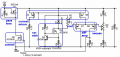
Mine is having a more cryptic name:
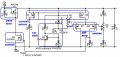
The maximum output voltage is limited to about 14V. Q7 and Q8 are the limiters.
The dropout voltage is several volts.
I used a current sink for the zener because low voltage zeners don't have sharp knees, so varying the output voltage affects vref. I used a BJT because it's easier to control the current.
I used a current mirror (Q3, Q6) to have better control over the current in the differential amplifier. The current varies with output voltage.
I added R5 to be able to set the reference voltage lower than the zener voltage. This isn't as easy to do with BJT's where you need to contend with base current.
The resistor values in the voltage divider could be larger, but I only had 1k pots handy. R5 could have been a higher value too.
In the BJT version, R1 sets the maximum current and you have to contend with current gain. That's why the pass element in BJT regulators use a Darlington configuration. The Motorola BJT version showed collector resistors on both transistors in the diff amp. Since the output is single ended, one of the resistors was unnecessary.
I dont believe we are doing the same experiment here.
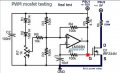
What did you measured in this oscilogram? Put 2 red dots on your cct diagram where the probes are, for this experiment.
The maximum output voltage is limited to about 14V. Q7 and Q8 are the limiters.
The dropout voltage is several volts.
I used a current sink for the zener because low voltage zeners don't have sharp knees, so varying the output voltage affects vref. I used a BJT because it's easier to control the current.
I used a current mirror (Q3, Q6) to have better control over the current in the differential amplifier. The current varies with output voltage.
I added R5 to be able to set the reference voltage lower than the zener voltage. This isn't as easy to do with BJT's where you need to contend with base current.
The resistor values in the voltage divider could be larger, but I only had 1k pots handy. R5 could have been a higher value too.
In the BJT version, R1 sets the maximum current and you have to contend with current gain. That's why the pass element in BJT regulators use a Darlington configuration. The Motorola BJT version showed collector resistors on both transistors in the diff amp. Since the output is single ended, one of the resistors was unnecessary.
Yes... well I was right, in not understanding everything you build there. There are a lot of higher level modules in there than my practice knowledge. I am good but not as you good. You are my better!
And I finished filming the entire experiment with the mosfet and my Power supplies used. Because you were not understanding what the hell Im doing there. But I had some serious and interesting problems to figure out, to observe and to somehow correct them. Thats what I was doing. Movie will come later today. Stay tuned.
We are. I'm pointing out issues that affect measurement accuracy.
Ideally, power supply voltage would remain constant regardless of the current being drawn. My data shows that wiring resistance is affecting measurements by up to about 10%. When I used short #12 leads for the 5V supply, that dropped to about 3%. Maybe double those numbers due to how I have my grounds connected.
The only new circuit block is the differential amplifier. My first post in this thread was the current mirrors and current sink/sources. We've been using MOSFETs as variable resistors in the current sink circuit.
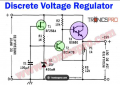
One of the first steps in analyzing a circuit is to identify the building blocks. There are conventional ways to draw them to facilitate recognition. People who don't really understand what they're doing will draw them unconventionally (e.g. drawing Q1 vertically instead of horizontally as pass transistors are usually drawn).
This is an example from the internet of how to not draw a discrete voltage regulator schematic:
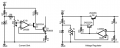
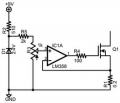
The initial current sink circuit we were using for load testing/transistor power capacity would be recognized as a voltage regulator if it was drawn differently:
Essentially, what I did was rotate the transistors 90 degrees counterclockwise and rotate the opamp 180 degrees.
The opamps in both of the circuits are essentially voltage followers. That's a very basic opamp configuration.
EDIT: In the description of a non-inverting amplifier, equation 3-17a would be easier to recognize as a voltage divider if they formatted more conventionally:
\( \large E_2 = E_{out} (\frac{R_{in}}{R_F+R_{in}})\)
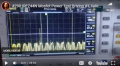
You're powering the PWM MOSFET with pulsating DC. That's why you see those humps at a frequency of 100Hz:
The irregularities are due to the scope averaging data (one of the major disadvantages of digital scopes).
You need to put a filter cap on the output of the bridge rectifier. That will smooth out the voltage. Voltage won't be regulated. The PWM circuit doesn't draw much current, but the downside is that the gate voltage won't be high enough to turn the MOSFET on hard. If you try to compare readings for different MOSFETs, threshold variation could affect your data. EDIT: previous statement not relevant because you're powering the MOSFET from the pulsing DC voltage.
In my case, I've already verified that the threshold voltage spread between my AliExpress specials is less than 0.3V and I have mine sorted by differences of less than 0.05V. The datasheet allows a variation of 2V (Vgs(th)=2-4V).
I'm not sure what the purpose of the video was. The title indicated a failed attempt, but I didn't watch enough to find out what your conclusions were.
The conclusion is that I can not drive that mosfet at a higher power like I did with the BJT. Because of this PSU problem.
Do watch this small fragment from 39:07 to 39:39 so its 30sec where Im explaining my goal with this project.
The PWM circuit is *not* intended to test power capabilities of the DUT (Device Under Test). It's being used to operate the MOSFET at "high" current while not having to worry about needing a heat sink due to high power dissipation.
To measure the power being dissipated by the MOSFET, you need to have a load resistor. You measure the drain voltage when the device is on (hard). What I was seeing was the drain voltage was at about 0.5V. Using a 5V supply and a 1 ohm load resistor, that means the resistor was dropping 4.5V and the MOSFET was dropping 0.5V. Ignoring the likely voltage drops in the wiring, when the MOSFET is on, the current in the resistor is 4.5A. So, the resistor was dissipating 20.25W (4.5A^2*1 ohm) and the MOSFET was dissipating 2.25W (4.5A*0.5V).
If you were operating at a 10% duty cycle, power dissipated over one full cycle would be 2.25W (22.5W/10).
You can also use this measurement to get an on resistance; which will be higher than the datasheet spec because the conditions specified in the datasheet aren't being met. I commented on the slope in the on waveform and said it was due to junction heating.
I don't have an explanation why the output went below ground...
EDIT 2: It's not real. I took the same measurement with my Tek 7D20 and, as expected, the signal doesn't go below ground. Better after I went through the calibration. Will post screen captures later...
Because I was seeing a significant voltage drop in the supply wires, the drop across the load resistor could have been 3.5-4V. That makes a significant difference in the calculations. Instead of testing at 4.5A, I was testing at more like 3.5-4A. That's still sufficient for most of my needs. I do want to use some of the AliExpress MOSFETs in an electronic fuse and I was the fuse to be capable of handling 10A.
If you want to measure power handling capability, you should use the current sink circuit. And be prepared to provide adequate heat sinking.
To really be testing current and power dissipation capabilities of the IRFZ44N, we should be trying to get 30A and be willing to let the case temperature get up to 100C.
EDIT: a couple more things. The bridge rectifier you're using probably isn't good more than 1-2 amps. The same goes for the transformer. With a 1 ohm resistor, you're trying to draw more than that.
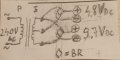
Are there two separate windings on the transformer? Or are you putting a bridge rectifier across the whole winding and another across the center tap?
If can get 15V from the bridge rectifier you've labeled as 9+V, you can use that to power the PWM and use your big supply for the MOSFET. Don't worry about the sound you're hearing. That shouldn't hurt the power supply. Mine do it too. At first, I thought it was the MOSFET making the noise. After you mentioned your power supply making noise, I listened more carefully and found it was the supply.
I've used the edit feature thousands of times. Sometimes I try to make edits in quick succession and the website makes me wait. In the case I mentioned in this thread, I tried half a dozen or so times, gave up, and made a new post.
It could have been my slow internet connection, but it failed so many times and I was able to make a new post, so I think it was the site.
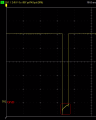
Waveforms for drain and power supply droop after calibrating the Hantek 6022BE.
The supply leads are 3' of #12, so I expect a voltage drop of about 150mV. The photo above only shows half of the drop due to where I placed the ground lead of the probe.
I still have no idea why the scope continues to show the supply voltage is 5.1V when I have it set to 5.00V (measured with HP bench meter).
With these measurements, ignoring supply lead drops, current in the 1 ohm load resistor is 4.8A and MOSFET voltage drop is 0.2V.
If you want to measure power handling capability, you should use the current sink circuit. And be prepared to provide adequate heat sinking.
To really be testing current and power dissipation capabilities of the IRFZ44N, we should be trying to get 30A and be willing to let the case temperature get up to 100C.
Ok, I see your point now....
I don't remember if I try it already. But this will be the official test then.
This will also be in the same time a continuous driving of the mosfet, just to be on point.
- On the previous experiment the Mosfet+1R+PSU2, that "line" I was pointing in the video, it is pulsing. The biggest problem is that PSU2 is pulsing ! How to protect PSU2 from pulsing? To keep it constant, and then after some sort of filtering the pulsing to be visible only on the Drain of the mosfet? That's where my mind is concentrated to. Another smart question is how this problem is solved in commercial products? Can we dissect something that is driving in pulse directly from source and see there how they solved this issue with pulsating source? Or, if not a commercial circuit, then a consecrated circuit from some datasheet that you may know. I personally have no idea where to look.
I do have a theory though. I believe and I expect, if we will dissect such a scheme, we will probably see a very fast switching fv, in order of a few MHz probably. While this one I had here were exactly at 533Hz (still very fast though) on the Gate of the mosfet reading. And unofficial something like 15Hz on the Drain to PSU2 probing. Is unnoficial because most of the time I got no reading and if I catch a reading it was very jumpy values. So the Gate pulse is not really parraleled to the Drain !!! Because something is holding/slowing the pulse on the Drain, and my bet is the Coil in both this fix transformer PSU2 and some filtering coil on the output segment of my variable PSU1.
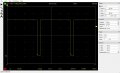
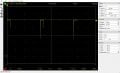
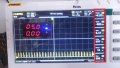
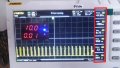
- Here is a reading with 5V and 10V for the Gate driver (for comparison reasons). And my hand probing on the Gate mosfet while the black probe is linked to the negative rail of the cct. You can see it is reading 533Hz on that gate. So that circuit module is doing it's job just fine. This other side, the 'line', is doing a very poorly job !!!! Thats THE problem !
Not the power cables that you cut their length recently and you keep insisting on them. Yes there are losses in them but the real problem for this experiment is really not in those cables. Is this active PSU2 !
I hope I am very clear now for you, my direction and my concentration. I want to steer you in my direction of thinking.
I will also do the power experiment, with the continuous driving mosfet, but it will remain a secondary problem. THis pulsating or active PSU2 is the big problem to figure it out. Ok? Thanks.

 Facebook
 Google
 GitHub
 Linkedin