Mosfet for boost converter

Thread Starter

psoke0

Joined Mar 31, 2017
205
hi. so i found a mosfet that looks like its allright for my needs. but i want to ask you too. im building a boost converter its will switch with 100 kHz Mosfet will need to pull down the inductor for only 1 amp . what i want to ask is my boost converter will just charge a capacitor no load. i want to charge the cap up to 220 V i think its will be slow but its okay. i will use low capacitance. okay the question is my mosfet says Drain to source voltge of only 30 V . isnt that going to be problem when incutor pushing 220 v in to the cap ? is it going to blow it up ?
https://pdf.direnc.net/upload/rtr040n03tl-4a-30v-n-kanal-mosfet-sot23-datasheet.pdf
 

Audioguru again

Joined Oct 21, 2019
6,826
The datasheet for the IRF740 shows that the on-resistance is a maximum of 0.55 ohms only when its gate voltage is 10V. But you are feeding the gate with only 4.2V maybe when a lithium battery is fully charged and only 3.2V when the battery needs to be recharged.
 

Thread Starter

psoke0

Joined Mar 31, 2017
205
The datasheet for the IRF740 shows that the on-resistance is a maximum of 0.55 ohms only when its gate voltage is 10V. But you are feeding the gate with only 4.2V maybe when a lithium battery is fully charged and only 3.2V when the battery needs to be recharged.
butis it okay DS voltage for this curcuit or not . and how can i learn how much resistance will be with 3,7 v GS
 

Papabravo

Joined Feb 24, 2006
22,058
butis it okay DS voltage for this curcuit or not . and how can i learn how much resistance will be with 3,7 v GS
In the datasheet there is a characteristic curve that shows drain current as a function of Vgs. There is also the threshold voltage which tells you the point at which the MOSFET begins to turn on. You don't wan to spend much time in this region, because this is where the device will have to dissipate maximum power, i.e. where it warms up considerably. There is also a theoretical equation that relates Vgs to drain current. Drain current is proportional to the square of the difference of Vgs and Vt, the threshold voltage. The characteristic curves will allow you to empirically determine the constant of proportionality. Ohm's law will allow you to infer rds(on) from the drain current and Vds.
 
Last edited:

Thread Starter

psoke0

Joined Mar 31, 2017
205
In the datasheet there is a characteristic curve that shows drain current as a function of Vgs. There is also the threshold voltage which tells you the point at which the MOSFET begins to turn on. You don't wan to spend much time in this regions because this is where the device will have to dissipate maximum power, i.e. where it warms up considerably. There is also a theoretical equation that relates Vgs to drain current. Drain current is proportional to the square of the difference of Vgs and Vt, the threshold voltage. The characteristic curves will allow you to empirically determine the constant of proportionality. Ohm's law will allow you to infer rds(on) from the drain current and Vds.
sorry my english s not that good but. even if i determine darain current with vgs how can i tell the rdson will be for learn rdson i need vds so how can i learn vds at given vgs
 

Papabravo

Joined Feb 24, 2006
22,058
sorry my english s not that good but. even if i determine darain current with vgs how can i tell the rdson will be for learn rdson i need vds so how can i learn vds at given vgs
If you don't know how to read the datasheet, and you lack the theoretical knowledge, I guess you have to measure it. Do you at least know how to setup the experiment to measure it?
 

Thread Starter

psoke0

Joined Mar 31, 2017
205
If you don't know how to read the datasheet, and you lack the theoretical knowledge, I guess you have to measure it. Do you at least know how to setup the experiment to measure it?
yes i know but im trying to figure this out before buying the mosfet
 

Thread Starter

psoke0

Joined Mar 31, 2017
205
i think what u are telling me is this
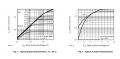
let see if i understand it correctly. if i feed gate with min 4.5 v the drain current will be just below 1 Amp in the right.
so if drain current is about 1 amp the vds will be about 1 volt in left right ?

1589734417893.png
 

Papabravo

Joined Feb 24, 2006
22,058
No. The graph on the right is a pulse test with Vds = 50V and a Vgs pulse 20 μsec wide with the Vgs value along the horizontal axis. The curve on the left is also a pulse test with a 20 μsec pulse. This is a highly contrived test setup and does not reflect any kind of typical application circuit. Do you know how to construct a DC load line on Fig. 1?

Neve mind. The Vgs(th) on this part is 2 V typical and 4 V. You are barely turning the device on and operating mostly in the linear range. It is going to get very warm and probably going to let the magic smoke out.
 
Last edited:

Thread Starter

psoke0

Joined Mar 31, 2017
205
No. The graph on the right is a pulse test with Vds = 50V and a Vgs pulse 20 μsec wide with the Vgs value along the horizontal axis. The curve on the left is also a pulse test with a 20 μsec pulse. This is a highly contrived test setup and does not reflect any kind of typical application circuit. Do you know how to construct a DC load line on Fig. 1?
no
 

Papabravo

Joined Feb 24, 2006
22,058
Never mind. I just had a look at the datasheet for the IRF740 and it looks like the Vgs(th) is 2 V typical and 4 V maximum. You cannot make an efficient boost converter with a device operating in its linear range. You'll let the magic smoke out.
 

Audioguru again

Joined Oct 21, 2019
6,826
The graphs on the datasheet are only for a "typical" one. But you cannot buy a typical one, some are better and many are worse.
The gate-source threshold voltage is shown to be 2V for some of that Mosfet and 4V for others. It barely conducts (only 0.25mA) at that threshold voltage. All of that Mosfet turn on fully when the gate-source voltage is 10V.
 

Thread Starter

psoke0

Joined Mar 31, 2017
205
okay lets say i build second boost converter for generating 10+ v for the gate of this mosfet :) i know its not efficent but then what i want to learn please teach me guys
 

Papabravo

Joined Feb 24, 2006
22,058
How is building a 2nd one going to help if you can't build the first one. One reason for using a controller chip is that you can do a number of interesting things on a substrate that you can't do with discrete components. I'm not sure you can get a device with the right parameters to do a discrete design.
 
Top