A parabolic mic works by having a microphone element located at the focal point of a parabolic reflector. The type of microphone element does not matter - electret, dynamic, carbon, whatever. If you are using a purchased parabolic mic, please post a link to its product page / vendor / etc.
Given that the TS has already mentioned that they assembled the amplifier and that it took a fair amount of effort to make it work, it is a reasonable guess that the whole parabolic mic system was built by the TS. I own one of those less expensive purchased parabolic microphone systems and the amplifier it has is no better than the one shown by the TS. And replacing the original mic with "a condensed microphone" would be a very major bit of surgery. So the TS choice is entirely reasonable.
Now if the TS is willing and able to share some details about their particular parabolic mic system, that could provide a bit of education for the rest of us.
The description of that AMAZON item is better than most from that seller, but still rather useless as far as providing useful information. AND why waste money on a product that will certainly not be easily adaptable to the application???
The only obvious benefit is that the product shown would utilize the phantom power provided.
The description of that AMAZON item is better than most from that seller, but still rather useless as far as providing useful information. AND why waste money on a product that will certainly not be easily adaptable to the application???
The only obvious benefit is that the product shown would utilize the phantom power provided.
So, have you seen the parabolic mic setup of the TS?? I have not, but I am guessing that switching the microphone will not be simple. And while the quality of the IC amplifier may not be as good as wanted, the quality of the signal before the amplifier should be rather good. Hence my original suggestion.
Connect positive pin of c7 to pin 2 of xlr. Connect ground of circuit to pins 1 an 3 of xlr. Use microphone input of mixer. P7 will control the level. Try it at maximum first.
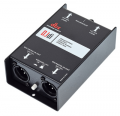
That would depend very much on the input signal level that the DI box is intended to handle. Direct Input "boxes" include a wide variety of arrangements because of the variety of devices they may connect to. Adapting a Juke Box output to a PA balanced mic input is much different from adapting an electric guitar output to a mic balanced input.
And the connection suggested in posts #4 and #5 may also work if your DI box is only for low level signals like an unbalanced crystal microphone or an electric guitar magnetic pickup.
I have never understood these values before but now I realize it is all about the values working together with the circuit.
Looks like the Palmer can handle more at the input. Do you suggest using that if i don't make any chances to the circuit?
I am little bit hesitant to undo soldering because it might cause smoke and cracked components as happened before...
I could just replace the speaker with the TRS jack .....or maybe connect the jack to the wiper(the one that is going to the negative of C7) of the potentiometer and ground?
OK, I see the DI box, it can work quite well. For the best quality and simplest operation you should connect the TRS connector to the two ends of the volume control on the parabolic microphone amplifier. Connect the "S" side to the "common" terminal on the volume control, connect the "Tip" to the other end of the control, and nothing to the middle "wiper" variable connection. Use a normal shielded cable to the DI box input connector, "S" to "S" and Tip to tip. I am hoping that you understand those instructions, if not P.M. me for additional discussion.
The attenuator on the DI box will serve to adjust the level to the recorder as needed.
Connect positive pin of c7 to pin 2 of xlr. Connect ground of circuit to pins 1 an 3 of xlr. Use microphone input of mixer. P7 will control the level. Try it at maximum first.
It may be that the phantom power is also on the line inputs. I suggest the DI box, which the TS already has on hand, as a good isolation and impedance match and level set scheme.
OK, I see the DI box, it can work quite well. For the best quality and simplest operation you should connect the TRS connector to the two ends of the volume control on the parabolic microphone amplifier. Connect the "S" side to the "common" terminal on the volume control, connect the "Tip" to the other end of the control, and nothing to the middle "wiper" variable connection. Use a normal shielded cable to the DI box input connector, "S" to "S" and Tip to tip. I am hoping that you understand those instructions, if not P.M. me for additional discussion.
The attenuator on the DI box will serve to adjust the level to the recorder as needed.
I seriously suggest that you are satisfied with the results before spending that much effort. Considering the expense of that recorder, I am guessing that your requirements for sound quality are more than those of average folks. And the fact that you not only were aware of Direct Input boxes but also had them on hand tells me that recording is a bit more than a casual activity for you. At least that is my guess.
It may be that the phantom power is also on the line inputs. I suggest the DI box, which the TS already has on hand, as a good isolation and impedance match and level set scheme.

 Facebook
 Google
 GitHub
 Linkedin



 @ 60 Hz) 1 M Ohm(s)