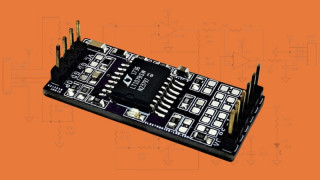
Microphone circuit chart

Thread Starter

riversun

Joined Oct 31, 2024
32
What do you see different about the two datasheets?
One is by ON-Semi and the other is from ST.
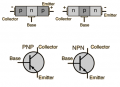
There is no difference , thank you! i got confused bacause in some data sheets the emitter is down and sometimes up, but it is always the emitter arrow pointing inward...and i sent two similar datasheets with my question... My apologies for the silly question!
 

MrChips

Joined Oct 2, 2009
34,815
FYI, emitter arrow pointing away from the base is NPN transistor, base is P, emitter is N, e.g. 2N3904.
Emitter arrow point towards the base is PNP transistor, base is N, emitter is P, e.g. 2N3906.

1748803508296.png
 

MisterBill2

Joined Jan 23, 2018
27,523
Hello,

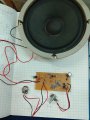
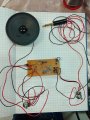
Is there anybody who could tell me how this circuit should be changed in order for it to work for recording? I mean replacing the speaker (LS) to mono TRS jack for output signal. It is parabolic microphone and as such works quite good.
I would take the output signal from the junction between C8 and P1, with the return tied to the circuit common negative. That scheme will provide a medium impedance "single ended" voltage output. It might be a bit to low level for a line level input on an average recorder. It might be too much for a magnetic microphone input, but about right for a crystal mic input.
 

MisterBill2

Joined Jan 23, 2018
27,523
Certainly that speaker will function like a dynamic microphone. AND because of the larger diaphragm area, it will capture more sound energy. BUT the pickup pattern will be a bit broader. And the response will be different. My choice for the microphone for an outside parabolic reflector mic system would be a four-inch diameter plastic coned speaker, with a 45 ohm voice coil, if that would be available. Or at least an 8 ohm VC.
 
Last edited:

AnalogKid

Joined Aug 1, 2013
12,131
Compared to what is in a microphone cartridge, that speaker cone and its voicecoil have at least 100x the mass. The signal level will be very low.

ak
 

AnalogKid

Joined Aug 1, 2013
12,131
The speaker cone ALSO has about 100X the area to collect sound energy.
Meant to say 1000x. Sorry.

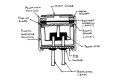
Visualize the thickness of the electret film in a mic cartridge - 0.0005". Now, visualize the thickness of the speaker cone in the 5-3/8" diameter rigid part. If the thickness of the cone is 0.5 mm (and that's pretty thin for a speaker of that size and power rating), that's almost 40x the thickness of the electret film. Granted the material densities are not equal, but even if the cone material density is one-tenth the film density, that still means the cone is 4x heavier per unit area.

Some electret cartridges are characterized out to 50 kHz and beyond. You don't get that kind of performance by being fat.


http://www.openmusiclabs.com/learning/sensors/electret-microphones/

1752353321178.png

ak
 
Last edited:

MisterBill2

Joined Jan 23, 2018
27,523
Certainly the electret microphone technology is impressive. A whole lot of signal and excellent frequency response. But speakers and dynamic microphones have a lot in common. A wire coil positioned in a magnetic field, and motion generating a current and voltage OR a voltage and current producing motion. Speakers can serve as quite effective microphones.
Certainly the speaker form-factor can be inconvenient at times. BUT the 32 ohm ear buds can serve as good communication microphones.
 

MisterBill2

Joined Jan 23, 2018
27,523
There is no difference , thank you! i got confused bacause in some data sheets the emitter is down and sometimes up, but it is always the emitter arrow pointing inward...and i sent two similar datasheets with my question... My apologies for the silly question!
I did not consider it a silly question.
 

Thread Starter

riversun

Joined Oct 31, 2024
32
Certainly that speaker will function like a dynamic microphone. AND because of the larger diaphragm area, it will capture more sound energy. BUT the pickup pattern will be a bit broader. And the response will be different. My choice for the microphone for an outside parabolic reflector mic system would be a four-inch diameter plastic coned speaker, with a 45 ohm voice coil, if that would be available. Or at least an 8 ohm VC.
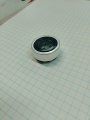
Does the speaker used as a microphone also need the resistor ?(what you said earlier that there needs to be resistor between the far left IN and the -22u). I was planning to place 10K resistor on that spot when using dynamic mic cartridge?Is 10k good there?
 

Thread Starter

riversun

Joined Oct 31, 2024
32
Meant to say 1000x. Sorry.

Visualize the thickness of the electret film in a mic cartridge - 0.0005". Now, visualize the thickness of the speaker cone in the 5-3/8" diameter rigid part. If the thickness of the cone is 0.5 mm (and that's pretty thin for a speaker of that size and power rating), that's almost 40x the thickness of the electret film. Granted the material densities are not equal, but even if the cone material density is one-tenth the film density, that still means the cone is 4x heavier per unit area.

Some electret cartridges are characterized out to 50 kHz and beyond. You don't get that kind of performance by being fat.


http://www.openmusiclabs.com/learning/sensors/electret-microphones/

View attachment 352562

ak
I thought to test the speaker as microphone ...i got small dynamic mic if it does not work. I will see if i can find better speaker for this.
 

MisterBill2

Joined Jan 23, 2018
27,523
Since the DC resistance of the speaker is probably less than 10 ohms, and certainly less than 100 ohms, and as that "excellent pre-amplifier" already has a 47K resistor across the input, there is no need for any additional resistor.
A caution is that IF you choose to substitute an electret microphone element in place of the speaker or dynamic microphone, you will need to add a resistor to provide the bias for that electret device. BUT ONLY if you make that substitution.
 

Thread Starter

riversun

Joined Oct 31, 2024
32
Since the DC resistance of the speaker is probably less than 10 ohms, and certainly less than 100 ohms, and as that "excellent pre-amplifier" already has a 47K resistor across the input, there is no need for any additional resistor.
A caution is that IF you choose to substitute an electret microphone element in place of the speaker or dynamic microphone, you will need to add a resistor to provide the bias for that electret device. BUT ONLY if you make that substitution.
Would 10 K then be appropriate if i change to the dynamic mic? I got dynamic mic capsule for this circuit. Should a new resistor be placed where the 47K is now or between the IN signal and the -22u?
 

Attachments

Thread Starter

riversun

Joined Oct 31, 2024
32
Would 10 K then be appropriate if i change to the dynamic mic? I got dynamic mic capsule for this circuit. Should a new resistor be placed where the 47K is now or between the IN signal and the -22u?
I found a speaker that fits your description, it is about 40 ohm but not plastic, it is aluminium and about 10cm diameter. I try this first and if it is not good i use the dynamic capsule that i got.
 

MisterBill2

Joined Jan 23, 2018
27,523
OK, "riversun", and now I am asking a favor: Please let us know how well the speaker as a microphone works for your application, which is some parabolic microphone project. I am asking because I want to assemble a parabolic mic system in the near future. I have a clear plastic cone intercom speaker and a three foot TVRO reflector that is not one of those off-axis types. And it has the original RF assembly at the focus, so I will not need to try and find where to put the microphone element.
I did build a "shotgun sound snooper" that was in Popular Electronics magazine many years ago. That worked but it was not impressive.
I did discover a serious hazard with using the setup, which is having a noisy car cross the path that I am listening on. So an amplifier with some sort of volume limiter would be a good addition.
(You can PM me with comments if you want.)
 

AnalogKid

Joined Aug 1, 2013
12,131
I did build a "shotgun sound snooper" that was in Popular Electronics magazine many years ago. That worked but it was not impressive.
My high school junior year science fair project. No one, including the judge, believed that I built it from scratch without help. I used the amplifier board from a dead portable reel-to-reel tape machine. The frequency response was terrible because of the equalization, but the little puppy did work. Still have it.

ak
 
Top