Maximum working EMF of Cu core automotive ignition cable?

Thread Starter

Hypatia's Protege

Joined Mar 1, 2015
3,228
Kind friends...

Re: our 'EHT tutorial' series - whereas we have received copious (on and off list) feedback advising economy in instruments and materials and whereas we find such advice wholly reasonable where application of same is consistent with quality and safety, I have taken the decision to advise use of automotive ignition cable over more costly alternatives where appropriate -- please note the following summary of commonly available EHT-insulated conductors with attention to the likely desirability of the former product in the eyes of 'economy minded' hobbyists:

-Solid core automotive ignition cable: (e.g. 'Hypalon Copper Conductor', etc) Outer Dia=7mm, Price ≈ $10 per meter -- Electrical data not published (Which is to say I cannot locate said data:oops:):mad:

-'TV grade' AWM 3239 CRT 'accelerator' lead: (e.g. 'KynarKable') Outer Dia=4.5mm (40kV working potential) Price ≈ $40 per meter)

Federal standard h0453 Px-250: Outer Dia=20mm (250kV working potential) price ≈ 300$ per meter

Despite much research and inquiry I have been unable to obtain a 'straight answer' to the titular question...

Although my own tests indicate insulation breakdown EMF of said product to range from 130kV - 160kV, I hesitate, on the basis of integrity and safety, to advise based upon empirical data - much-less extrapolate 'safe working stress' from failure stress...:eek:

SO... Any insight into the rated maximum working EMF specification of 'solid conductor' (i.e. 'non-resistor') automotive ignition cable will be greatly appreciated!:)

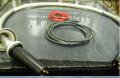
By way of mitigation of ambiguity/language barriers, I offer the following image of the products under discussion:

Foreground: Example of the (Cu conductor) ignition cable in question.
Mid image: 'TV Grade CRT Cable' (AWM 3239).
Background and encircling: Federal Standard 250kV radiography cable.

Many advance thanks for any info, ideas or input!

At your mercy
HP:cool:

GarretLabEhtCable.png
 

shortbus

Joined Sep 30, 2009
10,050
At one time the gold standard for spark plug wire was Packard 440. People will say it's no longer made but it's not true. The last ~10 years of my employment at Delphi Packard, in the plug wire dept. they ran that wire many times, for the aftermarket. I don't know the voltage rating and a quick Google didn't find much. It is used as a HV lead on neon signs though. Just the first link I looked at on Ebay - http://www.ebay.com/itm/Packard-440...ly-/381804838653?_trksid=p2385738.m2548.l4275
 

tcmtech

Joined Nov 4, 2013
2,867
Automotive ignition cable is good to around 40 - 50 KV it will start to break down at that voltage after a while.

If you need to go higher for your own DIY high voltage cabling there are certain larger gauge coaxial cables made for commercial radio transmitters and such applications that have some pretty impressive high voltage capabilities. I've seen a few odd pieces of the stuff that had ~ 8 - 10ga copper cores in a ~ 1.5" dia cable which if the outer braided conductor layer was taken off would likely stand up to the voltages you're working with for some time.

Beyond that, another option would be to make your own secondary insulation layers for whatever HV cable you use by putting it inside a thick wall silicone or similar rubber tube or several is needed. That's commonly done in neon signs that have to work in harsh outdoor environments where added reliability when wet and or dirty is needed.
 

ian field

Joined Oct 27, 2012
6,536
Automotive ignition cable is good to around 40 - 50 KV it will start to break down at that voltage after a while.

If you need to go higher for your own DIY high voltage cabling there are certain larger gauge coaxial cables made for commercial radio transmitters and such applications that have some pretty impressive high voltage capabilities. I've seen a few odd pieces of the stuff that had ~ 8 - 10ga copper cores in a ~ 1.5" dia cable which if the outer braided conductor layer was taken off would likely stand up to the voltages you're working with for some time.

Beyond that, another option would be to make your own secondary insulation layers for whatever HV cable you use by putting it inside a thick wall silicone or similar rubber tube or several is needed. That's commonly done in neon signs that have to work in harsh outdoor environments where added reliability when wet and or dirty is needed.
That sort of voltage is pretty much standard for CDI - you can probably buy HT cable rated for that use.
 

Thread Starter

Hypatia's Protege

Joined Mar 1, 2015
3,228
It is used as a HV lead on neon signs though. Just the first link I looked at on Ebay - http://www.ebay.com/itm/Packard-440...ly-/381804838653?_trksid=p2385738.m2548.l4275
Automotive ignition cable is good to around 40 - 50 KV it will start to break down at that voltage after a while.
Thanks for the info!:) -- Inasmuch as neon sign supply potentials seldom exceed 15kV (with respect to ground) - taken with the info that ignition cable insulation is degraded by stresses as low as 40kV, I believe I have my answer -- To wit: Ca. 30 kV maximum continuous working EMF...

If you need to go higher for your own DIY high voltage cabling there are certain larger gauge coaxial cables made for commercial radio transmitters and such applications that have some pretty impressive high voltage capabilities.
Indeed! From an 'anatomical' standpoint, Federal Standard cable is essentially multiple-central conductor, ultra-insulated (up to 250kV) RG218 -- and like coaxial transmission line said product features an outer ground mesh/braid (but as a safety feature) with the added benifet of enhanced capacitance! Had I my 'druthers' I'd feature FS as the cable-of-choice in all of our EHT projects/designs - Sadly, I'm advised (by several trusted sources) that many hobbyists would bawk at the Ca. $100 per foot 'price tag' - Frankly I don't get it inasmuch as such is a pittance by comparison with materials costs born by even 'tepid' TC enthusiasts (which being a closely related 'field') - still, there it iso_O:(

Mid image: 'TV Grade CRT Cable' (AWM 3239)
It's always nice to discover the solution was at my fingertips all along!:) --- FWIW My cost is $12K per 1000ft (hence $36 per yard pre-shipping) --- Unfortunately my supplier doesn't 'break up' spools (i.e. minimum order = 1000') @Kermit2 are you aware of a 'hobbyist friendly' supplier for this product that I might recommend to our readers?

That sort of voltage is pretty much standard for CDI - you can probably buy HT cable rated for that use.
But will the cable withstand continuous application of DC at such potentials (i.e. 50kV)? I'm bound to say I'd be much more comfortable with automotive ignition cable were the manufactures more forthcoming with electrical characteristics thereof -- Then too, my interest is restricted to metallic-conductor (i.e. non-resistive) products - a stipulation which appears to significantly limit my options:rolleyes::(

Again, many sincere thanks for your kind input!:)

Very best regards
HP:cool:
 
Last edited:

Doros

Joined Dec 17, 2013
144
I am not familiar with automotive ignition systems. Since an ignition coil is involved, is the voltage pure DC?
I am saying that because we know that a cable capable to withstand 60kV DC, is merely capable to withstand 15kV AC
 

Thread Starter

Hypatia's Protege

Joined Mar 1, 2015
3,228
@Doros Greetings and thanks for your feedback/interest:)

is the voltage pure DC?
No, in point of fact, automotive ignition systems are essentially low-frequency 'flyback converters' - as such, their unloaded output is, in essence, comprised of a series of 'over-lapping ring-offs', if you will...

I am saying that because we know that a cable capable to withstand 60kV DC, is merely capable to withstand 15kV AC
Inasmuch as peak EMF excursion and 'space charge' effects are down to waveform (as opposed to effective power), insulation derating conventions based upon sinusoidal power-form assumptions are dubiously applied to pulse topologies - Insight into 'breakdown' (NPI:oops:) of said conventions may be gleaned via consideration of the RMS to pk-pk relationship in sinusoidal systems - To wit: Erms=Epp/(2*√2) (i.e. ≈35%) in comparison with the typically <0.01% seen in low frequency pulse topologies (such as automotive ignition systems)...

Again, many thanks for your kind reply!:)

Best regards
HP:cool:
 

tcmtech

Joined Nov 4, 2013
2,867
Indeed! From an 'anatomical' standpoint, Federal Standard cable is essentially multiple-central conductor, ultra-insulated (up to 250kV) RG218 -- and like coaxial transmission line said product features an outer ground mesh/braid (but as as a safety feature) with the added benifet of enhanced capacitance! Had I my 'druthers' I'd feature FS as the cable-of-choice in all of our EHT projects/designs - Sadly, I'm advised (by several trusted sources) that many hobbyists would bawk at the Ca. $100 per foot 'price tag' - Frankly I don't get it inasmuch as such is a pittance by comparison with materials costs born by even 'tepid' TC enthusiasts (which being a closely related 'field') - still, there it iso_O:(
I will be going to a buddy of mine place one of these weeks to work on his scrap yard crane electromagnet control systems plus other equipment so while there I will have a look through his assortment of surplus bulk cable and assorted wiring and see what he has for HV and high powered RF coaxial cable if you want.

They have done scrap jobs with the utility companies around the region for some time (they get 20 cubic yard roll off boxes of HV power systems components to scrap all the time too) and have a huge amount of HV power line cable in every size imaginable and I know at one time they had some 200+KV AC rated underground remnants on spools from some utility power company job where they had to run some primary feeder lines under underground some place. :cool:

Downside is the stuff wa probably MCM 750 conductor size and ~3 - 4" diameter :p Upside is I could have some for free!

Beyond that I know they also have some assorted unused spools of larger coaxial that came from some communications transmitter business scrap job as well. Some that was in that ~1" - 1 1/4" diameter with a ~ 6 - 8 ga copper and aluminum core and a bunch on spools that was ~5/8" - 3/4+" dia with 10 - 14 ga cores which I am guessing would handle some serious voltage.

I'm guesting for what you are working with the RF coaxial stuff might be of interest.
 

schmitt trigger

Joined Jul 12, 2010
2,085
they had some 200+KV AC rated underground remnants on spools from some utility power company job where they had to run some primary feeder lines under underground some place. :cool:

Downside is the stuff wa probably MCM 750 conductor size and ~3 - 4" diameter
Would that work as an audiophile-grade speaker cable? :p:p:p
 

Thread Starter

Hypatia's Protege

Joined Mar 1, 2015
3,228
I will be going to a buddy of mine place one of these weeks to work on his scrap yard crane electromagnet control systems plus other equipment so while there I will have a look through his assortment of surplus bulk cable and assorted wiring and see what he has for HV and high powered RF coaxial cable if you want.
First of all thanks for the kind offer! As it turns out such will not be necessary - I apologize that my post was unclear -- I personally have no objection to buying in bulk and, in fact, am 'well stocked' with EHT cable of several 'varieties' (e.g. Fed Standard, AWM 3239, etc) I am, however, seeking a commercial source for 60kV AWM 3239 in 'hobbyist friendly' minimum quantities such that I may suggest same as a resource to readers of our EHT tutorial series... FWIW The reference cited in post #4 would be ideal provided they dealt in small quantities - Their omission of a public price schedule, however, fails to inspire me with a 'warm fuzzy feeling' in that regard:rolleyes:

Again, many thanks for thoughts and apologies for the misunderstanding:oops:

Very best regards
HP:)
 

ian field

Joined Oct 27, 2012
6,536
Thank you Ypatia for your explanation of automotive ignition system and voltages.
The flyback description is exactly right, but its a transformer so the output is AC - the secondary voltage is puny during the forward conduction period, but is for long duration. That builds up lines of flux round the core - when you break the primary current; the field collapses and induces a huge voltage spike. The energy is less because of losses, but you get big voltage instead of long duration.

CDI dumps at least 350V into the primary, which produces a big enough pulse on the forward conduction period. The spark gap clamps the peak voltage and that consumes most of the energy - the remaining energy causes the inductor to ring - at that point its behaving like a transformer as most people envisage it, but it doesn't reach an amplitude that produces any detectable effect.
 

tcmtech

Joined Nov 4, 2013
2,867
First of all thanks for the kind offer! As it turns out such will not be necessary - I apologize that my post was unclear -- I personally have no objection to buying in bulk and, in fact, am 'well stocked' with EHT cable of several 'varieties' (e.g. Fed Standard, AWM 3239, etc) I am, however, seeking a commercial source for 60kV AWM 3239 in 'hobbyist friendly' minimum quantities such that I may suggest same as a resource to readers of our EHT tutorial series... FWIW The reference cited in post #4 would be ideal provided they dealt in small quantities - Their omission of a public price schedule, however, fails to inspire me with a 'warm fuzzy feeling' in that regard:rolleyes:

Again, many thanks for thoughts and apologies for the misunderstanding:oops:

Very best regards
HP:)
I would say that using whatever cheap stranded core ignition wire with a good thick walled silicone rubber tube over that is about as good as you will get for cheap.
 

Thread Starter

Hypatia's Protege

Joined Mar 1, 2015
3,228
The flyback description is exactly right, but its a transformer so the output is AC
--Emphasis added--
As is the output of a 'standard' (non integrally rectified) reluctance gaped ferrite flyback 'transformer' applied to flyback topology (hence the efficacy/utility of following FBTs with cascades in certain 'vintage' TV receivers and contemporary SMPS systems)...
That said, flyback 'transformers' and, come to that, all manner of Fe induction coils (incl automotive ignition coils) driven in I_mode PWM topology will produce highly asymmetrical output (essentially 'pulsating DC')...

the secondary voltage is puny during the forward conduction period, but is for long duration. That builds up lines of flux round the core - when you break the primary current; the field collapses and induces a huge voltage spike. The energy is less because of losses, but you get big voltage instead of long duration.
Correct! - That said (Re: Fe induction coils/associated driver topologies) I wish to draw attention to the fact that only a trifling fraction of the output energy is apparent at EHT potentials! -- For example, an ignition coil driven via even well designed capacitor discharge or 'phase controlled mains' topology (the latter being, of course, a variant of of the former ) for a nominal peak output of 100kV across an arbitrary load will typically produce 93% of it's power below 8kV and well over 99% of its power below 16kV with a few thousandths of one percent at EMFs >=50kV --- Great for initiating arcs - not so 'dandy' for powering Coolidge tubes or IEC fusion systems:(

Very best regards
HP:)
 
Last edited:

ian field

Joined Oct 27, 2012
6,536
I would say that using whatever cheap stranded core ignition wire with a good thick walled silicone rubber tube over that is about as good as you will get for cheap.
Japanese motorcycle HT leads were pretty much the same stuff as on cars, but they put a soft rubbers sleeve over it that perished easily - it didn't do a particularly good job of preventing nicks to the original PVC insulation, and it trapped ran water and made sure any damage to the PVC resulted in breakdown.

The flexible nylon pipe used in pneumatic machines works much better - you'd get very impressive breakdown rating, but where you terminate it; not so much.
 

Thread Starter

Hypatia's Protege

Joined Mar 1, 2015
3,228
I would say that using whatever cheap stranded core ignition wire with a good thick walled silicone rubber tube over that is about as good as you will get for cheap.
Thanks! It's looking as if that's the way I'm headed...
FWIW: I have a pending inquiry in to 'Thermal Wire', While I doubt they sell in 'arbitrary' quantities, perhaps they've a 'line' upon a retail distributor - one can but hopeo_O:)

The flexible nylon pipe used in pneumatic machines works much better - you'd get very impressive breakdown rating...
IIRC said stock is quite similar to 'plastic' fuel line products (available down to <5mm Dia) --- definitely worth checking out! -- Thanks!:)

Best regards
HP:cool:
 
Top