Maximum battery life - SMPS or linear voltage regulator for 3.3V

Thread Starter

freeflyer

Joined Sep 9, 2016
148
With reference to the block diagram below (see top right corner), what is the best solution for maximum battery life ?

I selected an SMPS, because I wanted the device to still work even when the battery SOC is low.

e.g. if the battery voltage is 2.8V, then the SMPS will boost the voltage to 3.3V.

For maximum battery life which solution would be better, an SMPS (in this case a TPS63070) or a linear voltage regulator (LDO) ?

This leads to my other question.... what is the voltage range for a 1S LiPo ?

The battery is a PKCELL LP503035 and has a built in discharge protection circuit....

https://thepihut.com/products/500mah-3-7v-lipo-battery.

If the battery never goes lower than 3.3V, then it might be pointless having a boost SMPS ?


1759055195480.png
 

MisterBill2

Joined Jan 23, 2018
27,323
In the majority of instances, a well designed switchmode supply will provide e greater recovery of the battery charge.
The simple logic for this is that the smps is able to continue delivering power after the battery terminal voltage drops below the voltage required by the load. A linear voltage regulator is not able to do that.
For loads able to provide satisfactory performance at a reduced supply voltage, this may not be the case., although that will require a different definition of maximum battery life. An example is a flashlight that continues to provide light as a battery output voltage drops much lower.
 

MrAl

Joined Jun 17, 2014
13,684
With reference to the block diagram below (see top right corner), what is the best solution for maximum battery life ?

I selected an SMPS, because I wanted the device to still work even when the battery SOC is low.

e.g. if the battery voltage is 2.8V, then the SMPS will boost the voltage to 3.3V.

For maximum battery life which solution would be better, an SMPS (in this case a TPS63070) or a linear voltage regulator (LDO) ?

This leads to my other question.... what is the voltage range for a 1S LiPo ?

The battery is a PKCELL LP503035 and has a built in discharge protection circuit....

https://thepihut.com/products/500mah-3-7v-lipo-battery.

If the battery never goes lower than 3.3V, then it might be pointless having a boost SMPS ?


View attachment 356537
Hello there,

The choice of linear vs switcher is only valid when we are reducing the input voltage. If we have to boost it, we can never use a linear regulator. So we restrict our focus to the choice of linear vs buck. If we need a boost then we need a boost so there's really nothing to figure out unless we plan to use some sort of active switching where we switch one regulator out and a different one in.

The solution to this is actually quite simple.
The efficiency of any regulator is:
Eff=(Vout*Iout)/(Vin*Iin)

and with a linear Iout=Iin (with only a tiny bit more Iin) so this becomes:
Eff=Vout/Vin

Solving for Vin we get:
Vin=Vout/Eff

where Eff is now the efficiency of the buck converter, and Vin is the maximum input voltage where the linear and buck have equal efficiency.
This means if Vin is lower than this calculation for Vin, then the linear will be more efficient, as long as it still has enough voltage to work with.
So we have:
VinMax=Vout/Eff

and the minimum input voltage is the minimum voltage that the linear regulator needs to provide the needed output voltage Vout:
VinMin=Vout+Voverhead

and each linear regulator has its own Voverhead requirement. This can be as low as around 300mv to as high as 2.5 volts for example.

There are many cases where the linear beats the buck, but we have to be careful to evaluate over all possible input voltages when we are dealing with batteries because battery voltage decreases with time as the load is being powered. This leads to an averaging calculation where we calculate the efficiency over several expected inputs and the time periods we expect them to last. We can look into this also if you like.
 

dl324

Joined Mar 30, 2015
18,279
I selected an SMPS, because I wanted the device to still work even when the battery SOC is low.

e.g. if the battery voltage is 2.8V, then the SMPS will boost the voltage to 3.3V.

For maximum battery life which solution would be better, an SMPS (in this case a TPS63070) or a linear voltage regulator (LDO) ?
You don't have a choice. Because you require buck and boost, you have to use an SMPS.
 

MrAl

Joined Jun 17, 2014
13,684
Hello again,

I'd be careful about using a boost circuit with a battery just to get 'more' energy from the battery when it runs down. Many of these battery types should be disconnected when they run down too much so the battery does not get ruined. The cutoff on an LiPO battery would be around 3.0 volts per cell, but 3.3 volts is a better limit in order to prolong battery life. Ultimately check the specs on the exact battery being used.
Using a boost circuit that takes the battery down to say 2.0v per cell could damage the battery or at least limit the recharge cycles which means an early battery failure.

Of course it depends how it is being used. If the boost circuit never has to discharge it below 3.0v per cell then it's most likely not a problem. To extend life even more though it could be limited to 3.3v or something like that. This practice is becoming more common in cell phones too.
 

Thread Starter

freeflyer

Joined Sep 9, 2016
148
Thanks all for the replies.

I understand the difference between linear and SMPS regulators and how buck and boost works etc.

I should have made my post clearer, I am trying to decide which type of regulator will give me the maximum battery life and if an SMPS is overkill and I could get away with a linear regulator.

Hence the reason for asking about the battery voltage range.

For example, if the voltage range was:

100% SOC = 4.2V
1% SOC = 3.3V

If that were the case, I might get away with a linear regulator.

But I assume a linear regulator be less efficient than an SMPS so the battery would not last as long ?

A linear regulator works by dissipating the excess voltage as heat, whereas an SMPS only draws enough power to sustain the output.

On the other hand, if the voltage range was:

100% SOC = 4.2V
1% SOC = 2.5V

Then I would have to use an SMPS, unless the loads on the 3.3V rail could work down to 2.5V.

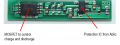
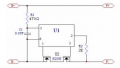
The battery is fitted with a PCM (protection circuit module) to protect the cell from being over discharged...

1759134714128.png

1759135194731.png


The link to the battery datasheet is below...

https://cdn.shopify.com/s/files/1/0176/3274/files/LP503035_500mAh_3.7V_20190510.pdf

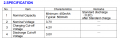
It states the discharge cut off voltage is 3.0V, so does this mean the lowest voltage I will see on the battery will be 3.0V and then the PCM will turn the MOSFETs off ?

1759135315035.png


This post relates to another post I wrote about power consumption...

https://forum.allaboutcircuits.com/...-current-when-devices-are-in-shutdown.207854/

There are similar products on the market that are 'always on' with battery life of up to a year....

https://vog.ee/
https://caelumsystems.com/product/talkable/

My device is drawing 1.5mA to 2mA whilst in shutdown and is not 'always on' (it has to be manually turned on) yet the 500mAh battery would not even last a month in shutdown mode.

So how are these other devices able to have such a long battery life ?

I need to somehow improve the battery life on my device.
 
Last edited:

dl324

Joined Mar 30, 2015
18,279
I should have made my post clearer, I am trying to decide which type of regulator will give me the maximum battery life and if an SMPS is overkill and I could get away with a linear regulator.
It was clear enough. You want to use a voltage regulator to provide 3.3V from a LiPo battery.

The 3.0V seems like the destructive discharge voltage. In any case, there's no LDO linear voltage regulator with a 0V dropout voltage. So, to generate 3.3V from a battery at 3.0V is out of the question.

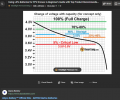
If this information is accurate, the cutoff voltage should be more like 3.55V. If you didn't operate the battery so deeply into discharge, you could probably get away with an LDO.
1759151198915.png

1759151558236.png
 

Thread Starter

freeflyer

Joined Sep 9, 2016
148
It was clear enough. You want to use a voltage regulator to provide 3.3V from a LiPo battery.

The 3.0V seems like the destructive discharge voltage. In any case, there's no LDO linear voltage regulator with a 0V dropout voltage. So, to generate 3.3V from a battery at 3.0V is out of the question.

If this information is accurate, the cutoff voltage should be more like 3.55V. If you didn't operate the battery so deeply into discharge, you could probably get away with an LDO.
Thanks Dennis,

The only thing to prevent the battery discharging is the PCM, which appears to be 3.0V.

So there is nothing preventing the battery from reaching 3.0V, at which point the PCM will disconnect the negative battery terminal.

If the battery voltage was limited to 3.55V, then the next question is which regulator would give the best battery life. A linear regulator or an SMPS ?
 

dl324

Joined Mar 30, 2015
18,279
If the battery voltage was limited to 3.55V, then the next question is which regulator would give the best battery life. A linear regulator or an SMPS ?
I haven't kept up with LDO technology. It depends on the current requirement. You'll have to look up the data yourself.
 

MrAl

Joined Jun 17, 2014
13,684
Thanks all for the replies.

I understand the difference between linear and SMPS regulators and how buck and boost works etc.

I should have made my post clearer, I am trying to decide which type of regulator will give me the maximum battery life and if an SMPS is overkill and I could get away with a linear regulator.

Hence the reason for asking about the battery voltage range.

For example, if the voltage range was:

100% SOC = 4.2V
1% SOC = 3.3V

If that were the case, I might get away with a linear regulator.

But I assume a linear regulator be less efficient than an SMPS so the battery would not last as long ?

A linear regulator works by dissipating the excess voltage as heat, whereas an SMPS only draws enough power to sustain the output.

On the other hand, if the voltage range was:

100% SOC = 4.2V
1% SOC = 2.5V

Then I would have to use an SMPS, unless the loads on the 3.3V rail could work down to 2.5V.

The battery is fitted with a PCM (protection circuit module) to protect the cell from being over discharged...

View attachment 356575

View attachment 356577


The link to the battery datasheet is below...

https://cdn.shopify.com/s/files/1/0176/3274/files/LP503035_500mAh_3.7V_20190510.pdf

It states the discharge cut off voltage is 3.0V, so does this mean the lowest voltage I will see on the battery will be 3.0V and then the PCM will turn the MOSFETs off ?

View attachment 356578


This post relates to another post I wrote about power consumption...

https://forum.allaboutcircuits.com/...-current-when-devices-are-in-shutdown.207854/

There are similar products on the market that are 'always on' with battery life of up to a year....

https://vog.ee/
https://caelumsystems.com/product/talkable/

My device is drawing 1.5mA to 2mA whilst in shutdown and is not 'always on' (it has to be manually turned on) yet the 500mAh battery would not even last a month in shutdown mode.

So how are these other devices able to have such a long battery life ?

I need to somehow improve the battery life on my device.
Hi,

One way is to make the device poll the inputs to see if there are any changes, and only turn on fully if there are changes.
This assumes a low power uC chip is being used though.
If you don't have that, then probably your own resort is to add a shutdown circuit that uses very low power and only turns the main device on for short periods to test the inputs for changes or whenever it is really needed to function fully.
Typically a uC can read inputs very fast and either turn back off (actually go into sleep mode) and stay off for a short time or stay on to make readings or output data.
A low power uC might draw 10ua when in sleep mode.
I did a refrigerator monitor like that and the batteries lasted for two years but still was able to monitor the temperature inside and provide status with a tri color LED, which also only turned on (pulsed low duty cycle) when necessary.
 

Thread Starter

freeflyer

Joined Sep 9, 2016
148
Hi,

One way is to make the device poll the inputs to see if there are any changes, and only turn on fully if there are changes.
This assumes a low power uC chip is being used though.
If you don't have that, then probably your own resort is to add a shutdown circuit that uses very low power and only turns the main device on for short periods to test the inputs for changes or whenever it is really needed to function fully.
Typically a uC can read inputs very fast and either turn back off (actually go into sleep mode) and stay off for a short time or stay on to make readings or output data.
A low power uC might draw 10ua when in sleep mode.
I did a refrigerator monitor like that and the batteries lasted for two years but still was able to monitor the temperature inside and provide status with a tri color LED, which also only turned on (pulsed low duty cycle) when necessary.
Thanks MrAl

I am doing everything you suggested, but with all possible devices in shutdown or low power mode the current draw is 1.5mA to 2mA. If the device was never used and left in shutdown, the 500mAh battery would not even last a month .

The uC is ultra low power with a current draw of 70nA during shutdown. There is something else drawing extra current and I've yet to identify why. Its all explained in my other post...

https://forum.allaboutcircuits.com/...-current-when-devices-are-in-shutdown.207854/

Below are the individual device currents specified in the datasheet. Most devices are in shutdown or low power mode and the calculated current is 181.37uA ...

1759239665116.png

I am using two of seven low power modes available for the STM32...

  • Shutdown: This has the lowest current draw
  • Standby: This has the second lowest current draw

A push button is used to wake the device from shutdown.

Once woken, it uses the real time clock (RTC) to wake every 30 seconds, take 10 pressure measurements and then go to standby.

If a pressure threshold is crossed, the device wakes from standby and runs for around 25 minutes before going back to standby once it crosses another pressure threshold.

Whilst running it enables the 5V supply, which powers the bluetooth receiver and audio amplifier. The pressure measurement rate also increases. This uses the highest current draw of approximately 150mA.

After 14 hours of being turned on, the device will go back into shutdown.

The devices currently on the market don't have a push button to turn them on / off, they are always on.

But they would still need to regularly take pressure measurements, so they would also need to wake every 30 seconds or so to take pressure measurements and check if a threshold has been crossed.

It seems these devices can be in this condition for a year, even though the battery is smaller. These devices also have an audible amplifier and speaker which will draw more current when in use.
 

MisterBill2

Joined Jan 23, 2018
27,323
The advice to avoid a linear voltage regulator is still valid, but now there are a whole lot of other concerns IN ADDITION to selecting the regulator kind. This appears to be a rather demanding project.
 

MrAl

Joined Jun 17, 2014
13,684
Thanks MrAl

I am doing everything you suggested, but with all possible devices in shutdown or low power mode the current draw is 1.5mA to 2mA. If the device was never used and left in shutdown, the 500mAh battery would not even last a month .

The uC is ultra low power with a current draw of 70nA during shutdown. There is something else drawing extra current and I've yet to identify why. Its all explained in my other post...

https://forum.allaboutcircuits.com/...-current-when-devices-are-in-shutdown.207854/

Below are the individual device currents specified in the datasheet. Most devices are in shutdown or low power mode and the calculated current is 181.37uA ...

View attachment 356603

I am using two of seven low power modes available for the STM32...

  • Shutdown: This has the lowest current draw
  • Standby: This has the second lowest current draw

A push button is used to wake the device from shutdown.

Once woken, it uses the real time clock (RTC) to wake every 30 seconds, take 10 pressure measurements and then go to standby.

If a pressure threshold is crossed, the device wakes from standby and runs for around 25 minutes before going back to standby once it crosses another pressure threshold.

Whilst running it enables the 5V supply, which powers the bluetooth receiver and audio amplifier. The pressure measurement rate also increases. This uses the highest current draw of approximately 150mA.

After 14 hours of being turned on, the device will go back into shutdown.

The devices currently on the market don't have a push button to turn them on / off, they are always on.

But they would still need to regularly take pressure measurements, so they would also need to wake every 30 seconds or so to take pressure measurements and check if a threshold has been crossed.

It seems these devices can be in this condition for a year, even though the battery is smaller. These devices also have an audible amplifier and speaker which will draw more current when in use.
Hi again,

Oh that's interesting.

You should know that even a voltage divider using resistors will draw some current. In one of my projects I had to increase the values of both resistors to get 10 times less current draw.
You might also note that linear regulators do not take zero current when they don't have any load. That's another issue I faced with one of mine. I had to look for a lower current draw linear regulator. It all depends how low you need the current to go, but all regulators I know of have some quiescent current draw. There may be some with a shutdown pin though so you can reduce power that way.

One of the other issues I was facing with another project was the uC had to work at 5 volts, but the only power source was 12 volts. The question became, how do you get a uC to work at 5 volts even in sleep mode with a 12 volt power source. The answer is, you need to regulate down to 5 volts one way or another. In my case I found a regulator that did not draw much current, but that may not be good enough for your project needs.

You can, however, look at using a uC that can run at maybe 2.5 to 5.0 volts. I think you have a 4.2v source? If so, you can run the uC right from the battery, and then manage the rest of the circuit by using the uC to shutdown everything else by shutting off the power source to those other devices for a time.

If none of this helps, then you have to troubleshoot more carefully. You have to check each device carefully for current draw. You should be able to isolate what component is drawing the unexpected current level. It could be one or more.
I know this may not be much fun but what else is there. Maybe put a small value resistor in series with a section of the circuit and measure the voltage across it to get an idea what current is being drawn. Since you have a lot of components, maybe you can divide the number in half and check that, then divide those in half, check again. If you have 8 components then group 4 and 4, check the current in each group, if one group is found to be drawing too much current, then focus on that group. Divide those up into 2 and 2, then check those, then isolate down to 2 components, then check each one. That should lead you to the component that is drawing too much, if there is only one that is.
In some cases you may have to use an oscilloscope but a meter should tell you something.
 

Thread Starter

freeflyer

Joined Sep 9, 2016
148
Thanks MrAl

Unfortunately its not possible to isolate anything on my custom PCB as its so compact. The PCB is 4 layer and has an internal power plane, so it would be very difficult if not impossible to disconnect the supply to components. Even if it was possible to isolate components, there would be a high risk of damage to the board.

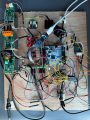
The best solution I could come up with was to use my dev board setup to measure currents....

1759328936431.png


However, the dev boards are not quite the same design as my custom PCB.

For example, some of the dev boards have LEDs, linear regulators and level shifters which I would need to remove and then perform some modifications after removing certain components.

I measured the MCU current draw on the dev board and it was just under 1uA, so the MCU is not the issue.

The current is being drawn by something else, but I've not had time to investigate further and need to make those hardware modifications.

I did have a pull up resistor on the FAULT output of the audio amplifier, removing this reduced the current slightly.

Note that my design does not use linear regulators, it only uses two SMPS as shown in the block diagram. There is a 3.3V SMPS which is always on and a 5V SMPS which is enabled by the MCU but only when the device is running.
 

MrAl

Joined Jun 17, 2014
13,684
Thanks MrAl

Unfortunately its not possible to isolate anything on my custom PCB as its so compact. The PCB is 4 layer and has an internal power plane, so it would be very difficult if not impossible to disconnect the supply to components. Even if it was possible to isolate components, there would be a high risk of damage to the board.

The best solution I could come up with was to use my dev board setup to measure currents....

View attachment 356634


However, the dev boards are not quite the same design as my custom PCB.

For example, some of the dev boards have LEDs, linear regulators and level shifters which I would need to remove and then perform some modifications after removing certain components.

I measured the MCU current draw on the dev board and it was just under 1uA, so the MCU is not the issue.

The current is being drawn by something else, but I've not had time to investigate further and need to make those hardware modifications.

I did have a pull up resistor on the FAULT output of the audio amplifier, removing this reduced the current slightly.

Note that my design does not use linear regulators, it only uses two SMPS as shown in the block diagram. There is a 3.3V SMPS which is always on and a 5V SMPS which is enabled by the MCU but only when the device is running.
Hi again,

Anything that gets a power supply lead directly is suspect. If the 3.3v SMPS is always on that's the first place to look. 1ma would not be unheard of by any measure.
Check out the chip data sheet and see what the quiescent current draw is. That's the first place to check I think.

If that is a problem, check out the TSP7A02 chip see if that would work.
 

Thread Starter

freeflyer

Joined Sep 9, 2016
148
Hi again,

Anything that gets a power supply lead directly is suspect. If the 3.3v SMPS is always on that's the first place to look. 1ma would not be unheard of by any measure.
Check out the chip data sheet and see what the quiescent current draw is. That's the first place to check I think.
Correct, its likely to be something on the 3.3V rail as the 5V rail (which powers MH-M18 bluetooth receiver and LM48100Q audio amplifier) is disabled.

I checked the datasheet for each component (some of which should be in shutdown or low power mode) and calculated a current draw of 181.37uA as shown in the table below...

1759330126590.png

Yet I measured a current of 1.5mA to 2mA, so its higher than the calculated 181.37uA.

I verified the current measurement of the uA range on my meter, by using an external 100R shunt resistor and measuring the voltage drop across it, so I am confident the current measurement is correct.

For both methods of current measurement, I had to short the shunt resistor to wake the MCU and then remove the short when the MCU entered shutdown. Otherwise the MCU drew too much current when trying to wake, causing too much voltage drop across the shunt resistor and therefore not enough voltage to power the MCU.

i.e. temporarily short the internal shunt resistor of the meter when measuring current and temporarily short the external 100R shunt resistor when measuring voltage on the meter
 
Top