Facebook
 Google
 GitHub
 Linkedin

Kind friends...
Re: our 'EHT tutorial' series - whereas we have received copious (on and off list) feedback advising economy in instruments and materials and whereas we find such advice wholly reasonable where application of same is consistent with quality and safety, I have taken the decision to advise use of automotive ignition cable over more costly alternatives where appropriate -- please note the following summary of commonly available EHT-insulated conductors with attention to the likely desirability of the former product in the eyes of 'economy minded' hobbyists:
-Solid core automotive ignition cable: (e.g. 'Hypalon Copper Conductor', etc) Outer Dia=7mm, Price ≈ $10 per meter -- Electrical data not published (Which is to say I cannot locate said data )
)
-'TV grade' AWM 3239 CRT 'accelerator' lead: (e.g. 'KynarKable') Outer Dia=4.5mm (40kV working potential) Price ≈ $40 per meter)
Federal standard h0453 Px-250: Outer Dia=20mm (250kV working potential) price ≈ 300$ per meter
Despite much research and inquiry I have been unable to obtain a 'straight answer' to the titular question...
Although my own tests indicate insulation breakdown EMF of said product to range from 130kV - 160kV, I hesitate, on the basis of integrity and safety, to advise based upon empirical data - much-less extrapolate 'safe working stress' from failure stress...
SO... Any insight into the rated maximum working EMF specification of 'solid conductor' (i.e. 'non-resistor') automotive ignition cable will be greatly appreciated!
By way of mitigation of ambiguity/language barriers, I offer the following image of the products under discussion:
Foreground: Example of the (Cu conductor) ignition cable in question.
Mid image: 'TV Grade CRT Cable' (AWM 3239).
Background and encircling: Federal Standard 250kV radiography cable.
Many advance thanks for any info, ideas or input!
At your mercy
HP
Re: our 'EHT tutorial' series - whereas we have received copious (on and off list) feedback advising economy in instruments and materials and whereas we find such advice wholly reasonable where application of same is consistent with quality and safety, I have taken the decision to advise use of automotive ignition cable over more costly alternatives where appropriate -- please note the following summary of commonly available EHT-insulated conductors with attention to the likely desirability of the former product in the eyes of 'economy minded' hobbyists:
-Solid core automotive ignition cable: (e.g. 'Hypalon Copper Conductor', etc) Outer Dia=7mm, Price ≈ $10 per meter -- Electrical data not published (Which is to say I cannot locate said data
)-'TV grade' AWM 3239 CRT 'accelerator' lead: (e.g. 'KynarKable') Outer Dia=4.5mm (40kV working potential) Price ≈ $40 per meter)
Federal standard h0453 Px-250: Outer Dia=20mm (250kV working potential) price ≈ 300$ per meter
Despite much research and inquiry I have been unable to obtain a 'straight answer' to the titular question...
Although my own tests indicate insulation breakdown EMF of said product to range from 130kV - 160kV, I hesitate, on the basis of integrity and safety, to advise based upon empirical data - much-less extrapolate 'safe working stress' from failure stress...
SO... Any insight into the rated maximum working EMF specification of 'solid conductor' (i.e. 'non-resistor') automotive ignition cable will be greatly appreciated!
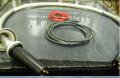
By way of mitigation of ambiguity/language barriers, I offer the following image of the products under discussion:
Foreground: Example of the (Cu conductor) ignition cable in question.
Mid image: 'TV Grade CRT Cable' (AWM 3239).
Background and encircling: Federal Standard 250kV radiography cable.
Many advance thanks for any info, ideas or input!
At your mercy
HP