Max power from an ultrasonic speaker/sounder/transmitter/resonator, and a driver for 20khz and 25khz.

Thread Starter

gray-b

Joined Aug 4, 2025
84
As part of my ongoing project, I need to drive a Piezoelectric ultrasonic speaker. I have 1 of each that resonates at 20khz and 25khz.

The max my sine wave oscillator can give out is 5v RMS, and the max the speakers can handle is 20v RMS. So to get the max out of the speaker I need a driver/amplifier give 4x gain and that can handle those frequencies. I had thought of a stereo amp, one for each frequency.

The only problem is I only have a 12v DC supply, which I could buck it to 24v DC.

Any ideas or suggests please.
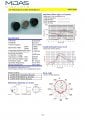
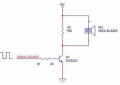
ultrasonic transducer1.jpg
 

Thread Starter

gray-b

Joined Aug 4, 2025
84
I believe square wave is out, as there are too many harmonics. But I am not sure with it being piezo. Any thoughts as I have plenty of 555's and 7555's
 

MrChips

Joined Oct 2, 2009
34,627
I believe square wave is out, as there are too many harmonics. But I am not sure with it being piezo. Any thoughts as I have plenty of 555's and 7555's
If the transducer resonates at 20 kHz or 25 kHz I think the harmonics will be reduced relative to the resonant frequency.
There is no harm in trying a 555-timer circuit.
 

ericgibbs

Joined Jan 29, 2010
21,390
Hi gray,
You can drive piezo with a square wave, it will be resonant at the stated frequency, and if you use a H bridge, you can get the equivalent of the 24V you are requiring.

What is the application??

E
 
Last edited:

0ri0n

Joined Jan 7, 2025
160
The TX transducer can be driven at the series resonance with a sine-/squarewave or at the parallel resonance with a sinewave. As you already have a sinewave generator you could use two op amps (rail-to-rail outputs), set up with the necessary gain in a bridge configuration with the transducer as a floating load. A 12V supply voltage can give you best case 24Vpp across the transducer.
 

MrChips

Joined Oct 2, 2009
34,627
During the testing stage, adjust the frequency of the function generator or 555-timer oscillator so that you can hit the actual resonant frequency.

I hope you are deaf to sounds above 20 kHz.
 

sparky 1

Joined Nov 3, 2018
1,218
For a given matched set will take care of different applications and with different application the
output will differ. When the function is distance, the signal can get too small and the circuit becomes unreliable.
In another application the distance is short range having different combination, adjust one thing you might
need to make other adjustments to get max power.

We can look at signals and find constraints on a working unit which is usually derated.
The above ideas sounds reasonable because it is not a big transducer. So the driver might possibly be about 25.00KHz at 15mA
just a guess? using 5V logic level ok. One way is to use a few 4049 so 15 mA worked for one application.
So the wave type would be square however finding the mA possibly using PWM to set duty cycle or current might be useful.
starting with a narrow duty cycle and increasing slowly without exceeding the absolute maximum in spec.

To find the sound pressure in mirco pascals or SPL. Could be complicated.
A known SPL is compared to an unknown SPL at least a fair approximation.
You can define what SPL you want for your application's maximum value within a reasonable level shown on the specs.

Take a look at a DIY sensor and scope for testing a car parking set and an exercise in messing with the cables and connectors.
distance, frequency, current, wave type.
 
Last edited:

drjohsmith

Joined Dec 13, 2021
1,549
there's a good possibility im remembering correctly, not least I can't find what any reference on line.

so

many decades ago, we wanted a powerfull ultrasonic transmitter to use underwater .around 25 Khz . The analog experts
used the fact the crystal produced the maximum output at resonance, and at resonance, there was an impedance max / min , can't remember which,
so they made an oscilator with the crystal as the frequency selective part !

just apply power , max pulse power comes out !

unfortunatly, my analog is about as bad as my java coding ,
 

BobTPH

Joined Jun 5, 2013
11,463
The analog experts
used the fact the crystal produced the maximum output at resonance, and at resonance, there was an impedance max / min , can't remember which,
so they made an oscilator with the crystal as the frequency selective part !
Isn’t that exactly what a self-oscillating piezo buzzer does?
 
Top