Facebook
 Google
 GitHub
 Linkedin
Hi All,
I'm relatively new to design, so I would sincerely appreciate any help, advice and feedback to get me started on the right direction.
Here's the scoop:
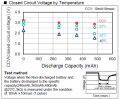
I'm designing a battery powered tracking device. This is device is powered using a CR2450X battery by Murata. I have linked the data sheet (Japanese followed by English).
What I can share is:
My device can read the battery voltage and temperature (this device will be used outdoors).
My device has a cutoff voltage of 2.0V (CR2450X nominal voltage is 3V)
The device's default state is 'asleep' (2uA consumption) and it periodically wakes up to do a RF transmission to a base station (50 ms transmission at 10mA, this is the largest load placed on the device)
I think I need to consider my device 'dead' when it can no longer perform the critical function of performing its RF transmission.
My thought is this - the battery must actually be considered dead long before it hits the actual 2.0V cutoff value (application specific), because putting a 10mA load on a battery at that point will cause the voltage to drop much further below 2.0V, rendering me unable to do my RF transmission.
So to provide a clear question - At what battery voltage should I consider my device actually 'dead' ? And How can I know this before hand? I think i can do a temperature and battery voltage reading, and pair that information together, but I am lost as where to take it from there. I know the answer will be temperature specific, and I will have to account for these temperature variances into my strategy for warning the low battery event is imminent.
Thank you in advance.
I'm relatively new to design, so I would sincerely appreciate any help, advice and feedback to get me started on the right direction.
Here's the scoop:
I'm designing a battery powered tracking device. This is device is powered using a CR2450X battery by Murata. I have linked the data sheet (Japanese followed by English).
What I can share is:
My device can read the battery voltage and temperature (this device will be used outdoors).
My device has a cutoff voltage of 2.0V (CR2450X nominal voltage is 3V)
The device's default state is 'asleep' (2uA consumption) and it periodically wakes up to do a RF transmission to a base station (50 ms transmission at 10mA, this is the largest load placed on the device)
I think I need to consider my device 'dead' when it can no longer perform the critical function of performing its RF transmission.
My thought is this - the battery must actually be considered dead long before it hits the actual 2.0V cutoff value (application specific), because putting a 10mA load on a battery at that point will cause the voltage to drop much further below 2.0V, rendering me unable to do my RF transmission.
So to provide a clear question - At what battery voltage should I consider my device actually 'dead' ? And How can I know this before hand? I think i can do a temperature and battery voltage reading, and pair that information together, but I am lost as where to take it from there. I know the answer will be temperature specific, and I will have to account for these temperature variances into my strategy for warning the low battery event is imminent.
Thank you in advance.
Attachments
-
547.5 KB Views: 5
-
 73.3 KB Views: 4