LM723 + Power MOSFET doing linear regulation

Thread Starter

Xymox

Joined Jun 12, 2022
13
Just for fun, I have decided to make a voltage regulator with a MOSFET handing the current and a LM723 at the heart of things.

I do NOT want to do any PWM. I want to operate the MOSFET in a linear DC manner.

Yes yes yes.. i realize this is crazy. But I like crazy.. Plus I dont see any one who has done this looking at google results. At least none i could see easily.

To complicate things further, I want to do sensing. Full sensing with + and -.

General parameters would be 14Vdc, no more then 5A.

I dont care that its not efficient. I dont care that i need a big heat sink. I would like fast step response.

I suppose it would be just as easy to use a op-amp rather then a 723. Maybe like a OPA277.

So I am posting to see if anyone has heard of such a crazy thing and try and shortcut design if I can look at what someone else did. Or be waved off as just a stupid idea that has no merit.
 

crutschow

Joined Mar 14, 2008
38,316
make a voltage regulator with a MOSFET handing the current and a LM723 at the heart of things
shortcut design if I can look at what someone else did.
Okay.
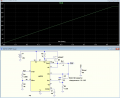
Below is the LTspice sim of an example 723 circuit using a P-MOSFET output buffer:
It's adjustable from about 2V (the minimum the 723 can do) to maximum (here about 19V with a 20V supply).

I'll leave the tweaking of the circuit to meet your requirements up to you, but feel free to ask questions.
Be sure and thoroughly study the 723 data sheet before that.
Have fun.

1736286891458.png
 
Last edited:

MisterBill2

Joined Jan 23, 2018
27,164
Here is an interesting thought, which is that in the era prior to switcher regulation, what we had was LINEAR DEVICES doing regulation, mostly. And a whole lot of really smart and highly motivated folks created the designs of some really great linear regulators. Quite a few of those designs were very well documented and some of the designs are still available.
The one caution I would offer is to avoid anything shown on you tube. The proportion of faked garbage is way too high, and besides, the other sources will have much better explanations that are correct. I am aware that some of it is "OK", but many other venues actually are much better.
 

DickCappels

Joined Aug 21, 2008
10,661
Good luck with your project, please share your results with us. From what I can tell, the main advantage the LM723 has over other regulators is that the Zener reference is very quiet.

It was after working with products using the LM723 for a couple of years that I felt great relief when National Semiconductor came out with the 78XX regulators - what a relief to get rid of all those ancillary components!
 

Thread Starter

Xymox

Joined Jun 12, 2022
13
crutschow

OMG... Wow....


Thank you !!

Well that looks fun ! I will go order up parts from mouser..

MisterBill2

Yes, I come from that era.. I just never married up a power FET in a linear way for VReg. Not sure it has advantage or disadvantage. I will just build it and abuse & measure it...

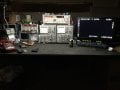
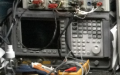
I love analog.. All this gear is FULLY restored.. I use it in my daily engineering.. Of course I also have digital scopes and a nice Tek MSO, but, this older gear is, IMHO, better when doing analog work on most things. Bench.jpg
 

Bordodynov

Joined May 20, 2015
3,430
Okay.
Below is the LTspice sim of an example 723 circuit using a P-MOSFET output buffer:
It's adjustable from about 2V (the minimum the 723 can do) to maximum (here about 19V with a 20V supply).

I'll leave the tweaking of the circuit to meet your requirements up to you, but feel free to ask questions.
Be sure and thoroughly study the 723 data sheet before that.
Have fun.

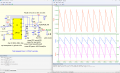
View attachment 339826
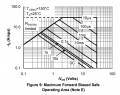
See. The AO6407 transistor can only output 200mA for a long time at an input voltage of 20V and an output voltage of 14V.
The presented scheme will not be able to produce 5A in any way!
1736320753198.png
 

crutschow

Joined Mar 14, 2008
38,316
The AO6407 transistor can only output 200mA for a long time at an input voltage of 20V and an output voltage of 14V.
Yes, the circuit was just an example design.
It was not intended to meet the TS's 5A spec, as I mentioned it was up to him to tweak the design to meet his requirements.
 

schmitt trigger

Joined Jul 12, 2010
2,027
A beautiful collection of vintage test equipment, congrats!
This looks very similar to the HP8590 which I used to work with, well over 35 years ago.

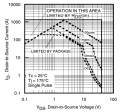
To your question..... Switching Mosfets, which are the vast majority out there, have a very poor SOA for linear operation, as Bordodynov clearly shows. The first overload you have, and before the current limit reacts, your Mosfet will let the magic smoke out.
Please search for Linear Mosfets. You will be a little shell-shocked with the price, though.
Have a read;
https://eepower.com/technical-articles/understanding-linear-mosfets-and-their-applications/#


Capture.PNG
 

Bordodynov

Joined May 20, 2015
3,430
What's wrong with the transistor in my circuit? It will give out 5A perfectly. I used this transistor in a current source to control a medical laser at current levels of 10 Amps. I do not recommend using MOSFETs in parallel in amplification mode. This can be done when using transistors with the same threshold voltages.
 

LowQCab

Joined Nov 6, 2012
5,101
10-Amps with how much Voltage from Drain to Source ?
The Thread-Starter intends to use a ~20-Volt-Supply.
If the Power-Supply is set for 5-Volts, and the Circuit is drawing ~5-Amps,
that's ~15-Volts at ~5-Amps across the FET, 15 X 5 = ~75-Watts that must be dissipated by the FET.

Your suggested Transistor would probably work just fine,
I was just providing additional options and more information.

In Linear applications I always like to use a TO-247 Package that can comfortably
dissipate the estimated Heat, and then double it.

You never know when odd circumstances will arise, and then "poof" the Blue smoke escapes.
.
.
.
 
Beware of FBSOA as Bordodynov and Schmitt Trigger were referring to. Most MOSFETs are mainly intended to operate as switches.

For example see

https://www.infineon.com/cms/en/pro...ion-guide/optimos-linear-fet-100v-150v-200v-/

I think that Littelfuse also makes some.

https://www.littelfuse.com/products/power-semiconductors-control-ics/mosfets-si-sic/n-channel-linear

~30 years ago I made my own e-load. Each range uses a "FETlington" arrangement. One MTP3055E 60V TO-220 being driven by the control op amp. That MTP3055E drives four NPN TO-220 bipolars like a darlington for the 20A range and similar for the 2A range. Each bipolar has its own emitter resistor and the current sense feedback voltage is averaged between the four. In this arrangement, those MOSFETs are actually fairly small (0.15 ohm 60V) but do not handle so much current. I will not say that I have beat the heck out of this e-load but nothing has broken in 30 years of occasional use.
 
Top