Lithium Batteries Thermal Cut Off

Thread Starter

Stamina7223

Joined Apr 8, 2025
1
I am developing a project where I use two 18650 batteries in series as a buffer in case the primary energy source (electricity from the home network) is missing. I want to integrate an NTC sensor to monitor the temperature of the batteries, so as to isolate the batteries in case their temperature is too high, to prevent fire or explosion.
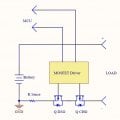
The two batteries in series are connected to a 2S protection BMS. The load (an ESP32), via a 5 V MP1584 step down converter, and a USB module for charging the batteries are connected in parallel to the BMS, as shown in the schematic below. Normally the USB module is always powered and acts as the primary energy source, both for powering the load and for charging the batteries. In case of power failure, the load is powered directly by the batteries.
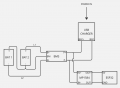
schematic.png

I want to add an NTC that activates a MOSFET to cut off the hardware connection between the batteries and the BMS (lines L1 or L2) if the temperature of the batteries exceeds 55°C, so as to isolate them from both the load and the charging module. These components should not be connected to the ESP32 and controlled through some logic; they should directly cut off the lines L1 or L2.
I do not know how to choose the proper components to use (MOSFET, NTC, ...) and, above all, how to properly connect them. Can anyone help with any ideas?

Thanks in advance!
 
Adding another mosfets in series with batteries will increase the drop/losses.

It will be better to turn off the mosfets they are already inside the BMS in case of over temperature.
You can short the mosfets gates with npn transistor for cutting the power off.

Those mosfets are usually connected like this:
1744129290086.jpeg
So you will need to add a gate resistors (like 10k) to be able to short the gates.
 
Last edited:

Irving

Joined Jan 30, 2016
4,996
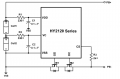
This is the actual circuit diagram of that BMS module. M1 and M2 are actually 2 MOSFETs in parallel - each of those 8205A devices is 2 MOSFETs. Some control chips do actually have an NTC input. This one doesn't. There is no easy way to change the operation of the BMS. Putting a gate resistor in series with OC (pin 2) connection to the MOSFET may actually stop the overcharge function working reliably.

1744136474509.png
 

MisterBill2

Joined Jan 23, 2018
27,161
There may be some (not obvious) means to have an external temperature sensor protect the batteries. Possibly there might even be access to the batteries available. Since I have no access to the BMS details it is not easy to provide detailed suggestions. AND, there may even be a BMS specialist lurking around here. Not me, though.
 
I am developing a project where I use two 18650 batteries in series as a buffer in case the primary energy source (electricity from the home network) is missing. I want to integrate an NTC sensor to monitor the temperature of the batteries, so as to isolate the batteries in case their temperature is too high, to prevent fire or explosion.
The two batteries in series are connected to a 2S protection BMS. The load (an ESP32), via a 5 V MP1584 step down converter, and a USB module for charging the batteries are connected in parallel to the BMS, as shown in the schematic below. Normally the USB module is always powered and acts as the primary energy source, both for powering the load and for charging the batteries. In case of power failure, the load is powered directly by the batteries.

View attachment 346421

I want to add an NTC that activates a MOSFET to cut off the hardware connection between the batteries and the BMS (lines L1 or L2) if the temperature of the batteries exceeds 55°C, so as to isolate them from both the load and the charging module. These components should not be connected to the ESP32 and controlled through some logic; they should directly cut off the lines L1 or L2.
I do not know how to choose the proper components to use (MOSFET, NTC, ...) and, above all, how to properly connect them. Can anyone help with any ideas?

Thanks in advance!
Thermal cut-offs are crucial for lithium battery safety. Precise voltage references help with accurate temperature monitoring. The LM4040AIM3-2.5 offers reliable performance in such scenarios, helping ensure circuits respond appropriately to thermal changes.
How is everything now?
 

Irving

Joined Jan 30, 2016
4,996
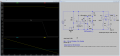
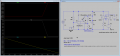
Here's how to do it fairly easily... Using a 10k NTC thermistor, a TL431 voltage reference, a cheap LM339 comparator, a few resistors, a 10k trimmer and a suitable N-channel MOSFET. When the temperature rises above 37C the MOSFET is turned off. The first simulation show the discharge state, so although the MOSFET switches off, current still flows out of the battery/BMS via the MOSFET body diode into the load R4 (exactly as it does on the BMS). Since battery temperature when discharging should be low this isn't an issue and doesn't require anything more complex. In the second simulation, charging, the MOSFET again turns off at 37C but now the current into the battery/BMS is cut off and the charging current falls to zero.
1744973037721.png
1744973131095.png
 

MisterBill2

Joined Jan 23, 2018
27,161
To avoid a lot of complication it seems to me that a simple normally closed thermal switch would be the most effective and possibly the most reliable. Or maybe several of them, one held against each cell. Add an LED and resistor across each switch and have instant indication of which cell was the hot one.
 
Top