linear rectifier

Thread Starter

arenwi

Joined Dec 29, 2014
37
Hello again, in this case I´m trying to amplificate a sinusoidal waves from an electret microphone, it cames with offset of 1.4 volts.

One of mi problems is the offset of the signal, using coupler capacitor of 10nf the ofset = 0volts. ok but it introcuce inestability with 50 hz of frcuency.
Like this yellow chanel before condenser and blue chanel after it:
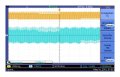
TEK0008.jpg
I was testing different capacitors elevtrolitic, ceramic and poliester. with bad results on electrolitic, worse with ceramic and the noise of the last picture wit polietser.

Another cuestion, I has asembled this amplifier:
changing the resistance of the imput to obtain gain.

The imput signal is the same of the first picture of this post. And after the amplifier configuration it generates:TEK0002.jpg I think that I has seen this singnal any time. I was looking the schematic and I can´t find any mistake.
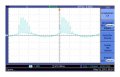
Any idea???

regards
 

AnalogKid

Joined Aug 1, 2013
12,078
The 50 Hz interference probably is power line related due to bad grounding technique.

1. What is the frequency of the signal you are trying to amplify?
2. Adjust your scope so there are only 4 or 5 cycles of that frequency visible. The first scope shot does not tell us anything because the period is too slow.
3. Post your schematic.
4. Post a photo so we can see your test setup. Many times the problem is in the wiring, not the design.

ak
 

Thread Starter

arenwi

Joined Dec 29, 2014
37
Hi ,

1.- I´m trying to amplificate 1k Hz.

2.- I sen the first image with this long time period becouse there yoy can see te effect of the low frecuency of 50 Hz. This picture is from the imput.

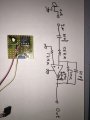
3.- This is mi schematic and circuit:
IMG_5737.jpg

I´m trying to use this big resistor becouse it will came in a portable device and using big resistor the current are less and you have more batery life with the same gain (I think).

Many thanks
 

AnalogKid

Joined Aug 1, 2013
12,078
Notice in the Linear Tech schematic you posted that the output is not exactly like the input. This circuit is intended to act as a rectifier, so if you want a simple amplifier this is not it. Also, you have drawn the symbol for an electret microphone, but there is no DC boas for it. Is the source an electret microphone, a dynamic microphone, or something else?

ak
 

Alec_t

Joined Sep 17, 2013
15,112
You are seeing partial rectification of the signal because the negative half-cycles of the signal drive the inverting input below the ground rail. Try biasing the non-inverting input at about half the supply voltage.
 

Thread Starter

arenwi

Joined Dec 29, 2014
37
Hi

yes I´m using an electret microphone without dc bias. But When I conect it I lose the signal. I was connecting the vcc of the op amp (4.5v) across a resistance of 10K to the positive of the imput. And nothing change on ground. but It lose the signal.

I know that there is an rectifier. I wont to acondicionate the signal since 0 volts to 3,5 to conect it to the adc of mi project.

I have a new desing, I had changed the in+ resistor = R1//R2.

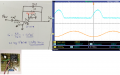
I make the gain calculation but the gain of the amplifier are really less. You can se the imput in yellow and the rectified output in blue.
Captura de pantalla 2015-05-17 a la(s) 00.40.23.png
Teorically it must have a gain of 17 but the real gain are: 328mV/124mV=1.46 Only ¡¡¡¡¡¡¡

Any ideas of this anormal gain???

Some information about biasing the microphone

many thanks team
 

MikeML

Joined Oct 2, 2009
5,444
As Alec said, you do not have the amplifier biased properly. To run it on a single supply, the non-inverting input cannot be tied to ground; it must be tied to a voltage near Vdd/2 or about 2.25V.
 

AnalogKid

Joined Aug 1, 2013
12,078
No, he is following the LTC app circuit for a rectifier. It is not biased normally on purpose. See the second image in post #1. Arenwi, there is a gain problem but it is not as bad as you think. Because the 328 mV ouput is rectified, it is a peak signal, not peak-to-peak like the input. So you must double it before calculating the gain.

The real problem is that the output is not above ground for 50% of the input cycle, which it should be for a lossless rectifier. If if were, it probably would be taller and your gain equation would be correct. Some of this might be a recovery issue with the amplifier being overdriven.

Also, note that in the LTC circuit it mentions performance up to only 100 Hz. You are operating 20 times that frequency. Again, the problem might be that the amp can recover fast enough when transitioning from being overdriven and clipping to linear amplification.

ak
 

Alec_t

Joined Sep 17, 2013
15,112
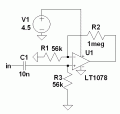
In your circuit, only the negative-going half-cycles of the input waveform can give a useful output voltage, but the input protection arrangement of the opamp clamps inputs below the negative supply voltage (oV), so the output voltage is limited.
Try this configuration:
Rectifier.gif
This should give close to the theoretical gain.
 
Last edited:

Roderick Young

Joined Feb 22, 2015
408
In your circuit, only the negative-going half-cycles of the input waveform can give a useful output voltage, but the input protection arrangement of the opamp clamps inputs below the negative supply voltage (oV), so the output voltage is limited.
Try this configuration:
View attachment 85919
This should give close to the theoretical gain.
This looks good, except that I would suggest instead of 56k to ground, do 110k to ground, and also 110k to Vcc. That will bias the amplifier at a point where the signal can go negative and not clip at ground. You could even go 1M to gnd, and 1M to Vcc.
 

Thread Starter

arenwi

Joined Dec 29, 2014
37
Hi roderik,

Many thanks for your answers.

I need to connect this amplified signal to the adc of mi microcontroller. For that I need to eliminate the negative part of the signal. The adc cames since 0 volts to 3.5 volts. If I cenyter the signal in the midle of thew adc (biasing it) I lose the part who is undher this voltage.

:)
 

Thread Starter

arenwi

Joined Dec 29, 2014
37
Hi I´m using an external power to the mic. It use 3 wires one of them only for power, If I use this microphone with 2 wires I must to supply bias to the mic.

This knight I hope I can test the circuit recomended by Alec_c.
I only need a simple wave rectifier with some gain.

regards
 
Top