Linear rectifier circuit

Hymie

Joined Mar 30, 2018
1,347
Designing the circuit using a 2.4V rail will be very difficult to my mind, bear in mind that as the battery discharges you will be operating at less than this.

Using the device I posted in #16 will give you many more options, I would even consider adding a module to give a split rail +/- V to power the op-amp.
 

Thread Starter

Pyrex

Joined Feb 16, 2022
502
Hymie,

as i said, i need a rectifier with 5% accuracy. In general, an capacitor ESR tester is not a precise device, accuracy of 10 or 20% is acceptable. So i don't want to build a circuit with voltage converters, high speed Opamps, voltage regulators and splitters, etc. Having in mind a small battery 2xAAA- how long it will last to discharge, if all those components to be powered?
And, as i said , i saw an ESR tester built on a 1.5V battery.
In worst case, i'll build the tester with a simplest rectifier, just want to compensate the temperature factor for stable readings. At high ESR values one's usually do not need a high accuracy, so it is possible to modify the metering circuit in such a way, that low output corresponds with high ESR values.( A simple rectifier has worst accuracy at small voltage )
As i said, the 200uA microammeter will be used, not a digital meter
 

Alec_t

Joined Sep 17, 2013
15,118
Will you be testing capacitors in-circuit or out-of-circuit?
What range of ESR values do you need/want to measure?
 
creating a circuit diagram from several sources
Hi,

Here is an ESR meter description with 1.5 V supply voltage, you may have come across? It oscillates around 12 - 17 kHz but the LC components can surely be changed to work around 100 kHz. Or only use the active rectifier stage from it.
It is possible the 200 uA meter would show too high initial collector current, in this case consider the bridge -like compensation to get zero initial current like shown in grid dip meters (GDO), here is what I mean from this link (but several such circuits are at several other places). It uses an old germanium audio pnp transistor in the meter circuit and I mean only the bridge circuit part on its collector side to adopt into the above ESR active rectifier transistor collector side too. Of course an Si transistor could also be used instead of the Ge type for better temp stability, the oscillator peak to peak amplitude may give high enough 'juice' to drive its base input.
There are useful pieces of info on ESR meter builds at eevblog if you wade through the older posts too.

Winnie
 

Thread Starter

Pyrex

Joined Feb 16, 2022
502
Hi,

Here is an ESR meter description with 1.5 V supply voltage, you may have come across? It oscillates around 12 - 17 kHz but the LC components can surely be changed to work around 100 kHz. Or only use the active rectifier stage from it.
It is possible the 200 uA meter would show too high initial collector current, in this case consider the bridge -like compensation to get zero initial current like shown in grid dip meters (GDO), here is what I mean from this link (but several such circuits are at several other places). It uses an old germanium audio pnp transistor in the meter circuit and I mean only the bridge circuit part on its collector side to adopt into the above ESR active rectifier transistor collector side too. Of course an Si transistor could also be used instead of the Ge type for better temp stability, the oscillator peak to peak amplitude may give high enough 'juice' to drive its base input.
There are useful pieces of info on ESR meter builds at eevblog if you wade through the older posts too.

Winnie
Hi,
I am familiar with the first meter powered from a 1,5V battery. Read some feedback, it seems it's oversimplified. Not stable readings, due to battery depletion. Frequency variation, etc.
The "5 transistor ESR meter" circuit diagram is noteworthy. However, it's drawback is square test signal, sensitive meter needed, supply from 9V battery
 

Thread Starter

Pyrex

Joined Feb 16, 2022
502
bob2,
i did read the feedback. Bizzare shaped test voltage,frequency is not stable, poor performance, especially if battery is depleted

BobTPH,
A typical PP3 9V battery have small capacity, high self-discharge and relatively high cost.
I prefer rechargeable NiMh AAA type
 

Thread Starter

Pyrex

Joined Feb 16, 2022
502
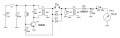
100kHz sine vawe oscillator from internet. The author said simutated in LT Spice, THD about 10%, amplitude remains 2mVp-p when powered from 2 to 2.9V battery.
The current source is built on VT3, LED ,R1 and R3. This improves output waveform significally.
Amplifier gain is set with R8-R9.
 

Attachments

Last edited:
Top