Lighting Project

Thread Starter

And!

Joined Nov 9, 2024
11
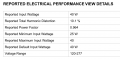
Looks like the LED's you have operate on 120 to 277 volts AC. These are not automotive style LED's. Operating them from 6, 12 or 24 volts won't work without significant rewiring. Not likely to be of any use for what you want. Not without employing an inverter.
What about removing the driver? Or installing a 12 to 120 inverter.
 

nsaspook

Joined Aug 27, 2009
16,325
The amp hours above came off a lift that was operating at 12 V. Why they give two different amp hours I’m not sure.
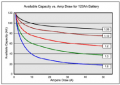
They are showing the effect of the Peukert factor/exponent with Lead-Acid batteries.

If you pull power at the 20hr (until the battery is flat) current rate, the battery total Ah capacity is 225, when power is pulled at the 5hr current rate till flat, the capacity will drop to 185Ah. This is a rating specification normally only seen in traction batteries
or batteries designed for RE.

https://www.victronenergy.com/media/pg/SmartShunt/en/battery-capacity-and-peukert-exponent.html
The capacity of a battery depends on the rate of discharge. The faster the rate of discharge, the less capacity will be available. The relation between slow or fast discharge can be calculated by Peukert’s law and is expressed by the Peukert exponent. Some battery chemistries suffer more from this phenomenon than others. Lead acid are more affected by this than lithium batteries are. The battery monitor takes this phenomenon into account with Peukert exponent.
Example curves for several Peukert factors.
1731264831201.png
 

Thread Starter

And!

Joined Nov 9, 2024
11
Thank you. So what type of set up would be recommended. Sounds like an auto light with a DC buck converter?
 

Tonyr1084

Joined Sep 24, 2015
9,744
Depends on the solution to the problem you seek. If you want a work light, using LED's is a good route. Use of an automotive tail light can provide a decent amount of light. If you want more than something like a tail light there's a possibility you could use HID lighting. It operates on 12 volts and powers a High Intensity Discharge lamp. But you want to be very careful with that because it uses high voltage on the bulb, the bulb gets VERY hot and just touching the bulb while cool can cause it to fail prematurely. Though HID is an option I'd not go that route without some serious structural engineering - making something safe from contacting high voltage and safe from touching a hot lamp.

If I wanted to illuminate an area I'd go with some sort of flood light. They make LED Flood lights. They will need 110 VAC so an additional inverter that takes 12VDC and turns it into 120VAC. Will this be a practical solution? Sort of. Is there a more practical approach? Probably, but I'm not coming up with any solutions just now.
 

bassbindevil

Joined Jan 23, 2014
922
Inverters are relatively cheap, so that's not a terrible option. You'd have AC available for other purposes, depending on the capacity of the inverter. But weatherproof automotive LED flood lamps are available in a wide range of styles and sizes. Like I said before, the power rating can be inaccurate; one of mine draws 8 watts at 12V, but is rated at 48 LED watts because it has 16 x 3 watt LEDs.
 

Tonyr1084

Joined Sep 24, 2015
9,744
weatherproof automotive LED flood lamps are available in a wide range of styles and sizes.
For what I gather is the TS targeted outcome, an automotive headlight would shine a thin beam rather than cast a wide field of light, which is what I think the TS wants. Judging by the available light panels, 100 to 277 VAC if I remember correctly.
 

MisterBill2

Joined Jan 23, 2018
27,528
Based on the details provided we still have no information as to what voltage and current are required for the actual LED portion of the lites that the TS has on hand.
So lots of suggestions based on guesses, and some good ideas, but so far I have not seen the actual voltage and current requirements of the actual LED portions of the proposed lights that the TS has on hand. Without THAT information, a suggestion of the best choice to most efficiently power the proposed lights will be rather difficult. An experiment to determine the required LED array current at the actual LED array voltage will need to be done.
 

Tonyr1084

Joined Sep 24, 2015
9,744
What about removing the driver? Or installing a 12 to 120 inverter.
Likely, but I don't know this for a fact - - - the internal driver probably outputs somewhere around 48VDC. When I said you would have to do significant rewiring I meant you may have to reconfigure (if even possible) how the LED's are wired up. We have no idea how they're wired or what voltage they run at. The driver can accept 120VAC up to 277VAC. The driver itself regulates the amount of current flowing through the LED's. Current, not voltage, is how LED's operate. But you can't have current without voltage. Not only will you have to rewire the panels you'll also need to build or buy a current regulator of some sort.

Frankly I just don't see this being a viable project. But that's just my opinion.
 

MisterBill2

Joined Jan 23, 2018
27,528
IF the proposed lighting is similar to the panel lighting in the links, then indeed all we have so far is guesses, and alternate suggestions. I have worked with moving such lighting fixtures and it appears that making any changes at all will be a bit of an effort. So while they may be available they are not a good choice for modification.
So I suggest alternative products already made for the available voltages, 12 and 24 volts.
 

bassbindevil

Joined Jan 23, 2014
922
For what I gather is the TS targeted outcome, an automotive headlight would shine a thin beam rather than cast a wide field of light, which is what I think the TS wants.
There are 12V (nominal) lamps with "street legal", spot, and flood patterns; some of the light bars have combinations. You can estimate the pattern by noting from which angles you can see the LED phosphor.
 

MisterBill2

Joined Jan 23, 2018
27,528
IF the lights that the TS has available, on hand and cheap, are at all similar to the flat panel ones in the PDFs provided, an inverter to provide AC power is the choice.
BUT, if the requirement is a useful work light for use up on a scissor lift, that is probably not the best choice, but rather the cheapest choice. DC powered flood and spot lights are available for trucks in both 12 and 24 volt versions, and that variety is what I suggest.
 
Top