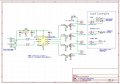
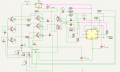
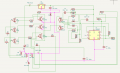
Better,almost , except that the transistors were rotated instead of flipped, so the E and C are reversed, which makes those connections more complex than they were.maybe your schematic editor can not flip a part.
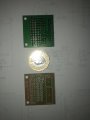
There are six screw terminals - (Pos and Earth from car wiring loom) and four outputs that feed rear lights, brake lights and indicators. The idea being an inline switch from the Pos and when switched on it displays a pattern at the rear lights - what pattern I am not sure as it's not something I have actually used.
The main purpose of this exercise is to.
1. Build a replica as close as possible to the existing one.
2. Build an improved version with later technology.
3. Build a programable one (Arduino compatible MCU).
As I progress through those stages, hopefully I will learn something - at the moment it's very much 'monkey see, monkey do.'
Answer 1 - You can’t ‘flip’ a component on the same side. R for rotate it maybe? A footprint is fixed by the component constraints. If you want to actually change pins you will have to edit the footprint or create a new one. Somewhere under help you’ll find a list of hot keys.
Answer 2 - There is No flip horiz/vert but, perhaps this will help - you can Mirror it but, only in footprint Edit mode… From there, if result is not what you want, then Flip/other tweaks…
Similar to the Arduino IDE, the MPLAB IDE allows for the development and programming of MicroChip PIC chips, such as the one used on my project.
I'm fairly certain there are C compilers, but I suspect they will generate excessive code, probably too much to fit into the PIC12F675 (or 683) that I use, so I've just programmed what I need in assembler code. After "building" your project from your .ASM file, the resultant .HEX file is programmed into the PIC chip.
The code I have is basically a controllable timer, and modifying timing parameters is simply a case of calling delay routines as needed - a trivial exercise in itself.
An earlier version of the board with the high-current MOSFET outputs uses a Microchip TC4468 quad buffer/MOSFET driver IC that can continuously source up to 250 mA into ground referenced loads. These may be more suitable to your needs. The only reason I switched to discrete MOSFETs was that people were asking me to supply driver for high-power CREE LEDs.
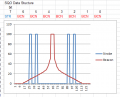
A good place to start with specifying the timing of your lights is with a timing diagram, easily constructed using excel.
An earlier version of the board with the high-current MOSFET outputs uses a Microchip TC4468 quad buffer/MOSFET driver IC that can continuously source up to 250 mA into ground referenced loads. These may be more suitable to your needs. The only reason I switched to discrete MOSFETs was that people were asking me to supply driver for high-power CREE LEDs.
As this unit is to power conventional lamps, I would imagine the output for each one could exceed 5-10 amps. In addition, I doubt that incandescent lamps have the same 'recovery time' as an LED (so the flash rate would have to be slower to somewhere in the neighbourhood of half a second).
As this unit is to power conventional lamps, I would imagine the output for each one could exceed 5-10 amps. In addition, I doubt that incandescent lamps have the same 'recovery time' as an LED (so the flash rate would have to be slower to somewhere in the neighbourhood of half a second).
Do they have something inbuilt to fool the car's ECU? Basically, they will be drawing a lot less current than the conventional bulb and the ECU might think they are open circuit (blown bulbs)
There are several advantages going the MCU route...
You can easily change the light patterns if you wanted to, it could even be programmed with several different "effects" using a pushbutton on one of the "R/C Servo" inputs, like the hazard warning "light bars" you see on the roofs of breakdown trucks. That would be hard to do with discrete components.
Reduced component count = higher reliability.
One of the output pins on the PIC12F683 can be modulated with PWM. I use that feature to drive a channel for a simulated "rotating beacon" as used on an aircraft, but it could have other uses.
Do they have something inbuilt to fool the car's ECU? Basically, they will be drawing a lot less current than the conventional bulb and the ECU might think they are open circuit (blown bulbs)
I'm sure they must have, most car lamps are nowadays LED. Sort of defeats the object if changing to a lower power consumption lamp means you have to put a load resistance on it to fool the ECU.
Maybe I am overthinking this - apart from the fact it is not legal to retrofit some lights in UK cars (like headlights). But if the vehicle is new enough to have an ECU to detect faults, but old enough for standard bulbs then the ECU is going to expect a certain current draw, 5-10 amps - on the other hand I believe that an LED is drawing around 20mA - therefore the only way to retrofit tail, brake, reverse and brake lights is to add some resistance to fool the ECU - otherwise it's going to throw errors.
Maybe I am overthinking this - apart from the fact it is not legal to retrofit some lights in UK cars (like headlights). But if the vehicle is new enough to have an ECU to detect faults, but old enough for standard bulbs then the ECU is going to expect a certain current draw, 5-10 amps - on the other hand I believe that an LED is drawing around 20mA - therefore the only way to retrofit tail, brake, reverse and brake lights is to add some resistance to fool the ECU - otherwise it's going to throw errors.
on the other hand I believe that an LED is drawing around 20mA - therefore the only way to retrofit tail, brake, reverse and brake lights is to add some resistance to fool the ECU - otherwise it's going to throw errors.
Yes and they make kits for that which include a power resistor(s). Very popular with motorcycle turn signals. Normally 50 watt 6 or 8 ohm resistors. They look like this.
Would it matter if there were constant warnings of blown bulbs ?
At least you'd know why, and cars managed quite well before we had these warnings. Filament bulbs regularly failed, due to the heat up/cool down cycle they go through every time they are used, which LED's would not suffer from.
I made a simulated alarm light for my garage which flashes an LED 3 times every 2 seconds. So since I put it there over 9 years ago it's flashed approximately half a billion times !!
Both - in normal use they will be what they are, brake, tail, indicator, reverse - but when the magic switch is flipped a pretty pattern. Either way, for a retro fit LED the circuit will have to assume the same current draw as a normal bulb - how that works out for original equipment LEDs is another matter

 Facebook
 Google
 GitHub
 Linkedin




 Normally 50 watt 6 or 8 ohm resistors.