Light flashing unit for car

Thread Starter

gchq

Joined Dec 27, 2023
69
No, that would be a four band code with RED RED ORANGE GOLD: 22K and 5% tolerance.
So, a four band is actually Band One | Band Two | Multiplier | Tolerance?

Plus, I think I am colour blind with brown and orange - sigh!

Thank you for your continued patience.
 

Ya’akov

Joined Jan 27, 2019
10,240
So, a four band is actually Band One | Band Two | Multiplier | Tolerance?

Plus, I think I am colour blind with brown and orange - sigh!

Thank you for your continued patience.
Yes, it is the total number of bands you can see on the resistor.

It’s not a problem, no patience required. I would hope that in my areas of ignorance anyone trying to help would be as “patient”. As I say, I really hate the “newbie” appellation. I’ve done my best to replace it with “neophyte”. The former seems to be concerned with that is lacking while the latter focuses on the potential, and on growth.

We are all neophytes when we begin something new, and it’s no sin—in fact, I think it is a merit and people who have an interest in growing a vocation or avocation really need to see how “newbies” are the future of their interest and should be treated as VIPs.
 

Ya’akov

Joined Jan 27, 2019
10,240
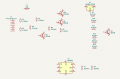
Could you tell me what these guys are?

View attachment 311114
Those are diodes. They appear to be signal diodes which are small diodes used to route low power signals and in other low power applications. The white band is the bar of the diode symbol. Once the circuit is drawn out, an estimate of the power handking requirements of the diodes can be made.
 

Thread Starter

gchq

Joined Dec 27, 2023
69
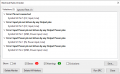
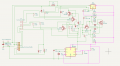
I ran into an issue with the ERC - apparently a rookie mistake.

Circuit_02.png

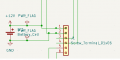
So, I added PWR_FLAG and it still throws the same errors. I know about pin 5 not connected (it's not connected on the sample board). Screenshot of battery added below.

Any ideas?

Happy New Year


Circuit_03.png
 

Thread Starter

gchq

Joined Dec 27, 2023
69
Sorted out one of the power issues by placing a bridge over the fuse - there is probably a way of defining the fuse as 'on' but not found it yet. Sorted out the unused pin with a no-connection flag.

On the NE555 as used in the board I have there is no direct power to pin 8, so that is the only error so far.

I defined each resistor with the same value for now - they will be edited later.Circuit_04.png
 

Audioguru again

Joined Oct 21, 2019
6,826
The original old fashioned NE555 was introduced 51 years ago using old TTL technology. Its output transistors conduct a shoot-through power supply current of almost 400mA each time its switches.

Your NE555 has the 22k of R3 on series with its power supply pin 8 to almost zero V and it is missing the important supply bypass capacitors mentioned in its datasheet.
 

Thread Starter

gchq

Joined Dec 27, 2023
69
Your NE555 has the 22k of R3 on series with its power supply pin 8 to almost zero V and it is missing the important supply bypass capacitors mentioned in its datasheet.
Thank you for your reply.

22k - I did say that that I had set them all to 22k and will adjust those later to the correct values - as far as I know ERC doesn't check on resistor values - the plan is to adjust them before running simulation.

Bypass - 0.01uf from pin 5? Will that work? At the moment I am trying to replicate the existing board, then work on updating things.

It was mentioned earlier that the Darlington MJ2501 should be replaced with something more available - could you make a suggestion for one, if possible, with a SPICE model?
 

Thread Starter

gchq

Joined Dec 27, 2023
69
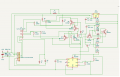
I have changed the resistor values (I think correctly), added a cap to pin 5 and found the missing power in.

Is this looking better?

Circuit_05.png
 

Thread Starter

gchq

Joined Dec 27, 2023
69
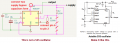
Your 555 oscillator is wired wrongly:
Thank you for that.

The next problem is running the simulator breaks with 'Error on line 3 or its substitute' which is not very helpful as there are no reference points on the schematic for 'line 3' - I do, however, think this relates to the screw and pin connectors (there are no SPICE models for connectors, so I just checked 'remove for simulation' as they are not electrically relevant.

If I add in the transistors that connect to the pins it might remove that error - but I can't find a SPICE model for the MJ2501 and I'm not sure which MOSFET would be the correct replacement or what design changes would be required.

It's a learning curve to be sure. Have built many high-end rack servers but never given a thought to the electronics (other than CPU pin placement and such like) behind them.
 

Thread Starter

gchq

Joined Dec 27, 2023
69
Does that "Line 3" possibly reference a code listing and not a circuit line? Or a components parameter list??
I have no idea - and debugging info is scant to say the least. I did come across one forum that suggested it was a circuit line. To check if it was the components list, I removed the component in line 3 and ran it again - still line three so I reckon whatever it is, it has nothing to do with that.

As for code listing where will I find that?
 

Thread Starter

gchq

Joined Dec 27, 2023
69
Solved that issue - it was the fuse, so just removed it from simulation.

Next problem was the Transient Analysis failed with timestep too small (apparently that means it's set too high) so kept reducing it until I got to 0.1F then the simulator ran - it fails on the same thing with DC, but there is no setting that I can see for a timestep.

Not really sure how to analyse it - and probably can't until I can figure out what I am going to replace the MJ2501 Darlington transistors with. If anyone has a suggestion for ones that have a model, I would appreciate it.

Thank you.
 

MisterBill2

Joined Jan 23, 2018
27,563
Somebody should have a substitution guide, or at least a data book that provides the specifications. The big challenge will be the base drive requirement.

I dug out my Motorola "bipolar power data " book. Only one PNP Darlington good for ten amps, butonly 40 volts Vceo, that is a 2N66488. It is rated at 100 watts Pd not 150.
 
Last edited:

Thread Starter

gchq

Joined Dec 27, 2023
69
Somebody should have a substitution guide, or at least a data book that provides the specifications. The big challenge will be the base drive requirement.
There are substitution guides, but they are all for the same type of transistor (none with a Model). Having said that there are some default models for a pnp transistor.

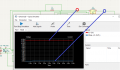
Here is another question. If you look at the probes for the L7805 in and out, it shows 12v in (correct) but 0v for out when I would have thought it should be 5v. Any ideas what I am doing wrong here?

I have to say that the KiCAD software is very flaky and the ngSPICE simulator does give differing results for the same schematic.

Circuit_06.png
 

eetech00

Joined Jun 8, 2013
4,705
I have changed the resistor values (I think correctly), added a cap to pin 5 and found the missing power in.

Is this looking better?

View attachment 311509
The schematic is chaotic and difficult to follow.
Here are some schematic drawing guidelines:

1. The schematic is a logical/functional representation. Don't show symbols as a physical representation of the part.
2. Supply connections top to bottom - top positive, bottom negative, or ground
3. Signal flow is from left to right - input at left, output at right
4. Notes at bottom left
5. Title at bottom right.

Item 1 above is the most often abused, so I thought I would note that first.
 

MisterBill2

Joined Jan 23, 2018
27,563
There are substitution guides, but they are all for the same type of transistor (none with a Model). Having said that there are some default models for a pnp transistor.

Here is another question. If you look at the probes for the L7805 in and out, it shows 12v in (correct) but 0v for out when I would have thought it should be 5v. Any ideas what I am doing wrong here? It might even be a failed voltage regulator.

I have to say that the KiCAD software is very flaky and the ngSPICE simulator does give differing results for the same schematic.

View attachment 311670
With power OFF, use the resistance setting to check for a shorted connection from the output pin to the common side.

The current schematic seems to have been made by drawing in the connections based on the parts location on the PCB. That is a good way to capture the circuit but then it needs a whole lot of re-arranging to make it very useful. And unfortunately we do not get to see the connections to the three power transistors, which would help understand the operation of the system.
 
Top