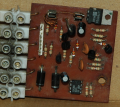
The screw connector uses the first two to connect to the car's live and earth (the live feeds the L7805), the other four are outputs to brake lights, indicators right and left and the other could be reverse lights, fog lamps or tail lights.
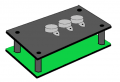
What about mounting the heat sink above the board? Then four screws that run through the heat sink and board, to the container with raised screw holes to support the board?
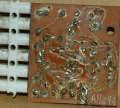
I suggest using some PCB cleaner spray (preferred) or rubbing alcohol and clean the boards.
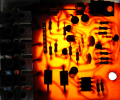
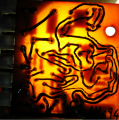
Especially the bottom of the main board so we can clearly identify traces, then repost.
What about mounting the heat sink above the board? Then four screws that run through the heat sink and board, to the container with raised screw holes to support the board?
That's possible, if you want to retain the original BJT power transistors.
But if we use mosfets, they likely won't require a large a heat sink. It will be much smaller.
There is also a possibility of using surface mount device for the remaining parts, making the overall circuit board much smaller than the original.
I have seen power-tab transistors mounted in the same places as the power transistors were mounted. A bit complicated but certainly possible. Of course, those were TO-220 package transistors with the collector internally connected to the metal tab. The base and emitter legs were bent to fit the socket connections.
So with a bit of careful thought the same design could be used.
Yes. if you've never done it before, but does get easier over time. They also require different tools/technique to solder.
We can also stay away from the smaller smd devices and use the larger ones. Even if we stay with thru hole devices the PCB would still be smaller than the original.
At the moment the plan is to make five, maybe ten.
On the subject of mass producing there is gap in the market for a particular electronics product, but it will need kickstarter funding and people with an expertise in electronics and software - watch this space. The last one sold for $11m cash and about $4.6m in notes and the buyer only used a portion of it.
The circuits look simple enough we could probably just simulate, debug, maybe breadboard certain functions, then make a thru hole prototype PCB. After debugging that, then decide whether to convert to SMD, part quantities, etc.
But its very important to know what the target lighting patterns will be.

 Facebook
 Google
 GitHub
 Linkedin