Someone enters the room and proclaims, "The president has been shot", then leaves. Discussion ensues.
I dont see a problem with that not sure why you would be so concerned, but you could elaborate.
Once a discussion starts it is not unusual for the person that started it to bow out, if it is something of interest to others they will continue to talk about it. We are not just here to answer questions we have our own interests too.
Once a discussion starts it is not unusual for the person that started it to bow out, if it is something of interest to others they will continue to talk about it. We are not just here to answer questions we have our own interests too.
Thank you, but I've been around a long time, I've seen how it works. It was a question based on the competing signatures of two long time members. But you've been around a long time, too, and probably knew that.
One of ideas of calculus is to divide the spiral in `n` rings, where n is turn count. As those are ideal rings with length =pi()*D, then there is not so difficult to sum it all. Yet there is factor making a mistake, that is vertical inclination between each turn beginning and ending - however, knowing the each turn `ideal` length (what minute ago You calculated) You may add the vertical component assuming that coordinates are spiralized along the wire, thus the wire `seems` straight. Allpying the Pythagor pants theorem, You get `real lenghth` =SQRT(`ideal lenght`^2+`vertical distance between each turns`^2). Just make an exercise with an Excel.
One of ideas of calculus is to divide the spiral in `n` rings, where n is turn count. As those are ideal rings with length =pi()*D, then there is not so difficult to sum it all. Yet there is factor making a mistake, that is vertical inclination between each turn beginning and ending - however, knowing the each turn `ideal` length (what minute ago You calculated) You may add the vertical component assuming that coordinates are spiralized along the wire, thus the wire `seems` straight. Allpying the Pythagor pants theorem, You get `real lenghth` =SQRT(`ideal lenght`^2+`vertical distance between each turns`^2). Just make an exercise with an Excel.
If you look back at post #10 you will see the first expression is an approximation. That's the result of doing what you suggest.
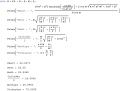
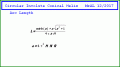
You will also note that in that same post there is a second expression, and that one is exact. That expression is found from the calculus as the calculation of the arc length of a curve. In three dimensions where the curve is parameterized with parameter 't' it boils down to:
Incremental arc length ds:
ds=sqrt((dx/dt)^2+(dy/dt)^2+(dz/dt)^2)
which is simply the square root of the sum of the squares of the orthogonal derivatives, and then the length L is computed by integrating that over the appropriate dimension.
So we end up with one approximate calculation and one exact. We were also looking for other approximations too though.
Once a discussion starts it is not unusual for the person that started it to bow out, if it is something of interest to others they will continue to talk about it. We are not just here to answer questions we have our own interests too.
Good to read that. The concept of forum exceeds that of a simple questions-answering service. I enjoy that. It is when incredible things show up from time to time. I always can leave a group where the ongoing conversation is above my head or just simply not interesting. Precisely this one, got me thinking of another way to solve the original question. Problem is, rusty Maths.
Look at the cone and cut it open and flatten it.
Now you have a pie shape.
you know the exact position of each wire that position stand for that part of the pie.
This wire is not strait it will shift each wire thickness over that part of the pie.
If however, the wire thickness is a fraction of the move you may assume an error close to zero.
Look at the cone and cut it open and flatten it.
Now you have a pie shape.
you know the exact position of each wire that position stand for that part of the pie.
This wire is not strait it will shift each wire thickness over that part of the pie.
If however, the wire thickness is a fraction of the move you may assume an error close to zero.
Ok,
de length of one side is L= sqrt (Rbottom^2 + height^2)
number of rotations N= -1+ L/wire thickness.
cone size is linear result in average diameter 1/2 bottom diameter = 2 x pi x Rbottom
length wire 2 x pi x R bottom x 0.5 x height.
Ok,
de length of one side is L= sqrt (Rbottom^2 + height^2)
number of rotations N= -1+ L/wire thickness.
cone size is linear result in average diameter 1/2 bottom diameter = 2 x pi x Rbottom
length wire 2 x pi x R bottom x 0.5 x height.
Look at the cone and cut it open and flatten it.
Now you have a pie shape.
you know the exact position of each wire that position stand for that part of the pie.
This wire is not strait it will shift each wire thickness over that part of the pie.
If however, the wire thickness is a fraction of the move you may assume an error close to zero.
Are you looking for another exact formula or another approximation?
Just to note, i think anything that includes an average of some kind will always be an approximation. This happens in the two dimensional spiral too where we only have a flat curve to start with. The log term takes care of the difference between an average turn and a true spiral turn.
It is true though that in regular everyday calculations of coil winding we never consider the log term and go ahead with the average calculation simply because it ends up being close enough given the other variables which contribute more to the error anyway. So you will never catch me using this in a coil winding formula (he he) because it is anything but practical for that. In a purely academic discussion though it would become significant. In this thread i try to address both views and others have also chimed in with approximations that are often just plain good enough.
The only thing i request is that the author specify the type of formula they believe their creation really is, either exact or approximate.
One thing we have been assuming all along in this thread is that the thickness of the wire is very very thin, so that the thickness does not contribute to any dimension. The only thing i see that changing though is the radius (or diameter) because then, as is usual in these kinds of calculations, we choose to work with the axial center of the wire which is not exactly on the surface of the cone if the wire has any thickness.
Also one more small note, since we have an exact formula you might compare your actual results to the exact formula. Note however that the exact formula in this thread probably assumes integer N because the measurement of R (or D) depends on that.
Try to keep in mind also that one test with one set of data is not enough to properly ascertain whether or not a given approximation is good or not. A number of data sets have to be tried and different attributes can be assigned to the different approximations. For example, max error and average error over a range of values for N, D or R, and anything else that might enter the picture.
So some approximations might look very good for a single set of N and D or R, or even over a short tange of those variables, but over a wider range they may fall completely apart.
The approximation i gave is taken from the normal way of computing the length of wire of a coil, but usually we assume some decent size for N.
Also it hit me that it might also be interesting to compute the self inductance of the conical helix if it was a real coil of wire. Perhaps also the mutual inductance of two such coils arranged in different positions relative to each other.
Reports of my demise have been greatly exaggerated.
I'm still following the thread, but since I got a good nuf answer to get the lights on my tree I'm happy to watch people better at math than I am solve this.
Reports of my demise have been greatly exaggerated.
I'm still following the thread, but since I got a good nuf answer to get the lights on my tree I'm happy to watch people better at math than I am solve this.
I've been wondering how the various answers between 25' and 27' would have influenced your shopping.
Would you buy 2 sets at 15 ft, or, 3 sets of 10 ft each.
Well since everyone got bored with the original conical helix, here's another one to perhaps spark new interest.
The previous one was based on the Archmedes spiral that was laid on the surface of a cone creating a helix that went up (or down) the cone. This next one is based on the involute of a circle.
The difference between the two is subtle, and by eye we might not even be able to tell the difference between the two if we saw them side by side. The Archimedes version has slightly different properties than this new one but they would look very much the same as a string of lights on a Christmas tree. This new one also has regular turn spacing however, it's just that the inclination is different so it leads to a different arc length especially for low N.
The formula for this new one is in the attachment, and drawing the curve looks almost like the last one except at the very start so i did not take the time to draw it yet.
Note that the two become equal for N very large so i have some confidence in the solution, but i did not check it with a second method yet so if anyone wants to do that that's cool too.
Note the formula is similar to the previous helix but a little simpler in nature because the curve itself is a little simpler.
Winding the lights on the tree using this method would require making sure the wire is always perpendicular to the center axis (trunk) looking straight down on the tree, which is not a requirement for the Archimedes version.

 Facebook
 Google
 GitHub
 Linkedin