Facebook
 Google
 GitHub
 Linkedin

Hello there,
Here is a math problem I thought would be really easy. It turns out it's not that easy, and even though I have not solved it yet I believe there is a solution.
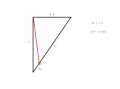
You'll have to refer the diagram to understand it most likely.
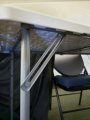
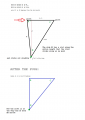
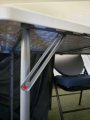
The brace is a brace for a table leg. It connects to the top of the table (horizontal line is the top of the table) and to the leg on the left (vertical line). This of course creates a right triangle that is easy to calculate.
Because the top side is 4.5 and the left side is 6 units, the hypotenuse C1 is 7.5 units exactly (stroke of pure luck it came out like that).
The question is, what is the point of intersection (circled in green) when we only reduce the brace by 1 percent?
Note that I had only shown the left side (leg) rotate (red line) about the original 90 degree angle pivot point (upper left corner) but it would seem that the hypotenuse also rotates (not sure about that yet though). As the hypotenuse C1 gets shorter by an amount we can call dC1, it becomes C2 (shorter now) and the 6 unit side rotates and becomes shorter also.
I'm really after the angle that the 90 degree angle changes to, but the other information would allow us to double check any results. This would be the length of the 6 unit side after rotation. The length of the hypotenuse is known that will be 7.5 times 0.99 for a 1 percent decrease in length. If preferred, change the length of the hypotenuse to a more convenient amount like 10 percent shorter or something else.
What I am after here is a fix for a table that wobbles back and forth as the brace becomes shorter. It becomes shorter because of the somewhat poor design. It's a folding table. I'd like to solve this so I can calculate how much I need to decrease the length from changing in order to reduce the angle of wobble to some specified value (like from now 90 to maybe 85 degrees with the wobble, to maybe 89.9 degrees or even 89.5 maybe. There will always be some wobble but I'd like to reduce it.
Note: It could be that we have to prevent C2 from rotating from it's original angle to the horizontal top. I know for a fact that the angle of the 6 unit side does change though. With the rotation C2 there might be a lot of solutions perhaps.
Here is a math problem I thought would be really easy. It turns out it's not that easy, and even though I have not solved it yet I believe there is a solution.
You'll have to refer the diagram to understand it most likely.
The brace is a brace for a table leg. It connects to the top of the table (horizontal line is the top of the table) and to the leg on the left (vertical line). This of course creates a right triangle that is easy to calculate.
Because the top side is 4.5 and the left side is 6 units, the hypotenuse C1 is 7.5 units exactly (stroke of pure luck it came out like that).
The question is, what is the point of intersection (circled in green) when we only reduce the brace by 1 percent?
Note that I had only shown the left side (leg) rotate (red line) about the original 90 degree angle pivot point (upper left corner) but it would seem that the hypotenuse also rotates (not sure about that yet though). As the hypotenuse C1 gets shorter by an amount we can call dC1, it becomes C2 (shorter now) and the 6 unit side rotates and becomes shorter also.
I'm really after the angle that the 90 degree angle changes to, but the other information would allow us to double check any results. This would be the length of the 6 unit side after rotation. The length of the hypotenuse is known that will be 7.5 times 0.99 for a 1 percent decrease in length. If preferred, change the length of the hypotenuse to a more convenient amount like 10 percent shorter or something else.
What I am after here is a fix for a table that wobbles back and forth as the brace becomes shorter. It becomes shorter because of the somewhat poor design. It's a folding table. I'd like to solve this so I can calculate how much I need to decrease the length from changing in order to reduce the angle of wobble to some specified value (like from now 90 to maybe 85 degrees with the wobble, to maybe 89.9 degrees or even 89.5 maybe. There will always be some wobble but I'd like to reduce it.
Note: It could be that we have to prevent C2 from rotating from it's original angle to the horizontal top. I know for a fact that the angle of the 6 unit side does change though. With the rotation C2 there might be a lot of solutions perhaps.
Attachments
-
 9.8 KB Views: 20
Last edited: