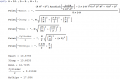
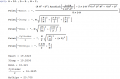
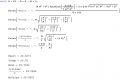
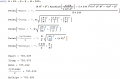
Actually i started from scratch because i wanted to also verify the Wolfram intermediate solution given on their site.
So i started with the helix:
x=r*t*cos(2*pi*f*t)
y=r*t*sin(2*pi*f*t)
z=t
and then computed the increment ds/dt and then integrated, then did some substitutions.
For D=20, H=48, N=4, the exact solution comes out to 11.60074 feet to 7 significant digits.
Looks like there are more than 4 turns on that tree in that picture though.
The interesting question is whether it is close by design, or by coincidence.
Almost any approximation is likely to match the exact solution at one point (unless it is always high or always low, of course). But how quickly does it deviate.
Yours still has the problem that it makes the dependence on H go away for high numbers of terms and quickly crosses into the impossible realm.
I'd agree that yours is close by design -- albeit it probably somewhat implicitly -- because you had in mind a cone of proportions in which H is roughly the same as D (or something like 2D).
An interesting plot would be the fractional error as a function of H/D.
Interesting, there are some merits to that formula but if you could tell us how you thought of it we may be able to make more sense as to why it works for some parameter values. See data in next post.
The interesting question is whether it is close by design, or by coincidence.
Almost any approximation is likely to match the exact solution at one point (unless it is always high or always low, of course). But how quickly does it deviate.
Yours still has the problem that it makes the dependence on H go away for high numbers of terms and quickly crosses into the impossible realm.
I'd agree that yours is close by design -- albeit it probably somewhat implicitly -- because you had in mind a cone of proportions in which H is roughly the same as D (or something like 2D).
An interesting plot would be the fractional error as a function of H/D.
Yes interesting idea so in the attachment i did a brute force comparison and have shown the H/D requested parameter with that data too. It's interesting that for some values the MrChips formula works pretty well but for others it goes a bit off. You can glean some conclusions from that data set if you like. What i see right off is the formula works best for high N and if H/D gets too high it requires a higher N to get back within some reasonable error percentage.
Note the error percentage is shown as actual percent like 50 percent not 0.50 the fractional percentage.
L1 is exact, L2 is MrChips formula result.
Also, view the text file with a non proportional font like Courier New for best reading.
I think you can have two simple solutions that bound the answer on both sides.
The upper bound is what you have. A lower bound would just be to use the circumference of the midpoint of the upper and lower circles. You best estimate is then just the average of the two. If the error bound is tolerable, then you are done. If not, come up with tighter bounds.
If the definition of "evenly spaced" you gave in post #3 is used: "Imagine a screw that has a pitch such that it goes lengthwise a distance H in N turns. The radius moves linearly with the height.", then wouldn't the average circumference of the upper and lower circles of each turn be the same as the circumference of the midpoint of the upper and lower circles?
Since the spiral is a space curve, there should be 3 orthogonal components at every little element of length ds.
Since we've been trying to find some simple formulas without doing the integration, averages of two orthogonal components have been used by most of the participants in the thread. It occurred to me to add an average of a third component; the component I've added is not perfectly orthogonal to the other two, but nearly so. It gives an improvement for the N=1 case.
Here are some computational results for the cases N equal to 1, 2, 3 and 100 with H=10 and D=5.
First, N=1:
Now with N = 2:
And with N=3:
With N large, such as N=100, all of the formulas are fairly good:
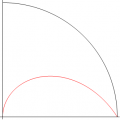
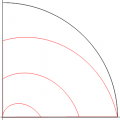
Just for grins, I plotted the curve on a flat piece of paper which could be cut out and rolled up into a cone with the plotted curve forming the "evenly spaced" spiral around the cone. Here's what the curve looks like on a 90° quadrant with N=1:
Interesting, there are some merits to that formula but if you could tell us how you thought of it we may be able to make more sense as to why it works for some parameter values. See data in next post.
The circles increase linearly from 0 to πD. Hence the average circle is πD/2.
I was not thinking of a Christmas tree but a more tightly wound spiral. Hence if there are N turns, the total length is πDN/2. This is independent of H and would work for large N.
When others didn't like this simplistic formula I just added the H/N term.
I could have added the more complicated (√(HxH + DxD) )/N but why make something more complicated than necessary if we're talking about lights on a Christmas tree.
Since the spiral is a space curve, there should be 3 orthogonal components at every little element of length ds.
Since we've been trying to find some simple formulas without doing the integration, averages of two orthogonal components have been used by most of the participants in the thread. It occurred to me to add an average of a third component; the component I've added is not perfectly orthogonal to the other two, but nearly so. It gives an improvement for the N=1 case.
Here are some computational results for the cases N equal to 1, 2, 3 and 100 with H=10 and D=5.
First, N=1:
I like that line of reasoning and that result looks very promising. Did you try other values of H and D? I could try that later today.
I'll have to give that some thought too. I was thinking of a boiler plate solution where we find one length exactly and then maybe find an algebraic modification to that, but the problem i run into is there are all three variables H, D, and N inside the asinh() function. Maybe more thought.
The plane curve version is called the Archimedes Spiral i believe. The spacing between each loop is equal. I ran into that back in the 1980's when i was finding a formula for the record time of a VCR tape vs the number count of take up reel turns. The record time is parallel to the length, so the length of the curve became the most important part of the study. Some interesting things came out of that, namely that although the curve looks uniform it is not in the normal sense because each section is linked to the length itself. It's like the length of the curve is encoded into the information about the number of turns and the differential number of turns over a given time period. That meant that i was able to determine the approximate time position of a VCR tape just by taking two count readings over a given time period like 10 second. That meant i could find any movie on the tape without rewinding. The more modern VCR's have time recorded on the tape, but that takes the fun out of it
That spiral has equal distance between loops because the wound tape has a constant thickness so each layer lays on top of the next and adds the same width to the total diameter each time.
The logarithmic spiral has a variable spacing so that is not like a tape being wound up.
If the definition of "evenly spaced" you gave in post #3 is used: "Imagine a screw that has a pitch such that it goes lengthwise a distance H in N turns. The radius moves linearly with the height.", then wouldn't the average circumference of the upper and lower circles of each turn be the same as the circumference of the midpoint of the upper and lower circles?
Yes, but the path length of the spiral between the upper and lower circles would be greater than the average circumference, just as the path length of the spiral around a cylinder is always greater than the circumference of the cylinder. So the circumference of the midpoint can serve as a lower bound.
For the new formula which added another component under the radical, i found that the error percent is worse for large H and small D. This makes me think that H has to be somehow included in that third component. The max error over the range i tried was around 10 percent. The max error for the other one was around 8 percent but there may be higher average error percent for the two component formula.
Also interesting is that the error looks almost constant above maybe N=2 for any given H and D. There may be a way to work that into the simpler formula.
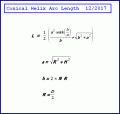
Here is a slightly different version of the exact formula. If we use radius R instead of D and define a few constants the main formula gets much simpler although we do have to compute the two new 'constants'.
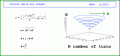
I redrew the equations and drew the curve itself and something becomes noticeable.
It looks like N must be in integer or else R (or D) can not apply directly.
Take a look, see what you think.
For example, it looks like if we dont finish out that last turn (on top) then R can not apply unless we consider it to be the measurement that R would attain if the number of turns finished out the last turn completely, because that is essentially a measure from the center axis to the end of the last turn. If we make R shorter to reach the end of the last partial turn, then that may still work but i have not checked this out.
Note that if we take the drawing and just draw 5.5 turns (there are 6 full turns there now) then the curve ends on the left side and so does not fill out the entire R. Now maybe making R that much shorter might work, but how much shorter, or do we even have to do that.

 Facebook
 Google
 GitHub
 Linkedin