isolation transformer

MisterBill2

Joined Jan 23, 2018
27,524
There are two methods of using an isolation transformer, one is if you require total isolation from the original (usually mains) supply.
In this case the secondary circuit remains isolated from ground.
The other is where you are for e.g. feeding a control or other circuit from a higher level such as a 3ph supply transformer, in this case, when transformed, the 120v or 240v 1ph control circuit has lost the reference to earth ground, it is then recommended that one side of the secondary is taken to an earth ground point in order to re-reference to earth.
Just as it is done in a residential service supply transformer.
Ref: NEC, NFPA79 etc.
Max.
Max, you have described a step-down transformer, which provides isolation as a secondary effect. For those applications it is the step-down that is required, the isolation is a free benefit. So that is quite a different situation.
In this instance we have an isolation transformer added for the sole purpose of providing isolation so that a shock hazard can be avoided.THAT is the sole purpose of the isolation transformer that I use when servicing AC/DC line operated equipment, since an indeterminate mains connection polarity may have the chassis frame at mains potential otherwise. With my isolation transformer in use I could only get a shock by putting both hands where they should not be. AND I have no problem with connecting a scope ground clip to the chassis, which is often tied to one side of the power cord. Of course, it is a good isolation transformer.
 

MaxHeadRoom

Joined Jul 18, 2013
30,662
Max, you have described a step-down transformer, which provides isolation as a secondary effect. For those applications it is the step-down that is required, the isolation is a free benefit. So that is quite a different situation.
In my Second example, yes!.
The first is the isolation transformer that could be 1:1 if needed! :rolleyes:
Max.
 

SamR

Joined Mar 19, 2019
5,491
I was perusing an old Oscilloscopes book and they were talking about isolating circuits using back to back 120/6V filament transformers. Feed 120 in and tie the 6V secondaries together to get isolated120V off the final output. Back when filament transformers could be found in a dead TV or Radio in the trash. Wouldn't have a lot of amps but it would be cheap back then.
 

MisterBill2

Joined Jan 23, 2018
27,524
I was perusing an old Oscilloscopes book and they were talking about isolating circuits using back to back 120/6V filament transformers. Feed 120 in and tie the 6V secondaries together to get isolated120V off the final output. Back when filament transformers could be found in a dead TV or Radio in the trash. Wouldn't have a lot of amps but it would be cheap back then.
I bought my isolation transformer at a clearance sale many years back. THEN, I was given a much bigger one that had the terminal strips broken in shipping. That is a 750 watt device, quite heavy. AND it has taps for 120, 240 and 480 volts.It took a few minutes to install new terminal strips to make it useful.
 

Reloadron

Joined Jan 15, 2015
7,890
I was perusing an old Oscilloscopes book and they were talking about isolating circuits using back to back 120/6V filament transformers. Feed 120 in and tie the 6V secondaries together to get isolated120V off the final output. Back when filament transformers could be found in a dead TV or Radio in the trash. Wouldn't have a lot of amps but it would be cheap back then.
When I was a kid I had an old Knight Kit scope my father built. Radio shack and a pair of 120V / 12V 2 Amp transformers. Worked just fine and enough to power the scope. That old scope went many years and died when the flyback transformer failed. I still have a dula trace module built for it, might be an Eico.

Ron
 

MisterBill2

Joined Jan 23, 2018
27,524
When I was a kid I had an old Knight Kit scope my father built. Radio shack and a pair of 120V / 12V 2 Amp transformers. Worked just fine and enough to power the scope. That old scope went many years and died when the flyback transformer failed. I still have a dula trace module built for it, might be an Eico.

Ron
I doubt that the scope had a flyback transformer. It probably had a special power transformer with an extra high voltage winding. I still have one of those Knight Kit scopes, it was the "New 5.2 Megahertz" models introduced in 1965. So far no power transformer problem.
 

Reloadron

Joined Jan 15, 2015
7,890
I doubt that the scope had a flyback transformer. It probably had a special power transformer with an extra high voltage winding. I still have one of those Knight Kit scopes, it was the "New 5.2 Megahertz" models introduced in 1965. So far no power transformer problem.
I want to say it was pre 65 maybe around 60 ~ 61 because I know my father built it as part of a course. I got my novice ticket in 63 and it was around then. Been gone over 20 years as I know it died before my dad and it's been 20 years since my dad passed away. I still have a Knight Kit signal tracer and I forget who made the LCR bridge down the basement. I want to say flyback but maybe not, it's been a long time. There is also an old signal generator down there which was a kit.

Ron
 

MisterBill2

Joined Jan 23, 2018
27,524
I just borrowed a B&K "Isopack", which was used for servicing those AC/DC hot chassis radios and TVs. So far my investigation shows that the ground pin on the outlet is carried through but the neutral pin is isolated. That rather much makes sense, since the "ISOPACK" is also able to boost or buck the available mains voltage by 20 volts. I will measure and see just how isolated the isolation really is.
 

MaxHeadRoom

Joined Jul 18, 2013
30,662
Reading the instruction sheet on the TR 110 Isopack it says using the isolated outputs, which indicate they are not referenced to earth GND, if so there is no 'Neutral' as such.
So in effect you are able to connect the 'DC Negative' chassis to an earth ground reference, as the instruction manual shows..
Max.
 

Thread Starter

neospam

Joined Jan 13, 2020
110
Not exactly. If we were talking about the Variac alone, then yes.

View attachment 208376

The autotransformer looks like the above. That's a tapped one instead of a wiper version. The socontary (wiper) MUST be fused.

You can have the variac first or second. I had the isolation transformer first and external to the case because it took up valuable bench space and then the Variac. Since the transformer is 1:1, it doesn't matter.

An isolation transformer prior means any circuits can be powered by the line voltage.

You also want to bond the ground and neutral after the transformer.
thanks.. I did not catch you guys were talking about the variac wiper. I will need to open it up and look.

I been thinking about the fuses. Learning more how they work and dont. Is there a adjustable current limiting schematic thats could be applied? Are fast acting "F" and rapid acting "FF" fuses fast enough for run away problem?
 

Thread Starter

neospam

Joined Jan 13, 2020
110
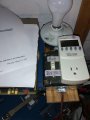
Hi everyone. it's been a while sense last posting in this thread. just want to update, still here. It was not easy to find my previous threads on here.. :(awkward website.. but anyway. lot of experienced gained and decided not to build a iso box. see pict in modular reclaimed items. I plug into my variac or wall, with in-line fuse if needed. hope everyone is well.
 

Attachments

Last edited:

Thread Starter

neospam

Joined Jan 13, 2020
110
Hi Ron, after looking at cost of buying meters and all.. kill-a-watt much better deal. now have 3 separate devices. variac, a bulb by-pass unit, and kill-a-watt. all can be used separate or together. :)
 

MisterBill2

Joined Jan 23, 2018
27,524
One caution with the kill-a-watt. device, which is important, is to only use it with mains power that is fairly clean, without much harmonic distortion and especially without high frequency noise. The reason that I was given is that the power supply used a capacitive reactance to drop the voltage, and that high frequency power will cause excess voltage applied to the regulator, resulting in a hard failure. But mains power should be clean enough to be safe. But not cheap alternators or inverters.
 
Top