Isolated 150mW AC-to-DC regulator?

crutschow

Joined Mar 14, 2008
38,540
Isn't this one isolated from the AC?
No.
But as we've been continually going round and round about, you need to define "isolation".
The capacitors will isolate you from a DC difference between the two.
It will not isolate for an AC difference between the two, but that may or may not be a problem.
It depends upon what you are trying to isolate from.
In other words what is one circuit doing that you don't want it to effect the other circuit?
That has not been clearly stated by you, other then to mention 200Vdc.
 

Thread Starter

johnyradio

Joined Oct 26, 2012
615
you need to define "isolation".
I mentioned "galvanic isolation".
"Galvanic isolation is a principle of isolating functional sections of electrical systems to prevent current flow; no direct conduction path is permitted. Galvanic isolation is used where two or more electric circuits must communicate, but their grounds may be at different potentials."
https://en.wikipedia.org/wiki/Galvanic_isolation
"Capacitors allow alternating current (AC) to flow, but block direct current (DC); they capacitively couple AC signals between circuits that may or may not be at different DC voltages."
That gives me a clue about your circuit. Does this mean your circuit is AC-isolated, but not DC-isolated, and any difference in ground potential between primary and secondary will lead to DC current flow?

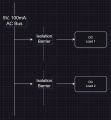
In this thread, my scenario is:
1726204713903.png

No current must flow between DC Load 1 and DC Load 2. They will definitely have a different ground potentials.
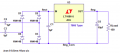
"Although isolated power is usually done with a transformer, it can also be done with capacitors and a H-bridge driver when the constraints of size and cost favor capacitors."
Not sure that will help here, with an AC/DC converter, but it might give a clue on how to do this. The ckt below obviously makes no sense, but maybe a step in the right direction? The embedded image is the output section of an H-bridge supply.

1726205438599.png

The article says "This circuit suits applications for which the potential difference across the isolation barrier is fixed." Same problem?
https://www.analog.com/en/resources/design-notes/isolated-power-using-capacitors.html
 
Last edited:

crutschow

Joined Mar 14, 2008
38,540
That gives me a clue about your circuit. Does this mean your circuit is AC-isolated, but not DC-isolated, and any difference in ground potential between primary and secondary will lead to DC current flow?
Just the opposite.
It will block DC difference but allow any AC difference to pass.
 

Thread Starter

johnyradio

Joined Oct 26, 2012
615
Just the opposite.
It will block DC difference but allow any AC difference to pass.
Then I think it fulfills the requirement, right? It will pass the AC through to the rectifier, to supply the DC components, but no DC current will flow across the barrier, right?
 

MisterBill2

Joined Jan 23, 2018
27,672
While that circuit I see in post #22 will provide DC isolation, it is not one that I would choose for most applications because the regulation will be poor, and because it will still present a serious shock hazard.
 

Thread Starter

johnyradio

Joined Oct 26, 2012
615
While that circuit I see in post #22 will provide DC isolation, it is not one that I would choose for most applications because the regulation will be poor, and because it will still present a serious shock hazard.
Thx for that. The AC bus is already isolated from mains by a UL certified commercial converter, so there's no shock hazard. This is a low-power system. The isolation is only for operational needs, not safety.

the regulation will be poor
"Poor" in what way? Ripple, fluctuating with temperature and load...?

The regulation would be a linear regulator, so i assume it will be quite stable, right?

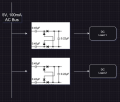
1726258689203.png

Like this:

1726258888909.png

How to select capacitance for this type of isolator?

This article says "capacitive isolation also has some disadvantages, such as low efficiency, high leakage current."
Could DC leakage get through the isolation?
https://www.linkedin.com/advice/0/what-advantages-disadvantages-different-isolation
 
Last edited:

MisterBill2

Joined Jan 23, 2018
27,672
If the supply voltage is 5 volts AC, then it is not likely that the regulator will have enough supply voltage to provide a solid constant 5 volts, if the load draws much current.
 

Thread Starter

johnyradio

Joined Oct 26, 2012
615
If the supply voltage is 5 volts AC, then it is not likely that the regulator will have enough supply voltage to provide a solid constant 5 volts, if the load draws much current.
You're right, the supply V will have to be somewhat higher to ensure the rectifier and regulator have enough headroom.
I'm still worried that leakage might be an issue for isolation.

How high can we go on the current? Do we need higher capacitance for higher current?

@DickCappels The threads are slightly different. This thread is AC/DC. The other thread is DC/DC. It's just a coincidence that the best solution for each is a very similar circuit. I didn't predict that.
 

crutschow

Joined Mar 14, 2008
38,540
If the supply voltage is 5 volts AC, then it is not likely that the regulator will have enough supply voltage to provide a solid constant 5 volts, if the load draws much current.
True.
My sim used a square-wave of about 18Vpp.
You need a minimum of about 9Vpp for a square-wave or 9Vpk for a sinewave.
How high can we go on the current? Do we need higher capacitance for higher current?
Yes.
Depends upon how high "high" is. :rolleyes:
 
Last edited:

Thread Starter

johnyradio

Joined Oct 26, 2012
615
You need a minimum of about 9Vpp for a square-wave or 9Vpk for a sinewave.
Will sine be more efficient than square? How will the rectifier/filter behave with a supply that goes negative on the troughs vs a supply that only goes to 0v?

Depends upon how high "high" is.
How to calculate capacitance? Here are some guesses:
(edit: new fmla)
I = V / Xc

XC is called the capacitive reactance, because the capacitor reacts to impede the current. XC has units of ohms (verification left as an exercise for the reader). XC is inversely proportional to the capacitance C; the larger the capacitor, the greater the charge it can store and the greater the current that can flow. It is also inversely proportional to the frequency f; the greater the frequency, the less time there is to fully charge the capacitor, and so it impedes current less.

Xc = 1 / 2π*fC
I = current, f = freq, C = capacitance
https://courses.lumenlearning.com/suny-physics/chapter/23-11-reactance-inductive-and-capacitive/
I = V / (1 / 2π*fC)
I = 2π*fCV

Target: 3.5A, 100 kHz, 12V supply, 200V iso

3.5 A = 2π*fC
3.5 A = 2 * 3.14 * 100 kHz * C * 12 V
3.5 = 7,536,000C
C = 3.5 / 7,536,000
C = 4.64437400E−7
= .00000464437400
= 4.64 µF
$1.56
L 31.50mm x W 18.00mm x H 27.5
4.7 µF Film Capacitor 200V 400V Polyester, Polyethylene Terephthalate (PET), Metallized Radial
https://www.digikey.com/short/h50v1r07

@ 400 kHz
1.16 µF
$0.51
1.2 µF Film Capacitor 250V 630V Polypropylene (PP), Metallized Radial
L 26.50mm x W 14.50mm x Height 29.60mm
https://www.digikey.com/short/hv3pv0dp

2.2 µF ±10% 250V Ceramic Capacitor X7R 2220 (5750 Metric)
L 5.70mm x W 5.00mm x H 2mm
$0.95
https://www.digikey.com/en/products/detail/cal-chip-electronics-inc/CHV2220N250225KXT/13558913[/QUOTE]
 
Last edited:

MisterBill2

Joined Jan 23, 2018
27,672
While a series capacitors isolation scheme is a good theory, consider that I have not ever in my career chosen to use this method, and also consider that I have not seen it suggested for use in any published circuits from sources that identify themselves. By that I mean both Hobby Class magazines and technical publications.
My point here being that while it would work, capacitive power circuit isolation is very seldom used. So aside from my own opinion that it is a poor choice, it appears that most other folks also consider it to be a poor choice. There are several reasons that I can see to never use this scheme, the first reason being that it certainly looks to me like it is intrinsicly inadequate no matter if even "perfect"capacitors were used. By that I mean capacitors with infinite leakage resistance and very high breakdown voltage are used.
 

crutschow

Joined Mar 14, 2008
38,540
There are several reasons that I can see to never use this scheme, the first reason being that it certainly looks to me like it is intrinsicly inadequate no matter if even "perfect"capacitors were used.
Can you elaborate on the technical definition of "intrinsically inadequate" or is that just an opinion?
And what are the other "several reasons"?

Just because a technique is seldom used doesn't mean it's not appropriate for the TS's application requirements.
The old saw "we always do it this way" view is often used to stifle innovation.
 
Last edited:

Thread Starter

johnyradio

Joined Oct 26, 2012
615
I have not seen it suggested for use
While i agree that common usage is an important indicator, ultimately the technical reasons are most important. I am concerned about leakage, which compromises the thing we need - isolation. According to what i've read, ceramics have a paper barrier which can suffer increased leakage over time. But not film caps. Still, it's critical to determine the cap leakage (which i haven't figured out yet), and determine how much is acceptable (if any).

If my formula and calculations (above) are correct, the required film cap for 100 kHz, 3.5A, 12V supply, 200V iso, is about 20mm x 30mm x 30mm (a bit smaller at 400 kHz), which is too large for my application. The required ceramic is about 5mm x 5mm x 2mm, which fits my application, but it's ceramic.
 
Last edited:

crutschow

Joined Mar 14, 2008
38,540
If my formula and calculations (above) are correct, the required film cap for 100 kHz, 3.5A, 12V supply, 200V iso, is about 20mm x 30mm x 30mm (a bit smaller at 400 kHz), which is too large for my application. The required ceramic is about 5mm x 5mm x 2mm, which fits my application, but it's ceramic.
Look at the leakage values for the various type capacitors to see which will be acceptable for your application.
Note that ceramics have a ceramic dielectric barrier, not paper.
 

Thread Starter

johnyradio

Joined Oct 26, 2012
615
Look at the leakage values for the various type capacitors to see which will be acceptable for your application.
IL = Vw / Rp
IL = leakage current, Rp = insulation resistance, Vw = working voltage
https://www.keysight.com/us/en/assets/7018-05086/application-notes/5992-1307.pdf
My target 2.2 µF @ 12V supply with this ceramic:
Rp = 10GΩ (10,000,000,000 Ω) or 500/CΩ whichever is smaller
https://88ce57.p3cdn1.secureserver.net/wp-content/uploads/2023/01/chv_series-1.pdf
C = 2.2 µF
500/CΩ = 500/ 2.2 µF = 500/0.0000022 = ~ 227,272,727
227,272,727 < 10,000,000,000

IL = 12V / 227,272,727
= ~ .00000005 A = .00005 mA leakage

And with the film cap that i calc'd to work at 400 kHz: 1.16 µF
Rp = 30,000 MΩ * 1.16 µF
Rp = 34,800 MΩ
IL = Vw / Rp
= 12V / 34,800 MΩ
= 12 / 34,800,000,000 (not sure if i'm supposed to convert megaohms to ohms here)
= .000000000344
= .000000344 mA leakage
 
Last edited:

BobTPH

Joined Jun 5, 2013
11,556
Any leakage at all means, strictly speaking, it is not DC isolated.

Sorry, but like @MisterBill2, I believe there must be a better solution. But since we do not know why he needs isolation, we cannot recommend one. Presumably, the isolated subcircuit needs to connect to another ground. But why? If the reason is to get a signal across, an opto isolator for that signal is the better solution . If it is because he needs a current measurement, an isolated current sensor (eg. Hall effect) is the better solution.
 

Thread Starter

johnyradio

Joined Oct 26, 2012
615
I believe there must be a better solution. But since we do not know why he needs isolation, we cannot recommend one. If the reason is to get a signal across, an opto isolator for that signal is the better solution.
This thread is about power-transfer, not signal.
The only other power-transfer isolation known to humankind is a transformer.

there's no such thing as zero leakage across an insulation barrier.
I'm guessing primary-to-secondary DC current-leakage in any typical transformer is going to be much, much larger than even the best film cap. I can't find a formula yet for transformer DC current-leakage, i'm just seeing leakage inductance, which i think is unrelated.

Still, my calc'd .00005 mA ceramic leakage might be acceptable for my application. TBD!
 
Last edited:
Top